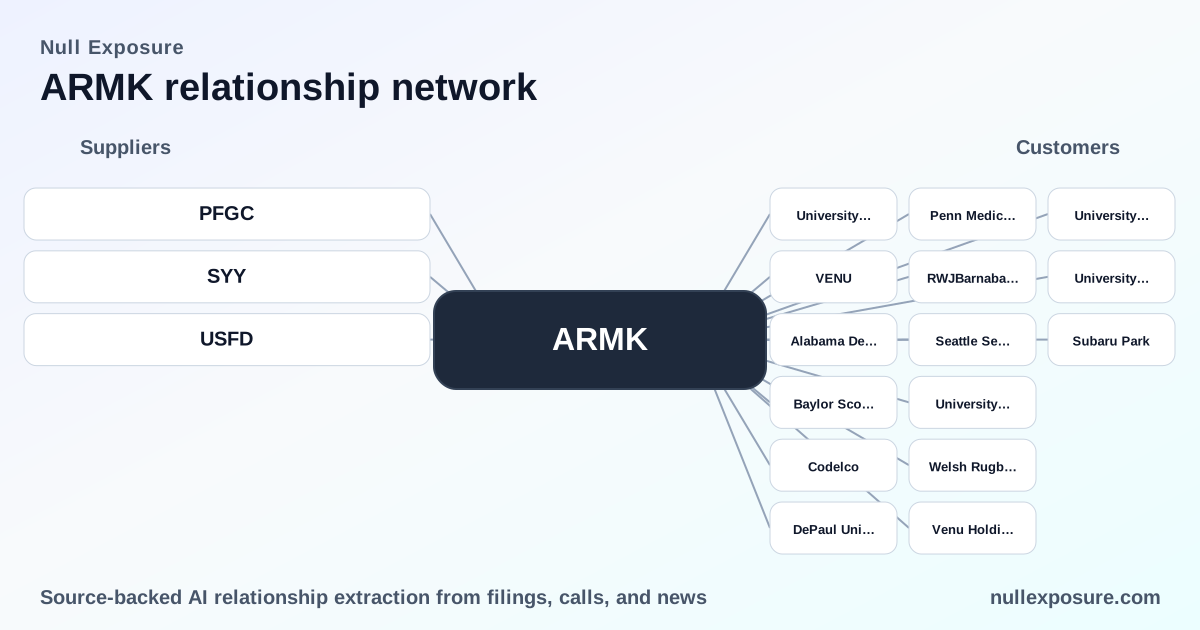
Aramark’s supplier spine: what investors and operators need to know about Sysco, US Foods and Performance Food Group
Aramark runs a high-volume, distributed food and services business that monetizes by operating foodservice and facility programs under contract for education, healthcare, sports, corrections and corporate clients. Revenue comes from service contracts (including revenue-sharing and client rent components), the sale of food and non-food products sourced through national and regional distributors, and operating leases tied to client locations — a model that combines recurring services revenue with significant pass-through procurement spend.
Explore deeper supplier relationship signals and contract posture at https://nullexposure.com/ for transaction-level context and monitoring.
How Aramark sources product and why the supplier mix matters
Aramark purchases most of its food and non-food products through national foodservice distributors; those distribution relationships are operationally central to day-to-day delivery. Distribution partners handle order tracking, logistics and last-mile delivery into Aramark’s thousands of client locations, which makes the distribution network a core operational dependency rather than a peripheral supplier relationship. According to the company’s FY2025 filing, the distributor channel is the primary procurement pipeline and therefore a key lever for cost, continuity and service quality.
This sourcing posture creates a mix of commercial dynamics: centralized negotiated pricing and rebates at scale, but decentralized execution risk at the location level. Investors should treat Aramark’s procurement model as both cost-management engine and concentration risk.
Contracting posture, concentration and operational constraints
Aramark’s 10‑K disclosures present a nuanced contracting posture across supplier and lease relationships:
- The company maintains a blend of short-term and long-term contractual arrangements. Distribution agreements can be indefinite with relatively short termination windows (commonly 60–120 days), while lease arrangements for real estate, vehicles and equipment range from one year up to 25 years. This mix gives Aramark flexibility in procurement but also leaves portions of spend exposed to market pricing with limited long-term price protection.
- Usage-based economics are embedded in the model. Aramark records substantial costs tied to leases associated with revenue contracts where rent paid to clients is often a percentage of sales; these usage-based components connect procurement and revenue volatility directly to client activity.
- Concentration is material at the company level. Aramark discloses that one distributor accounts for a very large share of U.S. and Canadian purchases; this translates into material operational and negotiating consequences for both parties.
- Maturity of relationships: Aramark describes multi-decade distribution arrangements in its filings, indicating deep operational integration with incumbent distributors that supports continuity but reduces short-term supplier substitutability for major lines of business.
These are company-level signals drawn from the FY2025 10‑K and should be folded into any supplier risk or vendor concentration analysis for financing, operational continuity planning, or cost forecasting.
The three named distributor relationships and what they mean for risk and negotiation
Sysco — the dominant distribution partner
Aramark reports a master distribution agreement with Sysco and states that Sysco distributed approximately 43% of Aramark’s food and non-food products in the U.S. and Canada in fiscal 2025, and that the relationship has been in place for over 40 years. That level of concentration makes Sysco both a strategic ally and a single point of supply exposure; the long-term agreement and scale create strong operational dependency and negotiating interdependence. According to Aramark’s FY2025 10‑K filing, this relationship is explicitly material to operations.
Source: Aramark FY2025 10‑K (filed Oct 3, 2025) — distribution and master agreement disclosure; fiscal 2025 purchase-dollar share.
US Foods — national distributor in the procurement mix
US Foods is listed along with other national distributors as a primary channel through which Aramark purchases products and other items. The company’s filing places US Foods in the grouping of large national distributors that supply Aramark’s operations across markets, implying standard national-distributor commercial dynamics (catalog pricing, rebates, logistics). Aramark’s FY2025 10‑K notes US Foods among the national sources for procurement.
Source: Aramark FY2025 10‑K (filed Oct 3, 2025) — national distributor disclosure; fiscal 2025.
Performance Food Group — included among national and regional suppliers
Performance Food Group is named as one of the national distributors through which Aramark buys products, indicating it is part of the multi-vendor procurement strategy Aramark uses to supply its operating units. The FY2025 10‑K identifies Performance Food Group in the same procurement list as Sysco and US Foods, establishing it as a meaningful supplier channel though not identified as a single dominant counterparty.
Source: Aramark FY2025 10‑K (filed Oct 3, 2025) — national distributor disclosure; fiscal 2025.
Implications for investors, operators and premium finance underwriters
- Concentration risk is real and measurable. With one distributor accounting for roughly 43% of U.S./Canada purchases, supply disruption, pricing disputes or service degradation at that counterparty would have an outsized effect on cost of goods sold, working capital and service uptime. Factor this into scenario stress tests and covenant design for financings tied to gross margin or EBITDA.
- Commercial flexibility exists but is partial. The presence of many national and regional distributors plus a mix of short-term distributor termination rights provides Aramark with options for re-sourcing, but long-standing master agreements and integrated logistics make rapid substitution costly in terms of transition and potential service disruption.
- Revenue-linked leases and usage-based costs create correlated exposures. Lease costs tied to a percentage of sales directly link Aramark’s operating cost base to top-line volatility at client sites; under revenue downturn scenarios, margins compress while fixed operational complexity remains.
- Supplier negotiation dynamics are asymmetric. Aramark’s scale gives it bulk-purchase leverage, rebate captures and vendor allowances, but the dependence on a dominant distributor creates negotiation limits that investors and operators should incorporate into expected margin improvement trajectories.
If you want transaction-level monitoring and alerts for supplier concentration changes and contractual expirations, visit https://nullexposure.com/ to see how these signals are tracked.
Bottom line and practical next steps for stakeholders
- Investors: Price in supplier concentration as a potential source of margin volatility and operational risk; ensure stress cases incorporate a Sysco-disruption scenario and revenue-linked lease sensitivity.
- Operators: Prioritize contingency plans for high-volume SKUs and location-level logistics continuity with alternate distributors; quantify transition costs and timing for re-sourcing if required.
- Underwriters / finance teams: Structure covenants and reporting triggers that reflect correlated usage-based lease exposures and large single-supplier dependency.
For ongoing tracking of Aramark supplier signals, master agreement expiries and concentration movements, check https://nullexposure.com/ — the monitoring informs underwriting and operational contingency planning in real time.
Key takeaways:
- Aramark’s model is distribution-dependent; one distributor handled roughly 43% of purchases in FY2025.
- Contract mix provides flexibility but leaves material single-supplier exposure.
- Usage-based lease economics tie costs to revenue and increase correlation risk.
These are the actionable supplier facts and constraints you need to fold into valuation, covenant design and operational resilience planning for Aramark.