Armata Pharmaceuticals (ARMP): supplier relationships, operating posture, and investable implications
Armata Pharmaceuticals develops and commercializes bacteriophage therapies targeting antibiotic‑resistant infections; the company monetizes by advancing clinical-stage assets (notably AP-SA02 and AP-PA02) toward regulatory approval and eventual product sales or licensing. Revenue today is minimal; value is driven by clinical progress, regulatory designations, and the ability to scale manufacturing and commercialization. For a consolidated view of supplier signals and contract risk, visit https://nullexposure.com/.
How Armata runs the business and where the economics come from
Armata operates as a clinical-stage biotechnology company with an asset-centric commercial model: development of phage therapeutics, the pursuit of regulatory milestones (End-of-Phase 2 meetings, QIDP designation), and the eventual transition to commercial manufacturing and sales or license agreements. Clinical success and regulatory precedence are the primary value drivers; manufacturing scale-up and capital structure are the primary operational constraints.
From the available information, Armata’s operating model shows a mix of long-term fixed commitments and short-term financing dependence. The company has entered multi-year real estate leases that create a long-term fixed-cost base, while its financing has included short-dated loans and credit facilities that concentrate refinancing risk. Armata also maintains an international footprint (a laboratory in Sydney, Australia) and outsources critical functions — contract research organizations (CROs) for trials and third‑party manufacturers for components — which places emphasis on supplier execution and third-party capacity.
Key business-model characteristics:
- Contracting posture: Significant long-term real estate commitments (multi‑year leases) combined with short-maturity debt instruments create a hybrid risk profile: fixed operating leverage with debt refinancing exposure.
- Concentration and criticality: Clinical and manufacturing outsourcing is material to program timelines; failure by CROs or CMOs would directly threaten regulatory and commercialization timelines.
- Maturity and spend: Armata is capital-intensive but early revenue: clinical-stage costs and mid‑range financing transactions (tens of millions) are the dominant spend drivers.
If you want a navigable supplier risk map tied to these signals, visit https://nullexposure.com/ for deeper supplier relationship intelligence.
A full rollcall of every reported relationship
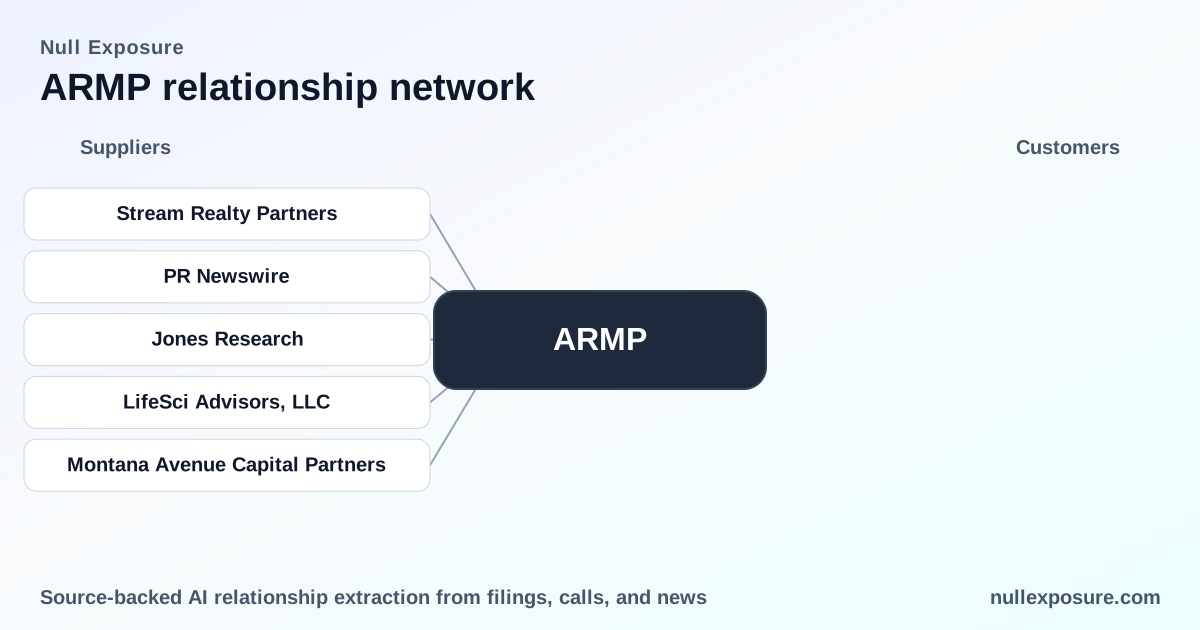
Below are the relationships captured in public reporting and press distribution for Armata. Each item is a concise one- to two-sentence summary with the reporting source and period.
- Stream Realty Partners — In FY2021 Stream Realty Partners’ Tim Dwight and Caleb Hodge represented Armata in a long-term office and R&D lease in Los Angeles, according to a Los Angeles Business Journal piece. (LA Business Journal, FY2021: https://labusinessjournal.com/real-estate/armata-pharmaceuticals-del-rey-office-lease-signal/)
- Montana Avenue Capital Partners — CBRE represented the landlord, Montana Avenue Capital Partners, in the same FY2021 lease transaction, confirming the landlord counterparty for Armata’s long-term premises. (LA Business Journal, FY2021: https://labusinessjournal.com/real-estate/armata-pharmaceuticals-del-rey-office-lease-signal/)
- PR Newswire (correction notice) — A PR Newswire distribution of Armata’s Jan. 13, 2026 news release contained transmission errors and required correction, according to a secondary report of the release. This indicates reliance on mainstream wire services for investor and media outreach. (StockTitan reporting on PR Newswire correction, FY2026: https://www.stocktitan.net/news/ARMP/c-o-r-r-e-c-t-i-o-n-armata-pharmaceuticals-jbc63kslkfna.html)
- Jones Research — Jones Research hosted a key opinion leader webinar on S. aureus bacteremia and AP‑SA02 on November 25 (FY2025), featuring noted infectious-disease specialists, which underscores active engagement with scientific investors and clinical opinion leaders. (PR Newswire release hosted by Jones Research, FY2025: https://www.prnewswire.com/news-releases/armata-pharmaceuticals-announces-key-opinion-leader-webinar-on-s-aureus-bacteremia-and-ap-sa02-hosted-by-jones-research-on-november-25th-at-1000am-est-302618023.html)
- LifeSci Advisors, LLC — LifeSci Advisors is repeatedly listed as Armata’s investor-relations contact in multiple FY2024–FY2026 PR Newswire releases (clinical data, publications, and regulatory news), demonstrating a stable IR/communications relationship used to distribute clinical and corporate milestones. (Multiple PR Newswire releases listing LifeSci Advisors, FY2024–FY2026: https://www.prnewswire.com/)
- PR Newswire (original releases) — PR Newswire itself served as the distribution channel for multiple Armata communications: Phase‑2 results, enrollment completions, QIDP designation, and scientific publications across FY2024–FY2026, indicating the company uses major wire services to broadcast regulatory and clinical progress. (Examples of PR Newswire releases, FY2024–FY2026: https://www.prnewswire.com/news-releases/armata-pharmaceuticals-announces-encouraging-results-from-the-phase-2-tailwind-study-of-inhaled-ap-pa02-in-non-cystic-fibrosis-bronchiectasis-subjects-with-chronic-pulmonary-pseudomonas-aeruginosa-infection-302335676.html)
- StockTitan (secondary aggregator) — StockTitan republishes and republishes PR Newswire releases (FY2026) including correction notices and company announcements, illustrating how Armata’s messaging propagates through financial aggregators for investor visibility. (StockTitan reporting, FY2026: https://www.stocktitan.net/news/ARMP/armata-pharmaceuticals-to-present-late-breaking-clinical-data-u6stlbmq3o7s.html)
What the supplier signals mean for investors and operators
The combination of relationships and contract evidence paints a coherent operational profile:
- Fixed real estate commitment: Armata entered substantial, non‑cancelable leases (documented 16‑year terms) that create long-term occupancy obligations. This elevates fixed-cost leverage and makes facility utilization and cash forecasting critical.
- Short-term financing concentration: The company has utilized short-maturity credit agreements and term loans in the tens of millions, which creates periodic refinancing events and interest expense pressure on the near-term cash runway.
- Outsourced critical workflows: Repeated references to CROs and third‑party manufacturers indicate core trial execution and manufacturing are externally dependent, making vendor selection and contingency planning vital for timeline certainty.
- Geographic diversification for trials and R&D: Armata maintains a Sydney lab and conducts studies in both the U.S. and Australia, which reduces single‑market execution risk for trials but introduces operational complexity across regulatory regimes.
- Communications and investor relations pattern: Stable use of LifeSci Advisors and PR Newswire establishes a consistent disclosure channel that investors can monitor for milestone-driven valuation inflection points.
Operationally, prioritize three monitoring items: real estate cash flow implications, upcoming loan maturities, and third‑party manufacturer/CRO performance against protocol timelines.
If you want tailored supplier exposure and counterparty risk maps tied to these signals, explore tools and reports at https://nullexposure.com/.
Investment takeaway and next steps
Armata is a clinical-stage biopharma with value contingent on clinical milestones and scaling manufacturing. Supplier and contract signals show a company with material long-term occupancy commitments, concentrated short-term financing, and outsized reliance on CROs and CMOs — a profile that accentuates execution risk relative to milestone-driven upside.
Actionable next steps for investors and operators:
- Monitor upcoming debt maturities and cash runway disclosures as immediate liquidity signals.
- Track PR Newswire and LifeSci Advisors announcements for formal clinical and regulatory milestones.
- Validate third-party manufacturing capacity and contingency plans when assessing commercial readiness.
For an investor-grade supplier relationship breakdown and to subscribe for alerts when these counterparties disclose material updates, visit https://nullexposure.com/.