Arrow Financial (AROW): Advisor and supplier relationships that shape the regional-bank playbook
Arrow Financial Corporation operates as a traditional regional bank holding company, monetizing through net interest margin, fee income from deposit and lending services, and expanding noninterest revenue via strategic insurance acquisitions and branch purchases. Recent activity—most notably acquisitions and advisory engagements tied to expansion in New York—signals a growth-through-consolidation strategy that leans on third‑party advisors, legal counsel, and rating/validation vendors to execute and communicate deals. For investors, the key operational levers are M&A-driven deposit and fee growth, disciplined capital deployment, and access to liquidity through correspondent and FHLB channels. Learn more about how supplier relationships influence credit and integration risk at https://nullexposure.com/.
How Arrow structures its external relationships and what that implies for operators
Arrow runs a mix of transactional, short-duration financing relationships and longer-running service-provider ties. The company uses correspondents and the Federal Home Loan Bank system for liquidity, hires boutique financial and legal advisors for M&A fairness opinions and closings, and acquires insurance agencies to diversify revenue. This combination produces a low vendor-lock posture for financing lines, a moderate dependency on specialized advisory firms during deal cycles, and growing operational complexity as insurance and branch networks integrate.
Operational constraints disclose three useful signals:
- Company-level signal — short-term contracting posture for funding: federal funds lines with two correspondent banks total $23 million and were not drawn in 2024, indicating an active but non-permanent short-term funding arrangement.
- Company-level signal — service-provider reliance for data and communications: Arrow engages multiple vendors for data processing and communication needs, signaling ongoing outsourcing of core operational services.
- Named-relationship signal — active collateralized borrowing with the FHLBNY: Arrow pledged collateral and had $9 million outstanding with the Federal Home Loan Bank of New York and an unused borrowing capacity of approximately $616 million as of December 31, 2024, underpinning material available liquidity.
Collectively, these signals point to manageable liquidity access, modest vendor concentration, and elevated execution risk during M&A integration rather than a single critical supplier dependency.
Supplier and advisor relationships the press tracked
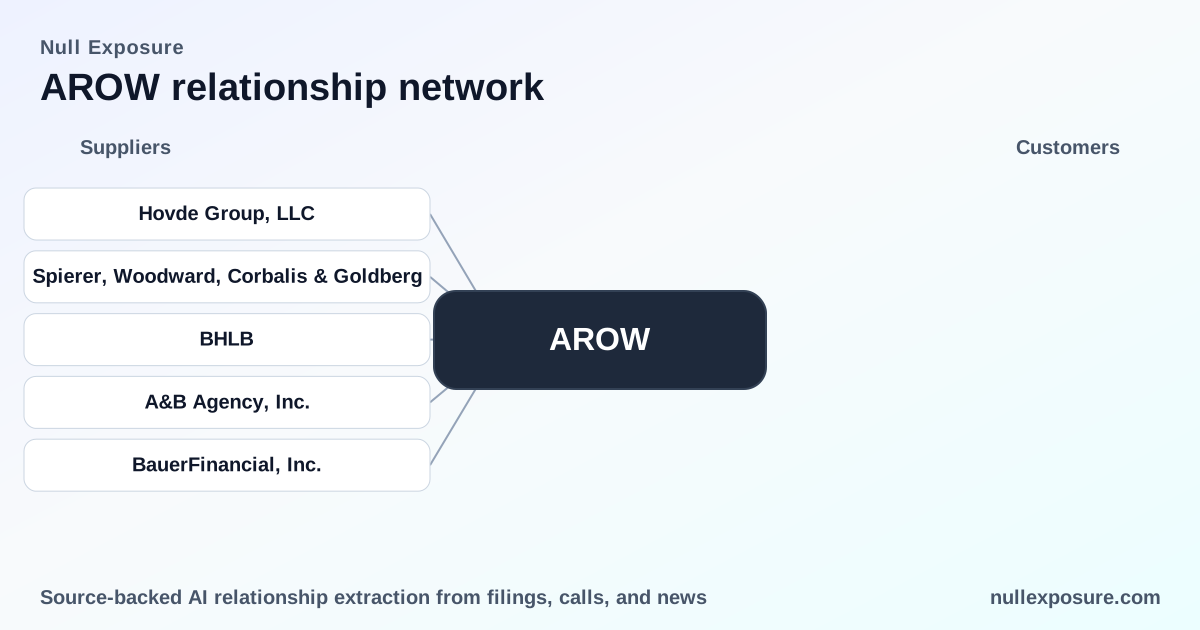
Hovde Group, LLC
Hovde acted as Arrow’s financial advisor and provided a fairness opinion in connection with Arrow’s acquisition activity tied to Adirondack Bancorp in FY2026. This engagement underscores Arrow’s use of boutique investment banking expertise for M&A valuation and transaction governance (Pulse2 and CityBiz coverage, March 2026; Arrow 8‑K reports reported via StockTitan, March 2026).
Spierer, Woodward, Corbalis & Goldberg
Spierer, Woodward, Corbalis & Goldberg served as legal counsel for the Adirondack Bancorp transaction, supplying the legal execution and closing support that accompany regional-bank acquisitions (reported by Pulse2 and CityBiz, March 2026; also referenced in the Arrow 8‑K via StockTitan, March 2026).
Berkshire Bank (BHLB)
Arrow purchased the Whitehall branch from Berkshire Bank in FY2025 as part of its local footprint expansion, a tactical branch acquisition that transfers deposit and lending relationships to Arrow’s platform (TradingView’s summary of Arrow’s SEC 10-K, referenced March 2026).
A&B Agency, Inc.
Arrow expanded its insurance operations with the acquisition of A&B Agency, Inc., signaling deliberate diversification into insurance brokerage and fee-based income streams to reduce reliance on interest-rate-driven revenue (TradingView reporting on Arrow’s FY2025 disclosures, March 2026).
BauerFinancial, Inc.
Arrow Bank National Association received a 5‑Star “Superior” rating from BauerFinancial, the national bank rating firm, providing a public credibility boost that supports deposit franchise strength and marketing positioning (PR Newswire press release on Arrow’s Q4 and FY2025 results, March 2026).
What these relationships mean for investor risk and operational execution
- M&A and advisor reliance raise execution and integration risk. Arrow’s use of Hovde and outside counsel for the Adirondack Bancorp deal reflects standard governance discipline, but the real test is cross-selling success and cost synergies post-close. Expect near-term integration expenses alongside revenue ramp opportunities from acquired branches and the insurance agency.
- Liquidity profile is conservative but diversified. Short-term federal funds lines are small and undrawn, while FHLB access provides substantial unused capacity (~$616 million at end-2024), indicating a robust backstop for growth or stress scenarios.
- Reputation and ratings matter for deposit gathering. The 5‑Star BauerFinancial rating supports local deposit stability and can reduce deposit beta on rate moves, an underappreciated advantage for regional banks competing on local trust.
- Operational vendor exposure is manageable but ongoing. Arrow’s dependence on service providers for data and communications is typical for banks of this scale; governance should emphasize vendor oversight and continuity planning as product lines (like insurance) are integrated.
Actionable takeaways for investors and operators
- Growth-through-acquisition is explicit and supported by external advisors; monitor integration metrics (deposit retention, cross-sell rates, cost-to-income convergence) in the quarters following announced deals.
- Liquidity is a strength—FHLB capacity plus unused correspondent lines create flexibility, but short-term lines mean Arrow prefers on-demand funding rather than long-term wholesale commitments.
- Diversification into insurance reduces single-source interest-rate sensitivity but increases operational scope; investors should price in mid-term efficiency catch-up and near-term execution risk.
For a deeper read on how supplier and advisor relationships influence transaction risk and credit profiles, visit https://nullexposure.com/ for practitioner-grade briefings and supplier maps.
Bottom line: pragmatic expansion with manageable vendor exposure
Arrow’s recent engagements—financial and legal advisors for acquisitions, targeted branch purchases, and an insurance agency add-on—collectively advance a playbook of modest scale M&A plus fee-income diversification. Liquidity channels and a top-tier bank rating support the balance sheet through integration phases. For investors focused on regional-bank consolidation, Arrow presents a measured growth profile backed by accessible funding and professional advisor support, with the primary near-term risk being successful operational integration and realization of deal economics.
Stay informed on supplier dynamics and their impact on bank valuation and credit risk at https://nullexposure.com/.