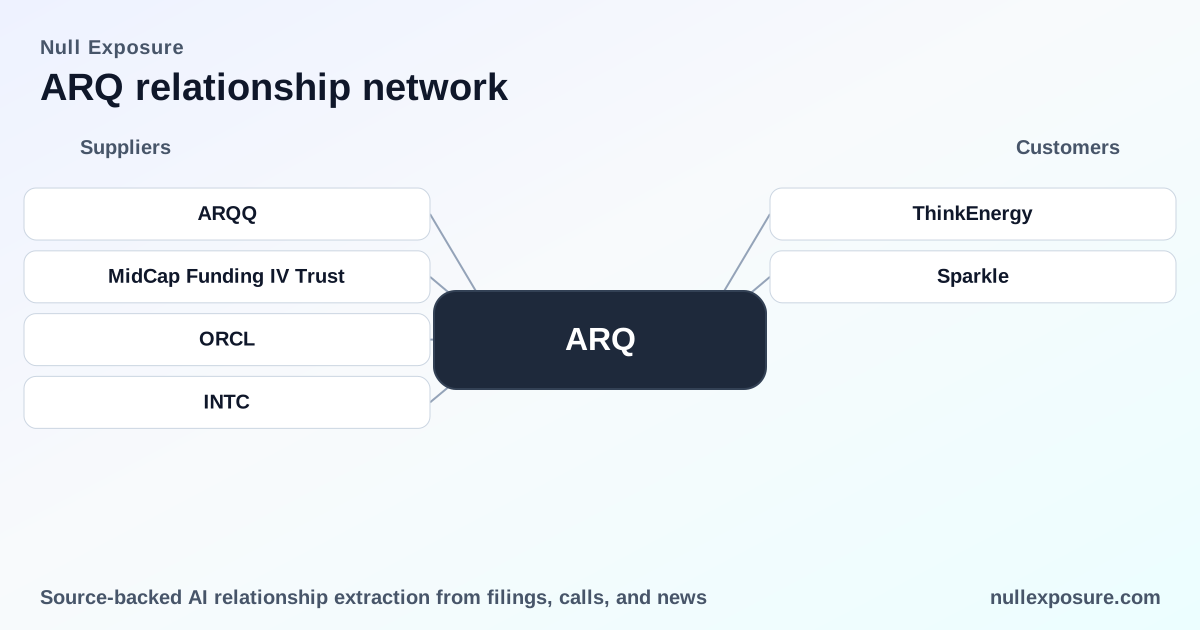
ARQ supplier relationships: who matters to operations and balance sheet
Arq, Inc. is a North American producer of activated carbon products that monetizes through product sales to industrial and environmental customers plus selective licensing and royalty arrangements tied to specialty technologies. Revenue comes from recurring product sales and structured agreements, while capital and liquidity are managed through a revolving credit facility that has required multiple amendments in recent periods. Investors should value ARQ on two axes: operating cash generation from carbon sales and counterparty exposure embedded in financing and intellectual property arrangements.
Visit the firm profile for ongoing monitoring and deeper supplier mapping: https://nullexposure.com/
How ARQ’s business converts raw materials into cash
Arq’s reported revenues for the trailing twelve months were approximately $120.3 million with gross profit of $38.5 million, highlighting a merchant manufacturing business that captures margin through processing and distribution of activated carbon. The company is currently unprofitable on a net basis (TTM diluted EPS of -1.27) and operates with a relatively small market capitalization of $80.3 million, which elevates the importance of its financing and counterparty relationships to short-term liquidity and strategic optionality.
Key financial signals: negative profitability, high beta (3.38), modest EBITDA ($3.64 million), and forward P/E of ~11.1 on consensus estimates. These factors frame why lenders and commercial partners matter to ARQ’s operating runway.
The counterparties shaping ARQ’s supplier and capital posture
Continental Stock Transfer & Trust Company, LLC
Arq’s disclosures reference Continental Stock Transfer & Trust as the transfer agent for ordinary shares in the context of a corporate action. According to a company press release (noted in FY2024), shareholders holding book-entry shares with Continental did not need to take action to receive post-split ordinary shares, which speaks to a standard custodial relationship for equity administration. Source: Arq press release (FY2024) — https://ir.arqit.uk/news-events/press-releases/detail/94/arqit-quantum-inc-announces-25-1-reverse-share-split
MidCap Funding IV Trust — revolving credit agent and lender
ARQ has an operationally critical revolving credit agreement administered by MidCap Funding IV Trust. Public filings and press coverage document multiple amendments to the Revolving Credit Agreement, including a second amendment in FY2025 and a fourth amendment in FY2026, indicating active covenant and tenor management with MidCap as agent. These amendments confirm that MidCap is central to ARQ’s short-term liquidity and working capital strategy. Source: 8‑K reporting via StockTitan (8‑K summary, FY2026) — https://www.stocktitan.net/sec-filings/ARQ/8-k-arq-inc-reports-material-event-6653002fd4d9.html; and market notice reporting the FY2025 amendment — https://www.theglobeandmail.com/investing/markets/markets-news/Tipranks/36602143/arq-inc-amends-revolving-credit-agreement/
Oracle — ecosystem and go-to-market channel (reported via press release)
ARQ is referenced in materials that position the company within a broader commercial ecosystem tied to defense-sector go-to-market support. A press announcement (FY2025) describes access to Oracle’s sales support and ecosystem resources as a commercial foundation for joint solutions, which signals potential distribution or channel opportunities for technology-enabled offerings. Source: Arq press release (FY2025) — https://ir.arqit.uk/news-events/press-releases/detail/109/arqit-joins-oracle-defense-ecosystem
Intel — technology partnership for product performance
ARQ announced collaboration with Intel (FY2024) to deliver productized solutions running on Intel Xeon Scalable processors, described as enabling out-of-the-box post-quantum cryptography solutions in the cited release. While this relationship is technology-centric, it demonstrates ARQ’s commercial activity beyond commodity carbon sales into licensing and platform-enabled offerings. Source: Arq press release (FY2024) — https://ir.arqit.uk/news-events/press-releases/detail/86/arqit-announces-collaboration-to-deliver-out-of-the-box-post-quantum-cryptography-solutions
Visit https://nullexposure.com/ for an integrated view of these partner and creditor exposures.
What the disclosed constraints reveal about ARQ’s contracting posture
The company-level constraint signals—extracted from public disclosures—form a coherent picture of ARQ’s supply and contractual model:
- Mixed contracting horizon. ARQ operates with a blend of long-term and short-term relationships: the firm maintains multi‑year royalty agreements (e.g., a five‑year Tinuum Group Royalty Agreement with automatic renewals) alongside annual supply agreements and spot purchases for various activated carbons. This structure reduces long-term supplier concentration for commodity inputs while preserving stable revenue lines where royalties apply.
- Dual licensor/licensee dynamics. Disclosures explicitly reference royalty mechanics for the Tinuum arrangement, positioning ARQ both as a licensee paying royalties and as a licensor for its M‑Prove™ technology where applicable. This duality diversifies revenue models but introduces IP-related cash flow dependencies.
- Operational outsourcing for non-core logistics. Shipping and handling are performed by third‑party shippers, indicating that distribution is outsourced and operational control is limited prior to customer receipt—an important input to working capital and fulfillment risk.
These constraints imply moderate contract maturity at the company level: long-term royalties coexist with renewals and spot procurement, producing a hybrid exposure profile that supports revenue stability while leaving cost volatility on commodity inputs.
Risk profile and investor implications
- Liquidity and leverage: Repeated amendments to the revolving credit facility with MidCap signal ongoing covenant and liquidity management; lenders are a central counterparty for near-term solvency. Source: 8‑K and press notices as cited above.
- Operational concentration: The mix of spot and annual supply agreements for activated carbons means input-cost volatility can compress margins rapidly, while royalties and licensing provide downside protection only where they scale.
- Market valuation: Small market cap, negative EPS, and elevated beta create a profile for active monitoring rather than passive holding; analyst consensus (four buy ratings) and a target price of $4.625 indicate some investor optimism against current market pricing.
- Governance and share administration: The retained relationship with a transfer agent for corporate actions is standard but relevant to investors during restructures or corporate actions. Source: Arq press release (FY2024).
Next steps for investors and operators
- For credit risk monitoring, prioritize the MidCap revolving credit relationship and track covenant amendments and utilization updates in future 8‑Ks and press releases. Public filings give the earliest read on liquidity pressure.
- For operational risk, maintain supplier-level screening of annual supply agreements and the mix of spot purchases to model margin sensitivity to carbon input price swings.
- For strategic upside, evaluate the monetization path of licensing agreements (such as the Tinuum royalty arrangement) to determine how much recurring non‑commodity revenue can reduce earnings volatility.
If you want a consolidated counterparty map and real‑time change alerts for ARQ, start here: https://nullexposure.com/
Conclusion — what matters now
ARQ is a small industrial manufacturer with a hybrid revenue model—commodity product sales balanced by selective royalties and licensing—and a financing structure anchored to MidCap as lender. The company’s operating resilience hinges on stable access to working capital and disciplined management of spot input purchases. Investors should focus on upcoming covenant disclosures, amendments to the MidCap facility, and any expansion or contraction in royalty/licensing income.
For a comprehensive supplier exposure brief and continuous monitoring, visit https://nullexposure.com/ and subscribe for alerts.