ARQT: Supply-chain posture and named counterparties that matter for investors
Arcutis Biotherapeutics operates as a focused dermatology commercial-stage biotech that monetizes primarily through sales of ZORYVE (roflumilast) and related product commercialization activities, while outsourcing virtually all manufacturing and many commercialization support functions to third parties. Revenue comes from product sales and channel economics; operating leverage and margin expansion depend on commercialization traction for ZORYVE and on maintaining uninterrupted supply from single-source contract manufacturers and service providers. For a quick supplier-risk read on Arcutis, see the coverage on Null Exposure: https://nullexposure.com/.
How Arcutis runs its supplier relationships — the operating model in plain English
Arcutis operates with a deliberately outsourced model: no internal manufacturing capability, reliance on single-source third-party manufacturers, and contracted relationships with wholesalers and specialty pharmacies for distribution and operational services. That posture produces distinct financial and operational characteristics:
- Contracting posture: Arcutis has long-term manufacturing supply agreements that include minimum purchase commitments; firm purchase commitments are material within the short-term planning horizon.
- Concentration and criticality: The company signals single-source dependency for clinical and commercial supply, which elevates supplier concentration risk and makes continuity of supply mission-critical.
- Maturity and spend scale: Firm future purchase commitments are in the low single-digit millions per year beyond the near term (approximately $7.5 million in 2025 and about $0.9 million for 2026 and 2027), indicating committed but contained near-term spend against a larger revenue base.
- Role mix: Suppliers function both as manufacturers (commercial production) and service providers (wholesalers, specialty pharmacies, CROs), so operational disruptions can affect both product availability and channel operations.
These signals are company-level and reflect the structure of Arcutis’ commercial and manufacturing strategy rather than any one counterparty.
Why the supplier posture matters to valuation and risk
Arcutis’ financial profile — $376M in trailing revenue and $339M gross profit (TTM) against a market capitalization of about $2.82B — creates a leverage dynamic where growth and margin expansion depend on commercial execution for ZORYVE and reliable third-party supply. The combination of single-source manufacturing and minimum purchase commitments produces two investor-relevant outcomes:
- Operational leverage: If ZORYVE scale accelerates, contracted capacity and minimums protect supply but can also lock the company into fixed cost or purchase floors before demand fully scales.
- Event risk: Any supplier compliance issue or failure to supply at acceptable quality or price is material and potentially business-critical, given Arcutis’ lack of internal manufacturing. This elevates tail risk relative to peers with in-house or multi-source capacity.
For a focused supplier-risk dashboard and continuous monitoring of counterparties, visit Null Exposure: https://nullexposure.com/.
Named counterparties and the recent signals investors should track
Below are the relationships surfaced in recent public reporting and filings. Each entry includes a concise investor-facing summary and the source.
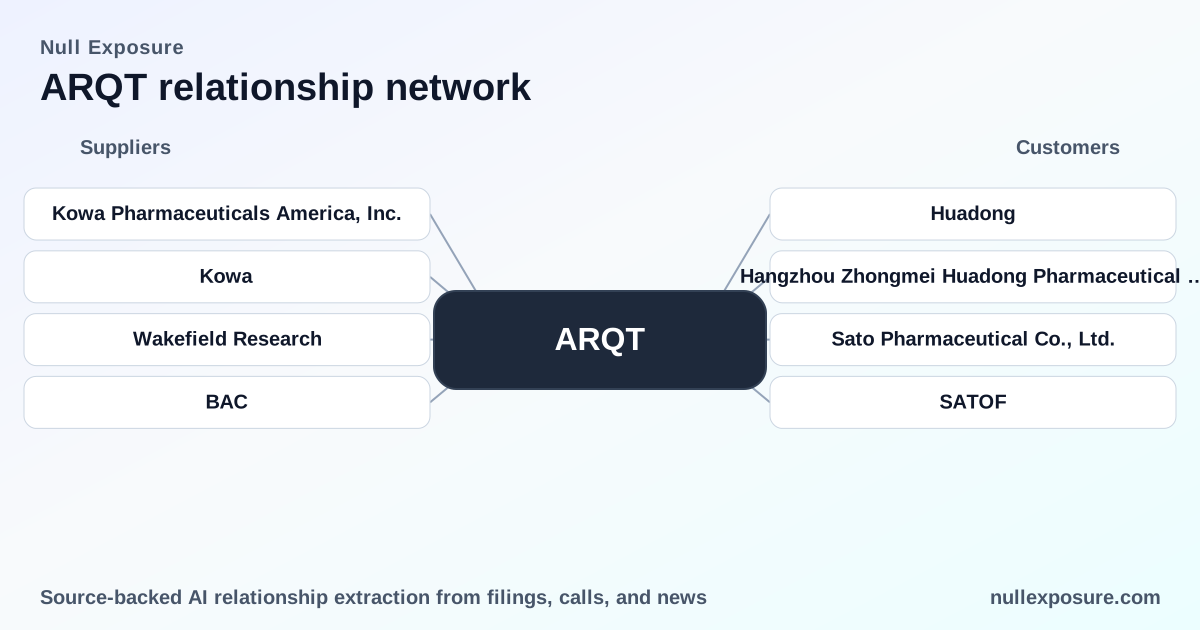
Kowa Pharmaceuticals America, Inc.
Arcutis terminated a promotional agreement with Kowa that had covered sales and promotion of ZORYVE to U.S. primary care physicians and pediatricians; the termination follows limited commercial contribution from the partner. A StockTitan report noted the termination of the promotion agreement (reported March 9, 2026).
Source: StockTitan news report on March 9, 2026.
Kowa (earnings-call mention)
During the Q4 2025 earnings call transcript, management cited the minimal contribution from Kowa as a reason for terminating that contract, signaling limited commercial lift from that channel partnership. The earnings-call transcript published on InsiderMonkey captures the management commentary (Q4 2025 / reported March 2026).
Source: InsiderMonkey earnings-call transcript (Q4 2025, reported March 2026).
Wakefield Research
Arcutis commissioned an online survey executed by Wakefield Research in collaboration with patient-advocacy organizations to quantify concerns about topical steroids, an effort aimed at shaping market education and commercial positioning for ZORYVE. The public release of the survey was reported by StockTitan in March 2026.
Source: StockTitan news release on March 9, 2026.
Merrill Lynch (broker reference in SEC filing)
A recent SEC filing includes a broker reference to Merrill Lynch (showing a broker address), indicating interaction with investment-banking or brokerage channels for capital markets or investor services; the detail is contained in the company SEC filing captured by StockTitan.
Source: StockTitan summary of Arcutis SEC filing (reported March 9, 2026).
What these named ties tell investors — synthesis and takeaways
- Commercial partnerships are active but can be short-lived. The Kowa termination demonstrates that Arcutis will iteratively optimize partner arrangements when partners deliver insufficient commercial return; that reduces long-term partner lock-in but raises execution risk during transitions.
- Market education investments are strategic. The Wakefield Research survey signals Arcutis’ focus on shaping clinician and patient perceptions — an important non-manufacturing lever to drive adoption without additional manufacturing spend.
- Capital markets relationships remain important. Broker references such as Merrill Lynch are routine for publicly listed biotechs and suggest ongoing engagement with investor services and potential capital raises or trading facilitation.
Midway action: for continuous monitoring of these and other supplier signals, check the Null Exposure research hub: https://nullexposure.com/.
Investment implications and a short risk checklist
- Upside catalyst: Execution-driven adoption of ZORYVE in primary care and dermatology clinics; successful channel partnerships and marketing lift will convert clinical strength into revenue scale.
- Downside risk: Single-source manufacturing and supplier concentration create outsized event risk; a material supplier failure would affect supply and financials materially. The company’s own filings state that loss of suppliers could materially impair operations.
- Capital efficiency: Minimum purchase commitments (firm future purchase commitments reported ~$7.5M for 2025 and ~$0.9M per year in 2026 and 2027) are manageable against current revenue but require demand to meet contracted volumes.
- Operational focus: Investors should watch operational KPIs — fill rates, channel uptake, inventory levels, and any supplier corrective actions — because they are the direct transmitters of supplier risk into financial results.
Conclusion and next steps for analysts
Arcutis operates a lean, outsourced commercial model where supplier relationships are central to both opportunity and risk. The Kowa contract termination, Wakefield Research marketing activity, and broker references together paint a company that is actively reshaping its commercial strategy while remaining exposed to supplier concentration. For investors and procurement-focused analysts, ongoing monitoring of manufacturing continuity and channel performance is essential.
For an actionable supplier-risk monitor and deeper counterparty profiles, visit Null Exposure and set up alerts: https://nullexposure.com/.