Artemis Strategic Investment Corporation (ARTE) — supplier relationships and investor implications
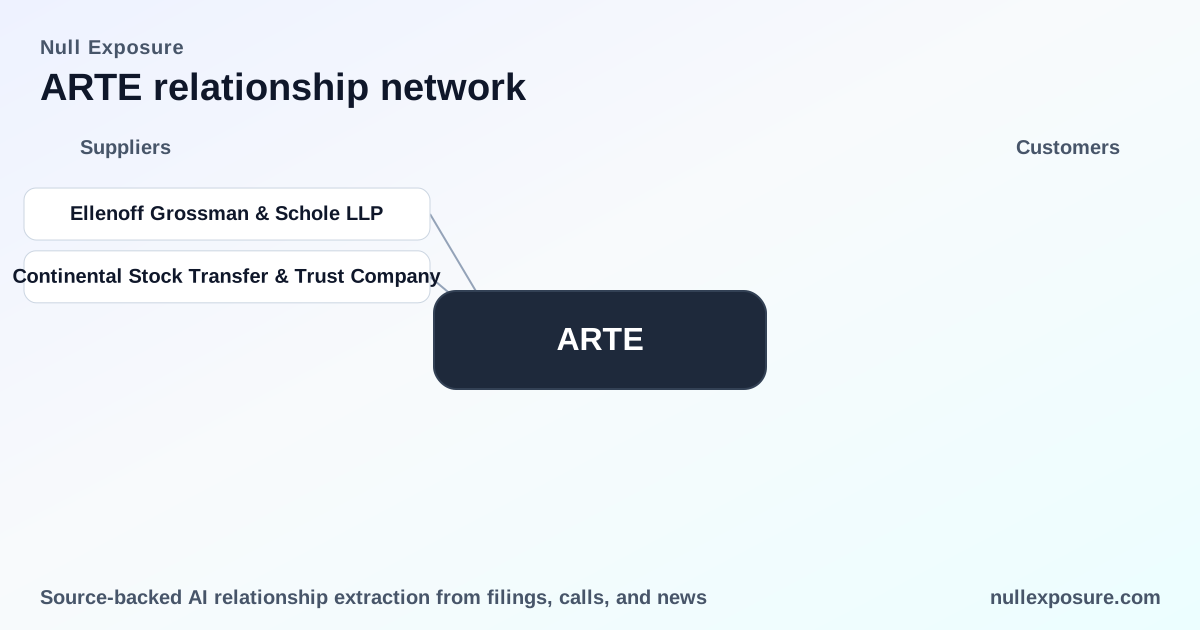
Artemis Strategic Investment Corporation operates as a special-purpose acquisition company (SPAC) that historically monetized through sponsor economics and transaction-related fees tied to completing a business combination; its supplier footprint reflects the standard SPAC vendor set—legal counsel and trust/account services that enable deal execution and trust-account management. Recent public disclosures show Artemis moving through late-stage lifecycle actions, including trust-account liquidation instructions, which materially change the company’s operational runway and counterparty exposure. For investors and operators evaluating ARTE supplier relationships, the key question is not the breadth of vendors but the criticality and timing of the relationships that remain. Learn more about the vendor landscape at https://nullexposure.com/.
Why suppliers matter for a SPAC in transition
Suppliers in a SPAC are not commodity vendors: legal counsel and the trustee/transfer agent are mission-critical for corporate actions, regulatory compliance, and distribution of trust funds. For ARTE, the available public records indicate a lean vendor map concentrated on these functions. That concentration creates a two-way profile: it reduces ongoing supplier management complexity but increases single-point operational risk should a counterparty fail to execute on liquidation or regulatory tasks.
Company-level signals from the public record show the following operating-model characteristics:
- Contracting posture: Tactical, transaction-focused engagements typical of SPACs—short-term, event-driven retainers with specialized firms.
- Concentration: A compact supplier set centered on legal and trust services rather than a broad operational supply chain.
- Criticality: High—both identified suppliers perform functions directly tied to investor cash flows and regulatory milestones.
- Maturity: The trustee instruction to liquidate the trust account is a clear indicator of late-stage lifecycle activity (dissolution or return of investor capital).
If you need consolidated supplier intelligence for due diligence or exposure analysis, visit https://nullexposure.com/ for a detailed supplier map and supporting sources.
The public relationships — what the record shows
Ellenoff Grossman & Schole LLP
Ellenoff Grossman & Schole LLP is listed as legal counsel for Artemis in connection with a transaction disclosed in March 2026, placing the firm in charge of legal work related to the business-combination process or dissolution proceedings. According to a Yahoo Finance article dated March 9, 2026, Ellenoff is serving as Artemis’s counsel in filings related to a strategic investment notice. (Source: Yahoo Finance, March 9, 2026.)
Continental Stock Transfer & Trust Company
Artemis instructed Continental Stock Transfer & Trust Company, the trustee of its trust account, to take actions to liquidate the trust account in connection with termination activity disclosed in fiscal 2023 filings; this identifies Continental as the operational counterparty responsible for returning capital to public investors. AccessNewswire reported the instruction to Continental in a termination announcement originally filed in FY2023. (Source: AccessNewswire, FY2023/announcement reposted March 2026.)
What each relationship implies for investors
- Ellenoff Grossman & Schole LLP — Legal counsel presence signals that Artemis maintained a standard transactional legal engagement to execute or unwind corporate actions; effective counsel can materially reduce execution and regulatory risk during liquidation or a late-stage combination. (Source: Yahoo Finance, March 9, 2026.)
- Continental Stock Transfer & Trust Company — The trustee relationship is the operational linchpin for any SPAC redemption or return-of-capital process; the instruction to liquidate the trust account is a definitive corporate event that dictates investor distributions and closes the SPAC lifecycle. (Source: AccessNewswire, FY2023/announcement.)
Investment implications: risk and return reframed
ARTE’s supplier disclosures point to a SPAC that has moved into terminal corporate actions. For investors, this produces several concrete implications:
- Liquidity event imminent or completed. The trustee instruction indicates that cash distribution mechanics are active; monitor trust-account reconciliation and final distribution notices for timing and exact share-holder entitlements.
- Limited vendor complexity. A lean supplier base reduces operational overhead but puts a premium on the performance of each counterparty—particularly the trustee and counsel—so due diligence should assess their track records on timely distributions and dispute resolution.
- Counterparty execution risk is the primary operational exposure. Legal disagreements or trustee processing errors can delay or alter distributions; legal counsel’s effectiveness in documenting and defending corporate actions is directly material to investor outcomes.
- Regulatory and documentation trail becomes the locus of value. With cashflows tied to trust liquidation, review of filings, press releases, and trustee confirmations replaces revenue projections as the relevant valuation anchor.
Key action points for investors:
- Confirm receipt schedules and reconciliation statements from the trustee and counsel filings.
- Review any post-termination claims or litigation filings that could encumber trust assets.
- Validate the trustee’s process for distribution and the legal counsel’s opinion letters or board resolutions authorizing liquidation.
Practical next steps for monitoring ARTE
- Pull the trustee distribution schedule and monitor for any amendments or legal holds.
- Read legal notices filed or appended to the termination announcement to confirm the scope of liabilities and the finality of the liquidation instruction.
- If you are an operator or vendor evaluating service opportunities, understand that SPAC engagements are event-driven and short-term; contract terms should prioritize clear termination and payment mechanics.
If you would like a consolidated supplier risk brief or to track similar SPAC supplier exposures across your portfolio, explore services and reports at https://nullexposure.com/.
Bottom line
ARTE’s public supplier footprint is compact and transaction-focused: legal counsel and the trustee are the decisive counterparties for investor outcomes. The instruction to Continental to liquidate the trust account marks the SPAC’s movement into an exit or winding phase, with distribution mechanics and legal documentation now dictating value realization. Investors should shift attention from growth scenarios to execution risk around trustee distributions and the final legal close; operators should price engagements with event-driven timelines and clear termination clauses.
For a deeper supplier exposure analysis and curated relationship maps, visit https://nullexposure.com/ and request the ARTE supplier brief.