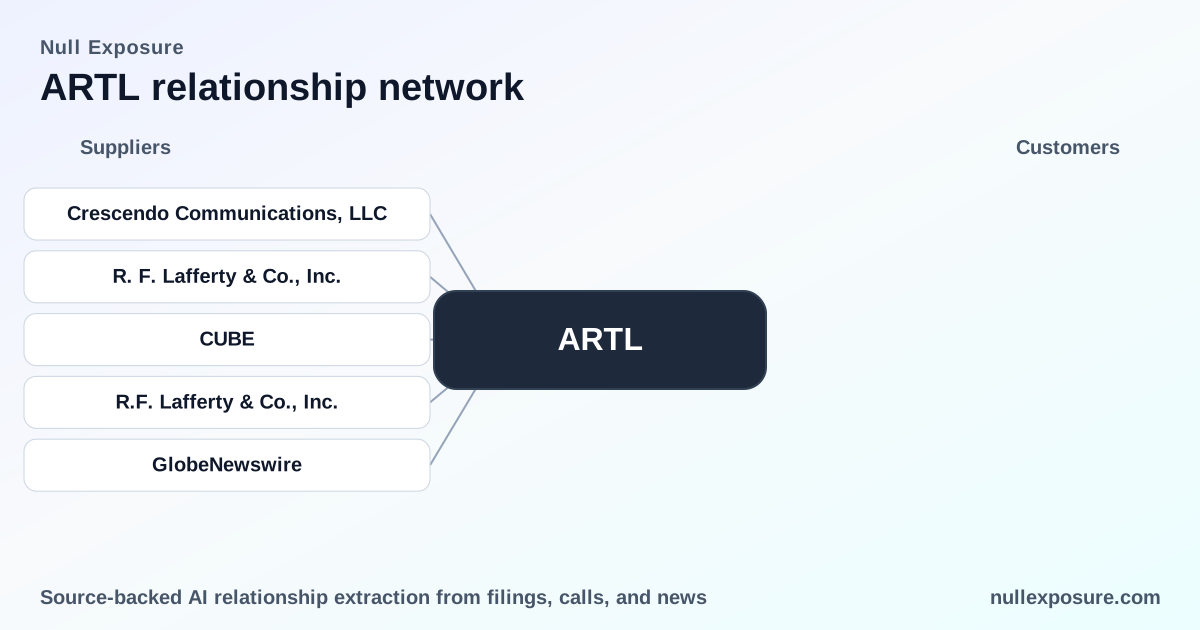
Artelo Biosciences (ARTL): supplier relationships, financing partners and operational posture
Artelo Biosciences is a clinical-stage biotechnology company developing therapies that modulate the endocannabinoid system; it generates value primarily through advancing clinical programs and monetizing through financing events, licensing or partnerships rather than product revenue. The company funds R&D through capital markets activity and targeted private placements, and it outsources a significant portion of execution—investor relations, underwriting and clinical work—to specialist suppliers. For a focused investor or operator assessment, that outsourcing pattern is the single biggest operational lever and risk vector for ARTL. — For related supplier intelligence and comparative profiles visit https://nullexposure.com/.
Why supplier relationships matter to investors in ARTL
Artelo is an early-stage biotech with no reported revenue and negative EBITDA, so supplier and capital-market relationships substitute for internal scale: investor relations determine market access; underwriters and placement agents unlock liquidity; CROs, academic partners and consultants drive clinical progress. That operating model creates a contracting posture that is outsourced, short-term and finance-driven, concentrating strategic risk in a small set of external vendors.
The supplier roster: who Artelo works with and what they did
Below are the relationships surfaced in public disclosures and press releases. Each is presented in plain English with the source cited.
Crescendo Communications, LLC
Crescendo is Artelo’s investor relations contact and is repeatedly listed as the company’s PR/IR agent across multiple press releases, including transaction announcements and clinical updates. According to GlobeNewswire releases and subsequent news postings in 2025–2026, Crescendo is the primary point of contact for IR on Artelo filings and business updates (e.g., Sep–Nov 2025 and Feb–Mar 2026 releases).
Source: multiple GlobeNewswire press releases and news reposts (Sep–Nov 2025; Feb–Mar 2026).
R. F. Lafferty & Co., Inc.
R. F. Lafferty acted as sole book-running manager and underwriter for Artelo’s $3.0 million public offering and also provided advisory services in connection with a PIPE/ATM placement disclosed in August–September 2025. GlobeNewswire and QuiverQuant reported the firm’s role in the offerings in Sep 2025.
Source: GlobeNewswire press releases on Sep 4–5, 2025 and related QuiverQuant summaries (Sep 2025).
R.F. Lafferty & Co., Inc.
A separate press item uses the punctuation-free variant of the name but attributes the same activity—serving as the sole book-running manager for the offering—confirming consistent underwriting and placement responsibilities in the Sep 2025 financing cycle.
Source: GlobeNewswire press release dated Sep 4, 2025 (pricing/closing of public offering).
CUBE (lead investor Bartosz Lipiński)
CUBE is identified as the vehicle for the lead investor in Artelo’s at-the-market private placement and in launching the company’s Solana (SOL) treasury strategy, with Bartosz Lipiński named as technical advisor and partner. The involvement was disclosed in an Aug 4, 2025 GlobeNewswire release announcing a $9.475 million ATM/private placement and the SOL treasury initiative.
Source: GlobeNewswire press release, Aug 4, 2025.
GlobeNewswire (news distributor / press channel)
GlobeNewswire is the distributor for many of Artelo’s official releases cited above; one QuiverQuant posting also noted that a summarized piece was AI-generated from a GlobeNewswire release. That distribution channel is the primary outlet Artelo uses to broadcast financing, clinical and corporate updates in 2025–2026.
Source: GlobeNewswire press releases (Aug–Nov 2025) and QuiverQuant summary flags (Sep 2025).
What this supplier map says about Artelo’s operating model
-
Contracting posture: Artelo operates with an outsourced, vendor-centric model. Investor relations, underwriters and advisers handle market access, while clinical execution is managed through CROs and academic partners referenced in corporate filings. This structure reduces fixed payroll but increases dependency on third-party timelines and terms.
-
Concentration and criticality: The supplier list shows high concentration: a single IR firm (Crescendo) is the primary public communications channel and one underwriting firm (R. F. Lafferty) led the recent financings. That concentration turns these relationships into critical nodes for liquidity and reputation.
-
Maturity and bargaining leverage: As a clinical-stage firm with no revenue and limited institutional ownership, Artelo’s bargaining leverage with suppliers is skewed toward short-term, fee-for-service engagements and financing-linked arrangements rather than long-term strategic contracts.
-
Operational implication: Outsourcing critical functions creates speed and flexibility but also exposes the company to execution risk if a key supplier’s priorities shift or market access narrows.
These are company-level signals drawn from public disclosures and press releases; they describe how Artelo runs its business rather than attributing contract terms to any single vendor.
Investment implications: runway, dilution and reputational vectors
Artelo’s recent financings—an Aug 2025 $9.475M PIPE/ATM and a Sep 2025 $3.0M public offering—demonstrate the company’s reliance on capital markets for working capital rather than operational cash flow. The use of a boutique underwriter and active IR model supports continued access to small, targeted raises but also signals higher dilution risk and sensitivity to retail/OTC liquidity conditions. The Solana treasury strategy announced with CUBE introduces an unconventional treasury approach that is novel but increases exposure to crypto-market volatility and governance scrutiny, as documented in the Aug 4, 2025 release.
For investor diligence: prioritize counterparty stability (IR and underwriters), monitor issuance cadence and dilution, and track CRO/academic milestones that convert pipeline progress into licensing or partnership value. For further comparative supplier intelligence, explore our tools at https://nullexposure.com/.
Practical next steps for operators and investors
- For investors: track Crescendo’s communications and R. F. Lafferty’s role as leading indicators of future financing cadence; treat the SOL treasury strategy as a headline-level risk factor requiring separate scrutiny.
- For operators: diversify critical supplier relationships where possible to reduce single-node risk and document contingency funding sources beyond ATM/PIP activity.
For a deeper supplier-level risk score and audit trail on Artelo and peer companies, see our platform at https://nullexposure.com/.
Bottom line
Artelo is a capital-markets-dependent clinical-stage biotech that outsources execution and relies on a very small set of external partners for funding and market communications. That model delivers flexibility but concentrates operational risk in vendor relationships—particularly investor relations and underwriting. Investors and operators should prioritize monitoring financing partners, IR cadence and the novel treasury experiments as primary drivers of near-term value and risk. For ongoing supplier monitoring and structured relationship analytics, visit https://nullexposure.com/.