ARTW: A supplier profile investors should read before underwriting exposure
Art's-Way Manufacturing Co., Inc. builds and sells agricultural equipment, modular science buildings, and steel cutting tools, and it monetizes through direct product sales and private‑label OEM manufacturing for larger equipment brands. The company’s economics are driven by product mix (new machinery vs. parts), private‑label OEM contracts that generate steady manufacturing revenue, and a small balance sheet that has used government-backed financing during stress periods. For investors evaluating supplier risk, the important frame is: this is a small-cap, manufacturing supplier with legacy OEM relationships, some single‑source imported components, and limited institutional coverage. Learn more on the platform: https://nullexposure.com/.
Why supplier relationships define ARTW’s operational footprint
Art's‑Way functions both as a branded manufacturer and an OEM supplier. That dual role gives the company volume through private‑label contracts while keeping product lines that command end‑user pricing. Private‑label manufacturing reduces marketing spend but also reduces pricing power and increases exposure to order variability from large OEM customers. At the same time, corporate disclosures show raw materials are sourced both domestically and internationally, and a specific component line (manure spreader beaters) is imported from Italy — a clear single‑source risk for that sub‑product. The company’s prior use of a U.S. Small Business Administration promissory note indicates periodic reliance on government‑backed financing rather than sustained institutional capital markets access.
What the record shows — partners, history and the implications
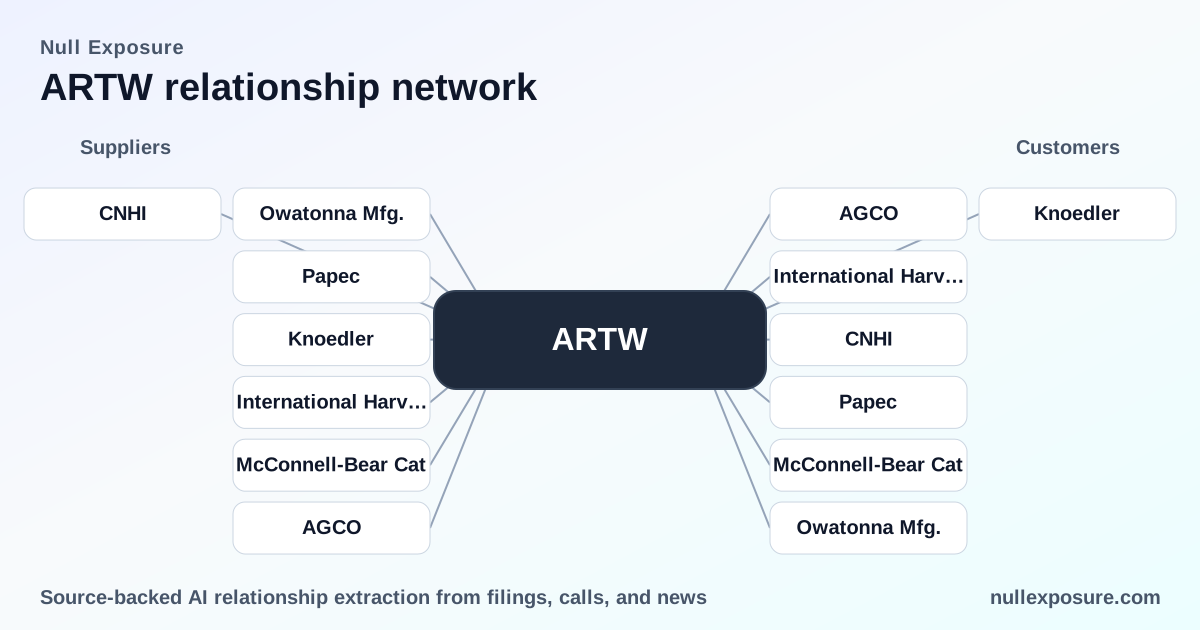
The public record lists several legacy private‑label or contract manufacturing relationships. Each entry below is taken from a historical industry write‑up that documents Art's‑Way’s role as a manufacturer of mixers and similar equipment (FY2017 reporting context).
- Owatonna Mfg. — Art's‑Way manufactured and private‑labeled mixers for Owatonna, reflecting the company’s role as a white‑label OEM for regional equipment suppliers (hayandforage.com, FY2017).
- Papec — Art's‑Way supplied mixers that were sold under the Papec name, illustrating choice of non‑exclusive OEM partnerships (hayandforage.com, FY2017).
- Knoedler — Art's‑Way produced mixers for Knoedler, showing the firm’s historical footprint across diversified agricultural equipment brands (hayandforage.com, FY2017).
- International Harvester (later Case New Holland / CNHI) — Art's‑Way built private‑label mixers used by International Harvester, an indication of relationships with legacy global OEMs that evolved into Case New Holland (hayandforage.com, FY2017).
- McConnell‑Bear Cat — Art's‑Way’s manufacturing for McConnell‑Bear Cat demonstrates contract manufacturing ties to specialty equipment lines (hayandforage.com, FY2017).
- Massey Ferguson (inferred AGCO) — The company has produced mixers for Massey Ferguson, pointing to heritage supply arrangements with internationally recognized brands (hayandforage.com, FY2017).
- Case New Holland (CNHI) — Reiterating the International Harvester lineage, Art's‑Way’s work for Case New Holland is evidence of legacy OEM engagements that continue to inform its commercial positioning (hayandforage.com, FY2017).
Each of these relationships underscores Art's‑Way’s operating model: a small manufacturer that captures volume through private‑label contracts rather than broad retail distribution of a single dominant branded product.
How the constraints in filings change what you should underwrite
Company disclosures and ancillary filings reveal three constraint signals that are material to supplier risk assessment:
- Government counterparty: a promissory note with the U.S. Small Business Administration (incorporated by reference to a Form 10‑Q filed July 10, 2020) confirms periodic reliance on government‑backed financing, which is a liquidity signal investors must price into downside scenarios.
- Geography — EMEA exposure: management states that some components are imported, and manure spreader beaters are sourced from Italy, creating a meaningful single‑source exposure to EMEA manufacturing and transport risk.
- Geography — North America sourcing: the company also sources raw materials domestically, which mitigates but does not eliminate supply chain concentration because some product lines rely on foreign suppliers.
These are company‑level signals — they affect the entire business, not any single OEM relationship, and they change the profile for covenant testing, inventory buffers, and contingency sourcing.
Interpreting concentration, criticality and maturity
Art's‑Way shows the classic features of a mature niche supplier: legacy OEM ties, low public liquidity, and highly concentrated insider ownership (insiders control nearly 59% of shares outstanding). This structure yields operational stability — management and insiders are aligned — but it also delivers low institutional scrutiny and limited secondary liquidity for new investors. Financials echo that mixed picture: positive EBITDA and a modest trailing P/E, but a negative operating margin on a TTM basis, which suggests episodic cost pressures or restructuring around product lines.
Operationally, the critical single‑source parts imported from Italy are the most actionable supplier risk: supply interruptions, shipping cost shocks, or trade policy changes in EMEA can create immediate production disruption for the manure spreader line, and because these are OEM‑label products, downstream customers expect consistent availability.
What operators and investors should watch next
- Monitor procurement disclosures and any amendments to sourcing language around imported beaters from Italy; a shift to dual‑sourcing would materially reduce production risk.
- Track receivables and covenant language tied to the SBA note; renewal, repayment, or additional government financing will change liquidity and leverage expectations.
- Watch OEM order cadence from the named partners (Case New Holland, Massey Ferguson/AGCO, etc.); a contraction in private‑label orders will compress utilization and margins.
If you want ongoing, structured monitoring of these supplier signals and relationship rollups, visit https://nullexposure.com/ for continuous coverage.
Final read: how to position exposure
Art's‑Way is a small, operationally focused OEM with valuable partner relationships that create steady manufacturing revenue but limited pricing power. The clear risks are single‑source EMEA components for specific lines and concentrated ownership that reduces market liquidity. For operators, the company’s OEM model is an asset — it keeps production volumes predictable — but investors should demand clarity on dual‑sourcing plans and the SBA financing status before increasing exposure.
For a practical next step, use the platform to track changes to these supplier links and filings in real time: https://nullexposure.com/. Act where the facts change: if Art's‑Way secures alternative sourcing for Italian components or replaces government financing with commercial credit, downside scenarios shrink materially.