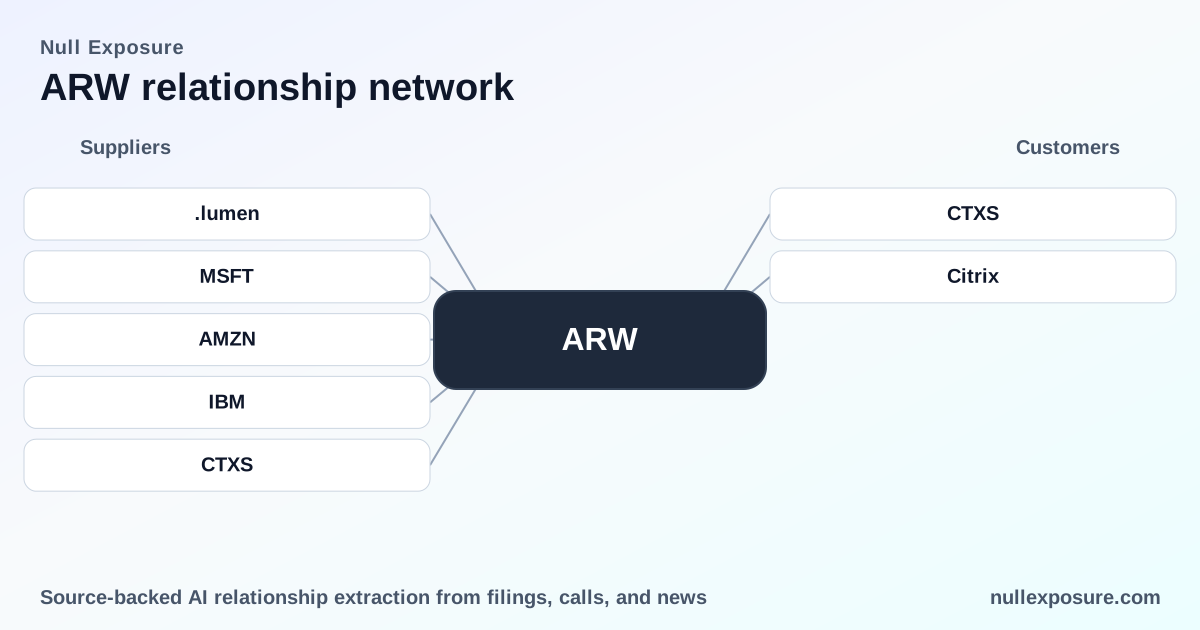
Arrow Electronics (ARW): supplier relationships that power an enterprise distribution engine
Thesis: Arrow Electronics operates as a global technology distributor and enterprise computing solutions provider, monetizing through hardware resale, value-added engineering, inventory management, and software/cloud distribution services to channel partners and OEMs; the company captures margin by combining scale purchasing, specialized engineering services, and platformized go-to-market offerings like ArrowSphere. For investors and operators, assessing Arrow’s supplier relationships is a study in breadth over concentration — the business extracts operating leverage from many vendor tie‑ins while accepting short-term, cancellable distribution contracts that keep supplier dependency manageable but commercially flexible. Learn more at https://nullexposure.com/.
Operational posture and business-model constraints
- Arrow buys inventory from many suppliers under non-exclusive distribution agreements that are typically cancellable on 30–90 days’ notice, which forces Arrow to manage working capital and inventory risk tightly while preserving go-to-market flexibility.
- No single supplier accounted for more than 8% of consolidated sales in 2025, an explicit signal of supplier diversification at the company level; this reduces single-vendor concentration risk but keeps Arrow exposed to broad industry supply cycles.
- Arrow’s role is predominantly buyer/distributor, exposing it to currency and procurement dynamics across Europe, APAC, Canada, and Latin America; this is a structural operational characteristic rather than a vendor-specific condition.
These constraints define Arrow’s supplier-readiness: short contract terms, notable but non-critical materiality of individual vendors, and buyer-centered negotiating leverage. That combination supports fast product turnover and partner expansion but requires disciplined inventory and FX management.
A catalog of recent supplier and partner relationships (what to watch) The following entries summarize every relationship noted in the source set; each is presented in plain English with a source citation.
Akamai Technologies (AKAM) — enterprise cloud and edge security
- Arrow announced a channel partnership to resell Akamai’s cloud, security and application delivery solutions through Arrow’s enterprise computing ecosystem, positioning Arrow as a distribution channel for edge and security services. According to GlobeNewswire (Apr 7, 2026): https://www.globenewswire.com/news-release/2026/04/07/3268929/0/en/Akamai-Teams-with-Arrow-Electronics-to-Power-and-Protect-Digital-Experiences-at-Scale.html.
- Investment takeaway: this strengthens Arrow’s cloud/security portfolio and supports cross-sell into existing channel partners.
Mobix Labs Inc. (MOBX) — EMI filtering components for defense and aerospace
- Arrow signed a global distribution agreement to initially focus on Mobix’s EMI filtering products, leveraging Arrow’s access to defense and aerospace channels. Reported in a FinancialContent/BizWire item covering Mobix Labs’ Q2 2024 results (published via markets.financialcontent.com): https://markets.financialcontent.com/wss/article/bizwire-2024-5-14-mobix-labs-inc-announces-second-quarter-2024-financial-results.
- Key point: Arrow is selectively adding niche component suppliers to deepen vertical exposure in defense/aerospace.
Dataminr — real-time AI-powered intelligence across EMEA
- Arrow will distribute Dataminr’s real-time intelligence solutions in EMEA, enabling channel partners to offer alerting and risk‑intelligence services across physical, digital, and cyber domains. Technology Reseller coverage (May 2026): https://technologyreseller.uk/arrow-electronics-to-distribute-dataminrs-real-time-intelligence-solutions-across-emea/.
- Strategic implication: this is an example of Arrow expanding beyond physical components into recurring‑revenue intelligence services.
Microsoft (MSFT) — distributor partner recognition for ArrowSphere AI
- Arrow was recognized as Microsoft’s 2025 Distributor Partner of the Year for its ArrowSphere AI offerings, highlighting Arrow’s role in distributing Microsoft AI software and cloud solutions. Cited in an earnings-call transcript summary (Q4 2025): https://www.insidermonkey.com/blog/arrow-electronics-inc-nysearw-q4-2025-earnings-call-transcript-1690325/.
- Why it matters: validates ArrowSphere as a platform for software and AI monetization.
Microchip Technology (MCHP / MCHPP) — reference-design collaboration and distributor concentration
- Arrow built a Single Pair Ethernet reference design using Microchip’s LAN8670 PHY and collaborating suppliers (Amphenol, Bourns), and Microchip’s FY2025 filings identify Arrow as the company’s largest distributor (10–12% of net sales). See Embedded and Microchip 10‑K filings (FY2025): https://www.embedded.com/arrow-electronics-releases-single-pair-ethernet-reference-design/ and Microchip 10‑K (mchp-2025-03-31).
- Investor note: Arrow is a material distribution partner for Microchip and also acts as a systems integrator for joint reference designs.
Amphenol (APH) — connector supplier on Arrow reference design
- Amphenol’s SPE connector is part of Arrow’s 10BASE‑T1S reference design, reflecting component-level collaboration on evaluation platforms. Reported by Embedded in May 2026: https://www.embedded.com/arrow-electronics-releases-single-pair-ethernet-reference-design/.
- Commercial effect: ties to tier‑one connector suppliers enhance Arrow’s engineering-led distribution value.
Bourns — magnetics used in Arrow reference designs
- The reference board incorporates Bourns’ SM91081AL isolation transformer/CMC, underscoring supplier integration at the physical layer. Embedded coverage (May 2026): https://www.embedded.com/arrow-electronics-releases-single-pair-ethernet-reference-design/.
- Takeaway: Arrow’s platform work creates downstream demand for component suppliers like Bourns.
.lumen / Lumen (assistive AI glasses scaling)
- Arrow announced collaboration with Romanian startup .lumen to scale production and improve performance of AI-powered intelligent guide glasses, providing manufacturing and engineering support. Covered by SimplyWallSt and FinViz commentary (Mar 2026): https://simplywall.st/stocks/us/tech/nyse-arw/arrow-electronics/news/is-arrow-electronics-arw-quietly-building-a-moat-in-assistiv and https://finviz.com/news/280038/arrow-electronics-inc-arw-partners-with-lumen.
- Strategic note: shows Arrow’s interest in startup scaling and assistive-technology verticals.
Quuppa — distribution agreement for location intelligence
- Arrow signed a distribution agreement with Quuppa, expanding Arrow’s indoor positioning and location-intelligence capabilities. Reported by New Electronics (May 2026): https://www.newelectronics.co.uk/content/news/arrow-electronics-consolidates-components-business-with-new-omnichannel-platform.
- Practical effect: adds another sensor/data component to Arrow’s IoT portfolio.
Citrix (CTXS) — service-provider agreement expansion
- An expanded Citrix partnership assigned Arrow responsibility for Citrix Service Provider agreements in North America and Europe, enlarging Arrow’s managed‑service delivery footprint. Marketscreener and SimplyWallSt discussed this expansion (Feb–Mar 2026): https://www.marketscreener.com/news/truist-raises-price-target-on-arrow-electronics-to-148-from-120-keeps-hold-rating-ce7e5ad9dd80f727 and https://simplywall.st/stocks/us/tech/nyse-arw/arrow-electronics/news/a-look-at-arrow-electronics-arw-valuation-after-strong-q4-ai.
- Commercial implication: deepens Arrow’s control over software/service distribution in key regions.
IBM and AWS (AMZN) — broad AI offer distribution
- Arrow’s management confirmed they distribute AI offers from IBM, AWS and Microsoft, indicating broad multi-vendor cloud and AI resale across major hyperscalers. Reported in CRN coverage of Arrow’s channel strategy (Mar 2026): https://www.crn.com/news/channel-news/2026/arrow-electronics-president-shortages-are-real-but-business-growth-outweighs-issues.
- Market effect: Arrow positions itself as a neutral channel aggregator for multiple AI stacks.
SLAB (Silicon Labs) — concentrated distributor role in FY2025
- Silicon Labs’ FY2026 10‑K noted that Arrow and another distributor together represented 28% and 21% of revenues in fiscal 2025, respectively, signaling high distributor-level concentration for specific suppliers. See Silicon Labs 10‑K (slab-2026-01-03): https://simplywall.st/stocks/us/tech/nyse-arw/arrow-electronics/news/is-arrow-electronics-arw-quietly-building-a-moat-in-assistiv (source link to 10‑K excerpt).
- Risk implication: certain suppliers are highly dependent on distributor partners like Arrow.
Analog Devices (ADI), Infineon (IFX), Littelfuse (LFUS), STMicroelectronics (STM), Quectel — component supplier access for mobility projects
- Arrow’s collaboration with SAVART and others gave startups access to components from these global suppliers, demonstrating Arrow’s role in sourcing for mobility and IoT programs. EET Asia coverage (May 2026): https://www.eetasia.com/arrow-electronics-driving-the-future-of-mobility/.
- Investor lens: broad supplier access supports Arrow’s ability to serve fast-scaling OEMs.
Implications for investors and operators
- Strength: scale and platform diversification. Arrow converts supplier breadth into multiple monetization vectors — hardware margin, engineering services, and recurring cloud/software distribution.
- Risk: short-term contracts and inventory exposure. The prevalence of cancellable, non-exclusive distribution agreements requires tight working-capital discipline and makes revenue visibility vendor-sensitive.
- Execution watchlist: supply‑chain KPIs (days inventory), ArrowSphere ARR and take rates, and margin capture on software/cloud deals.
For a deeper, structured view of supplier exposures and to track changes across these vendor relationships, visit https://nullexposure.com/ — the platform provides curated signals and relationship intelligence for investors and operators.
Conclusion Arrow’s supplier playbook balances wide vendor access with engineering-enabled distribution, producing recurring uplifts from cloud and software channels while operating under short-term supplier contracts that impose working-capital discipline. For investors, the core thesis is straightforward: Arrow monetizes scale and integration, and its risk profile is defined by inventory dynamics and the pace at which software/cloud distribution replaces low-margin hardware resale.