Arrowhead Pharmaceuticals (ARWR) — supplier relationships and operating implications for investors
Arrowhead Pharmaceuticals develops and commercializes RNA interference therapeutics, monetizing through product sales (notably REDEMPLO), collaborative licenses, and milestone/royalty streams while outsourcing much of its manufacturing and trial execution. The company runs a distributed operating model: discovery and clinical development in-house, with external partners delivering manufacturing, clinical operations, and investor/media communications. Investors should treat supplier relationships as operational levers that shape execution risk, regulatory timing, and market signaling.
For a deeper view of supplier exposure across biopharma portfolios, visit the NullExposure homepage: https://nullexposure.com/
Quick read: what this supplier list means for ARWR investors
Arrowhead’s disclosed supplier footprint in this sample is narrow and functional: the listed firms are communications and investor-relations service providers, while company disclosures concurrently confirm a reliance on third-party manufacturers and contract research organizations for clinical and commercial deliverables. That combination — public-facing communications partners plus single-source manufacturing and CRO reliance — creates two distinct risk vectors: reputational/timing risk managed by communications vendors, and operational supply risk driven by manufacturing and CRO relationships.
A mid-point action: if you track supplier concentration or counterparty risk for biotechs, review Arrowhead’s supplier signals on NullExposure: https://nullexposure.com/
The public-facing relationships (what’s on the record)
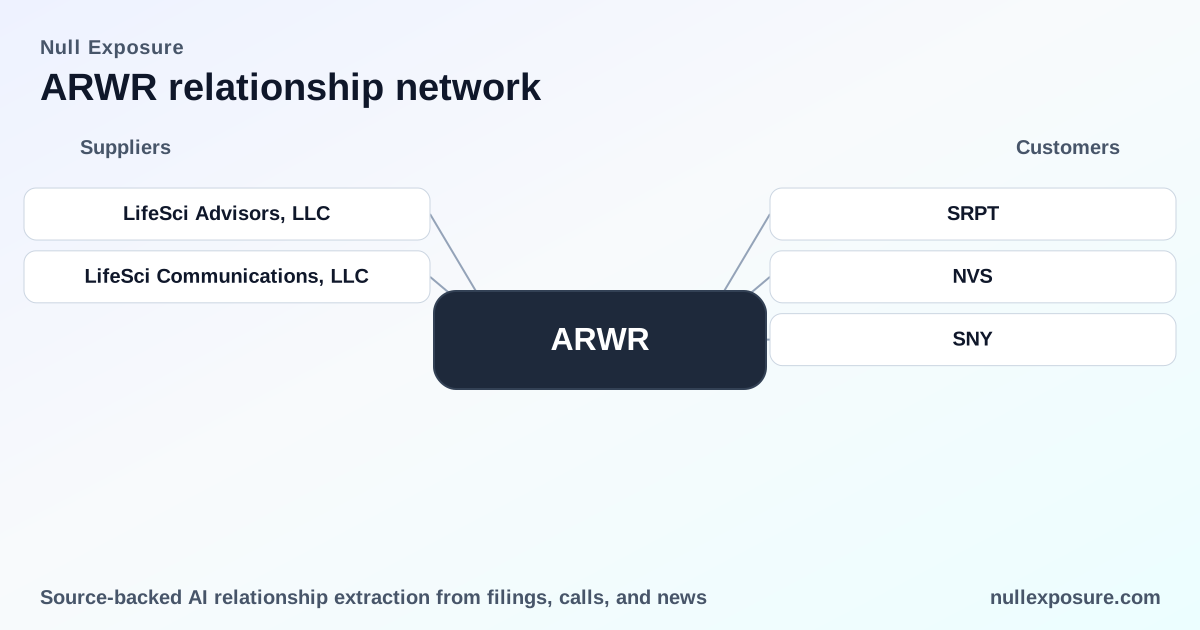
- LifeSci Advisors, LLC — Arrowhead lists LifeSci Advisors as its investor contact in the March 9, 2026 news release announcing the ARO-Dimer PA Phase 1–2a study, with a named representative and contact details. This positions LifeSci Advisors as Arrowhead’s retained investor-relations advisor for that announcement and likely for investor outreach tied to the program launch (StockTitan news, March 9, 2026).
- LifeSci Communications, LLC — The same March 9, 2026 release identifies LifeSci Communications as the media contact, complete with a named Ph.D. spokesperson and contact information, indicating an engaged media-relations contract for program-level disclosures (StockTitan news, March 9, 2026).
These two relationships are communications and investor-relations engagements, not manufacturing or clinical vendors; they shape messaging cadence and market perceptions but do not manage clinical supply chains.
What the company-level constraints reveal about sourcing and operational posture
Company disclosures included in the supplier profile provide explicit sourcing and operational cues:
- Third-party manufacturing dependence: The firm states, “we rely, and expect to continue to rely, on third-party manufacturers for the production of REDEMPLO and our drug product candidates for clinical trials and commercialization.” That language signals a long-standing outsourced manufacturing posture where Arrowhead retains development/control while outsourcing production execution. This is a common biotech model but it creates supply concentration and qualification risk that investors must price into timelines and cost forecasts.
- Single-source concentration for key components: Disclosures note drug substance and product for REDEMPLO are each currently sourced from a single, third-party manufacturer, and certain pulmonary delivery devices are single-sourced. Single-supplier ties for commercial product and delivery devices are a material operational exposure: a supplier disruption would directly affect time-to-revenue and regulatory commitments.
- Reliance on CROs and investigators: Arrowhead relies on independent clinical investigators and contract research organizations to run trials. That indicates operational dependence on external execution partners whose performance and regulatory compliance determine trial timelines and data integrity.
- Geographic diversification of trials with APAC exposure: The company enrolls many study subjects outside the United States, often in Australia and New Zealand, and has Phase 3 cohorts outside the U.S. This global enrollment strategy reduces enrollment time for certain indications but increases regulatory, logistics, and geopolitical variables across supply and sample handling.
Collectively, these signals describe an outsourcing-first operating model with concentrated manufacturing counterparty risk and geographically distributed clinical execution. Investors should interpret communications vendors as important for narrative control, but factory and CRO relationships as the drivers of operational delivery.
How those constraints translate into investor-level risks and negotiating posture
- Concentration and criticality: Single-source manufacturing of commercial and device components is a material vulnerability. Investors should assume Arrowhead negotiates long-term supply agreements with qualification clauses and regulatory-change protections, but those contracts still carry replacement risk and lead-time penalties.
- Contracting posture: The evidence supports an arm’s-length, third-party contracting posture rather than integrated captive manufacturing. Arrowhead’s leverage comes from being a commercial counterparty with future revenue potential, but contractual remedies will be central to execution — expect typical biotech supplier agreements with supply covenants, contingency inventories, and regulatory compliance warranties.
- Maturity and resilience: Reliance on established CROs and communications specialists indicates Arrowhead runs a mature externalized model rather than ad hoc vendors. That maturity mitigates some execution risk but does not eliminate the single-source manufacturing concentration highlighted above.
- Geographic operational implications: APAC trial concentration accelerates enrollment but requires robust logistics, regulatory coordination, and local vendor management. Cross-border sourcing and sample flow create extra points of failure and timeline variance.
Relationship-by-relationship detail (concise investor notes)
LifeSci Advisors, LLC — Named investor-relations contact in the ARO-Dimer PA Phase 1–2a study announcement, indicating a retained advisory engagement to manage investor outreach and disclosure for the program launch (StockTitan news, March 9, 2026).
LifeSci Communications, LLC — Listed media contact for the same program announcement, providing PR support and media coordination with a named scientific spokesperson, which underscores a professionalized approach to external messaging (StockTitan news, March 9, 2026).
What investors should monitor next
- Supplier concentration remediation: Watch for filings or press releases that disclose qualifying second-source manufacturers or contingency inventory levels for REDEMPLO and key devices. Those developments materially reduce operational tail risk.
- CRO performance metrics and enrollment updates: Trial enrollment cadence, site activation rates in APAC, and data-readout timelines tell you whether external execution is meeting expectations.
- Disclosure cadence and narrative control: Changes in communications providers or shifts in investor-relations strategy will reflect management’s assessment of market sensitivity around upcoming milestones.
If you evaluate supplier risk across a portfolio or need a supplier-centric risk score for ARWR, start with supplier concentration and trial geography as the highest-impact inputs. For more supplier intelligence and monitoring tools, visit NullExposure: https://nullexposure.com/
Bottom line for investors
Arrowhead operates an outsourced execution model where external manufacturers and CROs determine deliverable timing while communications vendors manage market narrative. The listed suppliers are communications specialists — important for investor perception — but the material operational risk resides in single-source manufacturing and globally distributed trial execution. Investors should prioritize monitoring supplier diversification efforts, contract disclosures, and APAC trial performance when assessing ARWR’s near-term execution risk. For continued supplier tracking and curated counterparty analysis, see https://nullexposure.com/