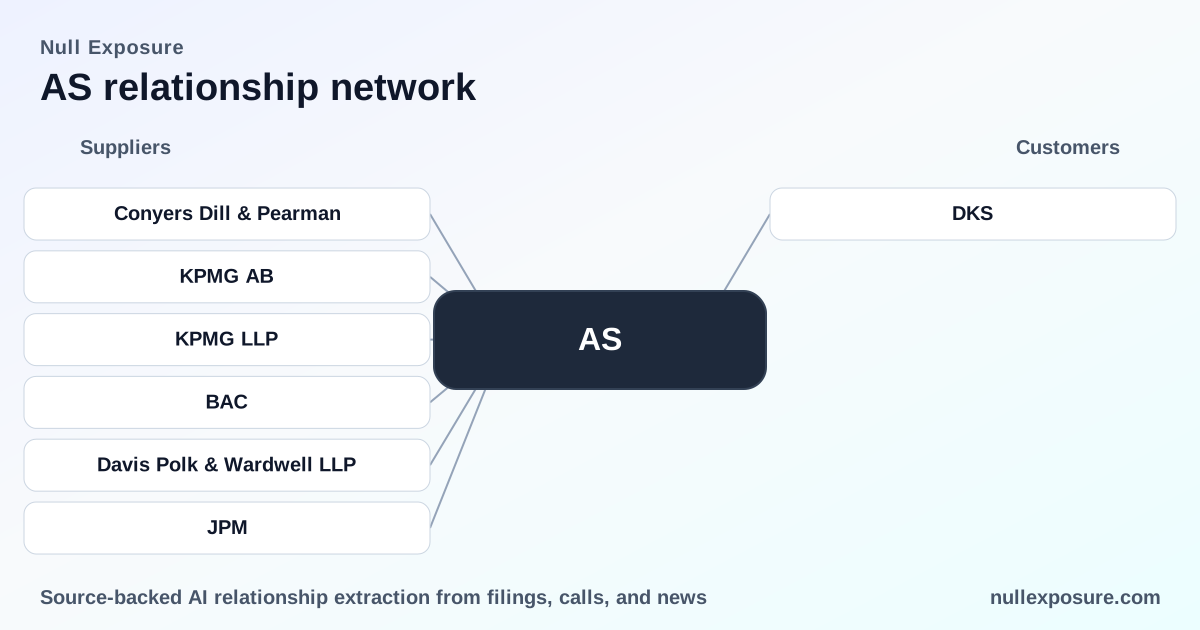
What Amer Sports’ supplier map tells investors about capital markets, control and legal perimeter
Amer Sports (AS) runs a capital-intensive consumer goods business that monetizes primarily through branded product sales and periodic access to capital markets. In FY2026 filings tied to a public offering and debt facilities, the company publicly documents a compact set of professional service suppliers that together drive its financing, audit assurance, and legal risk posture. Those supplier ties—top-tier banks, Big Four auditors and elite law firms—are not decorative: they reveal how Amer Sports structures contracting, manages regulatory exposure and underwrites credibility with investors. For direct access to deeper relationship analytics, visit https://nullexposure.com/.
The high-level take: professional suppliers equal market-grade governance
Amer Sports’ supplier roster in the March 2026 filings is concentrated among global banks, large accounting firms and specialist counsel. That combination signals a company comfortable using established capital markets intermediaries rather than boutique or captive providers. Concentration among a few global partners improves execution speed and reputational signalling, but also creates counterparty concentration risk important for investors and procurement officers to monitor.
If you want a deeper supplier risk briefing, start here: https://nullexposure.com/.
Who the company uses and why it matters
Below I list each supplier relationship referenced in the FY2026 filing set and provide a short, plain-English take with the original source context.
- Conyers Dill & Pearman — The firm is listed as Amer Sports’ Cayman Islands counsel and provided a legal opinion on matters including the recognition and enforceability of U.S. securities judgments in the Cayman Islands; the opinion is cited in the company’s March 2026 prospectus supplement. According to the filing, the Cayman counsel advised on the validity of ordinary shares under Cayman law (prospectus supplement, March 2026 via StockTitan).
- KPMG AB — KPMG AB’s audit report is relied upon for consolidated financial statements as of December 31, 2024, and the two-year period ended December 31, 2024; the company incorporated that report by reference into the March 2026 registration materials (prospectus supplement, FY2026 via StockTitan).
- KPMG LLP — KPMG LLP provided an audit and an assessment of internal control over financial reporting for the year ended December 31, 2025; the company incorporated those reports by reference in the March 2026 registration statement (prospectus supplement, FY2026 via StockTitan).
- BofA Securities, Inc. — BofA is named as a bookrunner, co-lead arranger and lender on Amer Sports’ term loans and revolving credit facilities and, with J.P. Morgan, is acting as a lead book-running manager for the proposed equity offering announced in March 2026 (prospectus and market release, March 2–9, 2026 via StockTitan and FinancialContent/BizWire).
- J.P. Morgan Securities LLC / J.P. Morgan — J.P. Morgan is identified as administrative agent, swingline lender, co-lead arranger and lender for the company’s credit facilities and is a joint lead manager on the March 2026 offering alongside BofA (prospectus, 6-K and market press release, March 2026 via StockTitan and FinancialContent).
- Davis Polk & Wardwell LLP — Davis Polk is cited for passing on certain matters of U.S. federal and New York law for Amer Sports in the offering documentation (prospectus supplement, March 2026 via StockTitan).
What these supplier links reveal about the operating model
Treat the roster above as a reality check on how Amer Sports contracts, funds itself and allocates legal and accounting functions.
- Contracting posture: Amer Sports engages marquee global providers rather than niche specialists, signaling a preference for standardized, highly enforceable contracts and rapid execution in cross-border securities work.
- Concentration: The financing and underwriting roles are concentrated with two global banks — BofA and J.P. Morgan — which centralizes execution risk but increases single-point exposure if market or counterparty stress arises.
- Criticality: Auditors and the lead banks are mission-critical to both day-to-day reporting credibility and episodic capital-raising; a disruption in those relationships would constrain both market access and investor confidence.
- Maturity and governance: Dual reliance on KPMG AB and KPMG LLP for adjacent periods of financial reporting and control assessment indicates mature reporting governance and layered assurance, consistent with firms that have complex cross-jurisdictional structures.
These are company-level operating signals, not attributions to any single supplier.
Investment and operational implications for evaluators
- Liquidity and access to capital are explicit strengths. The use of global bookrunners and active credit facilities shows Amer Sports runs with established market access, which supports refinancing and growth initiatives in a tight market. (Prospectus and market release, March 2026.)
- Legal perimeter is activity-focused and cross-jurisdictional. Cayman counsel and New York/U.S. counsel for securities matters show legal complexity tied to domicile and listings; legal opinions on enforceability are material when evaluating cross-border litigation risk (prospectus, March 2026).
- Concentration of service providers reduces transaction friction but increases counterparty dependency. Operators should quantify replacement lead times and contingency plans for underwriting and audit services as part of vendor risk management.
- Audit footprint signals control discipline. KPMG’s involvement across consecutive reporting periods denotes continuity in external assurance, which institutional investors prize for reporting comparability.
For targeted supplier dashboards and risk-scored relationship profiles, visit https://nullexposure.com/.
Final read: what to watch next
Amer Sports’ FY2026 filings frame a company that runs a high-trust, high-dependency supplier model centered on large banks, elite law firms and Big Four auditors. For investors, the key monitorables are continuity of the bank syndicate, audit opinion consistency and any shifts in legal counsel related to domicile or securities enforcement. For operators, the priority is building contractual fallback plans and documenting operational reliance on these suppliers.
If you want a concise brief tailored to your investment committee or procurement team, start with a supplier risk packet at https://nullexposure.com/.