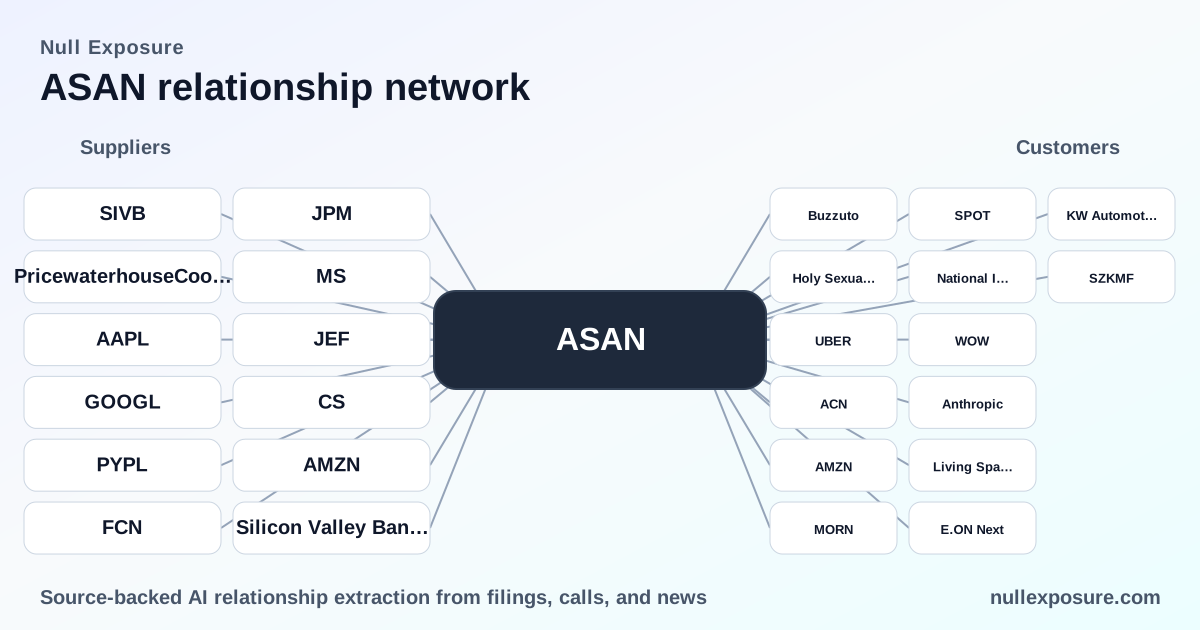
Asana’s supplier map: infrastructure, advisors, banks and distribution partners that power the business
Asana operates a cloud‑native collaboration platform sold on a subscription model to enterprises and teams, monetizing primarily through recurring seat-based SaaS subscriptions and ancillary payment processing and marketplace distribution. The company outsources critical infrastructure, financial advisory, and distribution functions to a small set of incumbent providers, creating high operational leverage but concentrated counterparty exposure that investors should price into valuation and operational risk models. For a quick look at the whole picture, visit https://nullexposure.com/.
The supplier roster in plain English
Below are every named relationship surfaced in public reports and filings, each summarized concisely with the primary source noted.
- J.P. Morgan — Served as a financial advisor around Asana’s direct listing process; investment bank participation was disclosed in coverage of the company’s IPO timeline. According to Renaissance Capital reporting on the FY2020 direct listing, J.P. Morgan was one of the advisors named.
- Morgan Stanley — Acted alongside other major banks as a financial advisor for Asana’s direct listing; this role was reported during the FY2020 listing planning. Renaissance Capital cited Morgan Stanley as an advisor in the FY2020 coverage.
- Jefferies — Participated as a financial advisor during Asana’s direct listing process reported in FY2020; noted in market press alongside other advisory banks. (Renaissance Capital, FY2020.)
- Credit Suisse — Identified as a financial advisor in media on Asana’s direct listing, reflecting the advisory syndicate assembled for the FY2020 liquidity event. (Renaissance Capital, FY2020.)
- Amazon Web Services — Asana uses AWS to host its platform and internal tools and has a 60‑month hosting contract requiring $255 million of spend with $216.359 million remaining as of October 31, 2025; AWS is described as Asana’s preferred cloud provider. This is disclosed in Asana’s 10‑Q covering FY2025.
- Amazon Web Services (AWS) — The duplicate listing reiterates the same long‑term hosting commitment and role as infrastructure provider; the company explicitly describes its platform as built on AWS in its FY2025 10‑Q.
- Silicon Valley Bank, a Division of First‑Citizens Bank & Trust Company — Named in an FY2026 8‑K as issuing lender, administrative agent, and collateral agent for a credit facility; the document references the bank’s role in the company’s lending arrangements (8‑K, FY2026).
- SVB — Disclosed as the administrative agent and primary counterparty under a November 2022 senior secured credit facility providing up to $150.0 million in aggregate facilities (term and revolver), with subsequent amendments noted through FY2025 in the 10‑Q. (Asana 10‑Q, FY2025.)
- PricewaterhouseCoopers LLP — Ratified as Asana’s independent auditor for the fiscal year ending January 31, 2026 with 99.2% shareholder support, reflecting governance and audit continuity. (Proxy/meeting materials reported on page filings, FY2026.)
- Apple App Store — Identified as a distribution channel for Asana’s mobile application, with the company relying on open marketplaces to make the app available to end users (Asana 10‑Q, FY2025).
- Google Play — Similarly listed as a marketplace relied upon for distribution of Asana’s mobile application to Android users, per the FY2025 10‑Q filing.
- PayPal — Cited as one of Asana’s third‑party payment processors used to bill customers for paid subscription plans, indicating reliance on external payment rails (Asana 10‑Q, FY2025).
- Silicon Valley Bank — The 10‑Q separately references the November 2022 credit agreement where SVB acted as issuing lender and administrative agent for the senior secured credit facility (Asana 10‑Q, FY2025).
- First Citizens BancShares, Inc. — First Citizens announced the purchase of certain SVB assets and liabilities on March 27, 2023, which the company disclosed as inclusive of Asana’s November 2022 senior secured credit facility; the transition is recorded in FY2025 filings. (Asana 10‑Q, FY2025.)
What the supplier picture implies about Asana’s operating model
Asana’s supplier footprint is concentrated and structured around a few critical externalities:
- Contracting posture: The company maintains explicit long‑term contracts with core infrastructure providers—most notably AWS, under a 60‑month hosting agreement—indicating predictable fixed commitments for hosting cost but limited near‑term flexibility on that spend. This contractual maturity provides operational stability but raises fixed‑cost exposure if cloud needs change.
- Concentration and criticality: Hosting and platform operation are highly concentrated with a single preferred cloud provider, giving AWS strategic importance to uptime and security. Similarly, reliance on major banks for advisory and credit facilities centralizes financial counterparty risk.
- Maturity and governance: Relationships with established auditors (PwC) and top‑tier banks for advisory work indicate enterprise‑grade governance and maturity in external partnerships; these are signals of readiness for large corporate customers and public markets scrutiny.
- Counterparty transition risk: The SVB / First Citizens transition underscores how external banking events can produce operational noise and necessitate covenant and administrative changes in lending arrangements; the company documented both the original SVB facility (Nov 2022) and the later First Citizens acquisition in filings through FY2025–FY2026.
For an in‑depth supplier risk assessment and tailored exposure analysis, see https://nullexposure.com/ — research and product teams will find the supplier mapping and contractual detail useful for underwriting scenarios.
Investor implications and risk checklist
- Revenue resilience supported by subscription economics, but cost and operational risk concentrated on AWS hosting commitments and third‑party marketplaces for distribution. Investors should model hosting spend as a fixed contractual outlay through late 2029 per the disclosed commitments.
- Liquidity and covenant risk are small but present given reliance on secured credit facilities — historical SVB involvement and the subsequent First Citizens transaction illustrate potential for counterparty operating events to require renegotiation or administrative updates.
- Regulatory and distribution dependencies (Apple App Store / Google Play) mean policy or marketplace fee changes can influence mobile acquisition economics for Asana’s freemium channels.
- Governance continuity is solid with PwC ratified as auditor and leading banks engaged for advisory and credit roles; these relationships support credibility with enterprise customers and public market investors.
If you want a supplier‑level heat map or scenario analysis (e.g., AWS outage, bank covenant stress), Null Exposure provides tailored infrastructure and counterparty reports at scale — learn more at https://nullexposure.com/.
Bottom line and recommended actions for investors
Asana’s operational model is classic SaaS: recurring revenue with outsized operational dependence on a small set of external providers. That structure produces clean revenue visibility but concentrated counterparty exposures—principally AWS hosting and bank credit arrangements—that investors must underwrite explicitly in valuation and scenario work.
Actionable next steps:
- Stress hosting costs and availability in downside scenarios given the 60‑month AWS commitment.
- Review covenant language and agent arrangements in lending documents and track any administrative transitions tied to bank consolidations.
- Monitor marketplace distribution economics (Apple/Google) and payment processor terms (PayPal) for margin pressure on smaller customer segments.
For a supplier exposure report customized to your portfolio or diligence needs, visit https://nullexposure.com/ and request a briefing.