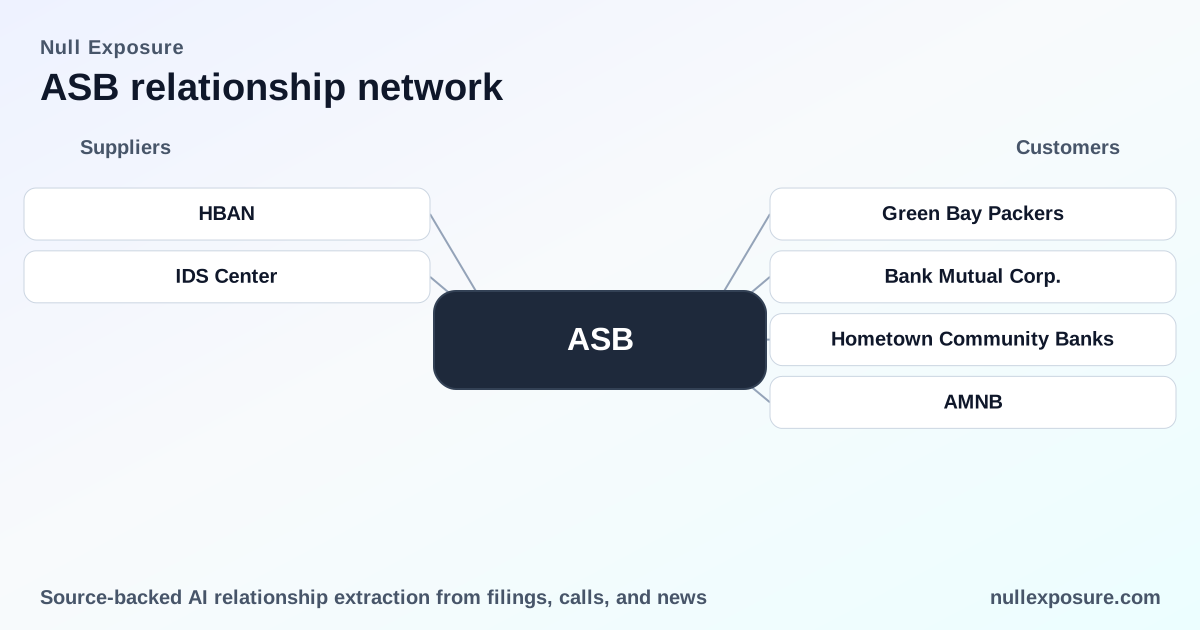
ASB Supplier Profile: Where Associated Banc‑Corp (ASB) Sits in the Commercial Ecosystem
Associated Banc‑Corp operates as a regional commercial bank that monetizes through net interest margin, fee income from retail and commercial banking services, and capital markets activity while managing a blended funding profile of short‑ and long‑term liabilities. For counterparties and investors evaluating ASB as a supplier or contracting partner, the bank’s operating model is characterized by sizable funding lines, active branch and real‑estate transactions, and material reliance on third‑party infrastructure services. Explore detailed relationship notes below and view the full supplier intelligence hub at https://nullexposure.com/ for deeper due diligence.
How ASB structures supplier and financing relationships — the quick read
ASB funds operations through a combination of short‑term advances and long‑term debt, leverages branch and lease transactions to reconfigure retail footprints, and outsources critical information systems and processing services to third parties. That profile produces high counterparty criticality for key vendors and meaningful funding concentration in secured advances and wholesale funding. For transaction counterparties and vendors, contracting will often involve multi‑year terms and operational SLAs aligned to banking regulations and collateral requirements. Learn more about supplier mapping and risk scoring at https://nullexposure.com/.
Mapped relationships you should know
Below are the supplier/partner relationships surfaced in our results, summarized concisely with source references.
Huntington National Bank — branch acquisition effects
Associated Banc‑Corp completed an acquisition involving Huntington’s Wisconsin branch network that triggered branch consolidations; a January 2019 Journal Sentinel report noted that 17 overlapping locations were likely to be closed as the banks integrated footprints, altering local commercial real‑estate and deposit servicing arrangements. Source: Journal Sentinel (jsonline.com), January 2019 — https://www.jsonline.com/story/money/business/2019/01/09/associated-plans-close-17-branches-after-huntington-deal/2524206002/
IDS Center — large lease commitment in Minneapolis
Associated Bank announced a strategic lease of the entire 43rd floor of the IDS Center to support headcount growth, more than doubling its current Minneapolis footprint and signaling a concentrated real‑estate commitment in a single downtown asset. Source: PR Newswire press release (reported March 2026 / FY2025 context) — https://www.prnewswire.com/news-releases/associated-bank-makes-significant-investment-in-downtown-minneapolis-with-move-to-iconic-ids-center-to-accommodate-rapid-growth-302480472.html
What the relationship mix tells investors and counterparties
The two relationships above reflect ASB’s dual focus on branch consolidation and strategic office expansion: branch closures follow acquisition rationalization, while selective leasing supports corporate growth and market presence. These actions reshape vendor demand — from branch‑level facilities and IT integration work during acquisitions to concentrated office services and building‑management contracts for new leased floors.
- Contracting posture: ASB operates with both short‑term operational contracts (e.g., facility management, repurchase agreements) and long‑term contractual obligations (senior notes, long‑dated advances), signaling that suppliers must support both transactional and multi‑year engagements.
- Concentration and spend: Funding and capital activity are large in scale — short and long‑term funding totaled several billion dollars in recent periods — indicating counterparty exposure and procurement spend well into the $100m+ band, and thus procurement and credit terms will be material for large vendors.
- Criticality and outsourcing: ASB identifies dependency on third parties for core information systems, data management, and processing services, which elevates service provider criticality and requires robust continuity and compliance controls from vendors.
- Maturity and lifecycle stage: The firm’s mix of short‑term liquidity management and long‑term funding instruments suggests a mature funding ladder with active liability management rather than one‑off financing tactics.
These are company‑level signals drawn from public disclosures and reporting, not tied to a specific vendor unless explicitly stated in the source material.
Risk and opportunity for suppliers and investors
For investors assessing balance‑sheet risk and counterparties evaluating contracts with ASB, priorities are clear.
- Risk concentration: Large swings in short‑term FHLB advances and repo activity increase sensitivity to market liquidity and counterparty funding lines; investors should monitor the bank’s short‑term funding composition and rollover profile. Evidence: company funding disclosures showing billions in short‑ and long‑term funding increases and composition shifts.
- Operational dependency: Vendors providing data processing or core banking services assume high operational risk, and their contracts should include strong service‑level guarantees, audit rights, and well‑defined exit and transition provisions. ASB explicitly notes dependence on third parties for key infrastructure.
- Negotiation leverage: Given ASB’s scale and frequent multi‑year obligations, suppliers that can offer bundled services (technology + facilities + compliance support) win higher share‑of‑wallet; conversely, single‑service vendors should expect competitive procurement and tight performance metrics.
- Real‑estate dynamics: Branch consolidations and concentrated office leasing change local vendor ecosystems — facilities vendors in divested branch markets will face contract terminations, while building services in markets like Minneapolis gain a predictable demand stream.
If your team evaluates ASB for supplier onboarding or credit exposure, calibrate bids and credit terms to reflect large spend potential, high contract criticality, and liquidity‑sensitive counterparties. For procurement teams, structure multi‑year, indexed contracts that preserve margin while aligning to ASB’s liquidity cadence. Learn how these supplier signals translate to procurement strategy here: https://nullexposure.com/.
Practical recommendations for operators and investors
- Require granular funding‑profile reporting in counterparty monitoring to capture short‑term advance concentration and maturity ladders.
- Demand SOC‑type attestations, disaster recovery tests, and explicit transition rights from information‑technology service providers.
- Price contracts to reflect the bank’s dual short‑ and long‑term funding posture: shorter notice periods for high‑liquidity instruments; longer amortization schedules for strategic office and branch deals.
- Maintain a playbook for branch consolidation scenarios, including termination clauses and repricing triggers tied to branch‑closure events.
Next steps for due diligence and monitoring
ASB’s supplier footprint combines material funding scale, strategic real‑estate commitments, and outsourced core infrastructure — a profile that rewards disciplined contract design and active counterparty monitoring. For a consolidated view of supplier signals and ongoing surveillance of ASB’s counterparties, visit our platform and request an intelligence briefing at https://nullexposure.com/.
Key sources referenced:
- Journal Sentinel (jsonline.com), January 2019 coverage of Associated Banc‑Corp’s acquisition and branch closures — https://www.jsonline.com/story/money/business/2019/01/09/associated-plans-close-17-branches-after-huntington-deal/2524206002/
- PR Newswire press release on Associated Bank lease at IDS Center (reported March 2026, FY2025 context) — https://www.prnewswire.com/news-releases/associated-bank-makes-significant-investment-in-downtown-minneapolis-with-move-to-iconic-ids-center-to-accommodate-rapid-growth-302480472.html
Bold takeaway: ASB is a large, liquidity‑sensitive bank whose supplier relationships combine high spend, multi‑year commitments, and critical third‑party dependencies — structure contracts and monitoring accordingly.