ASB-P-E (Associated Banc‑Corp supplier view): strategic relationships an investor should price in
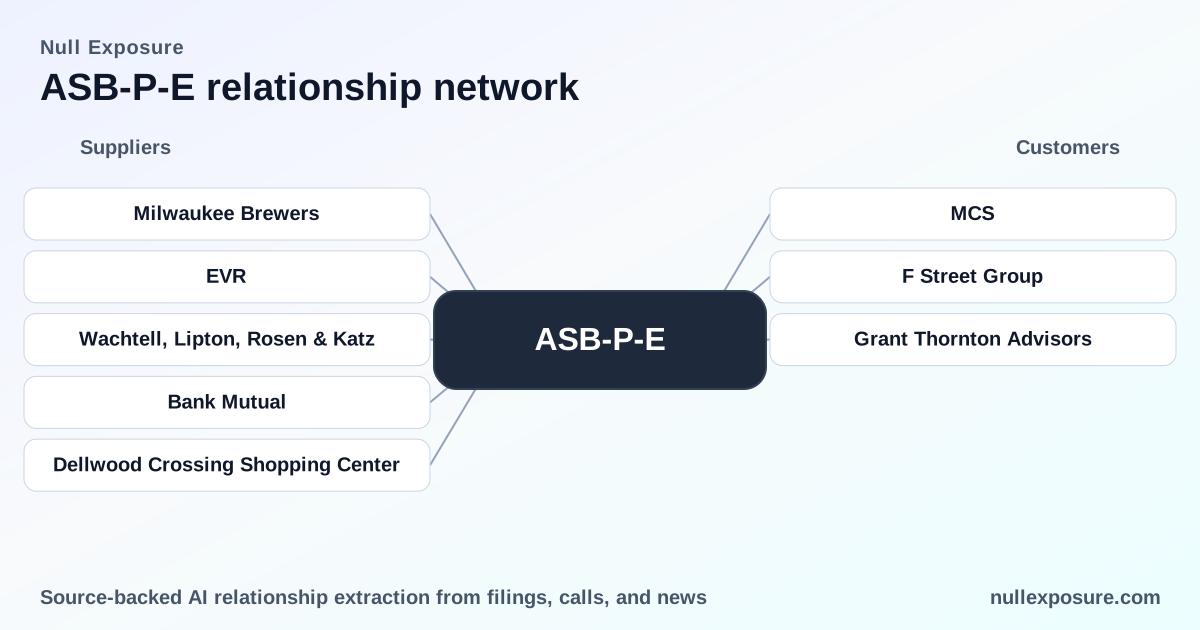
Associated Banc‑Corp (the ASB group behind the ASB‑P‑E listing) functions as a regionally focused financial institution that monetizes through deposit gathering, lending spreads, fee income, and strategic partnerships that expand customer acquisition and product distribution. The supplier relationships in this scope reveal a mix of marketing partnerships, real‑estate leasing, historical consolidation and external advisory engagements that directly influence growth channels, capital deployment and transaction execution. For investors evaluating exposure to ASB‑P‑E, the relevant question is how these external ties convert into durable deposit flows, cross‑sell economics and execution risk on acquisitions. Learn more at https://nullexposure.com/.
Why these supplier links matter for returns and risk
These relationships are not peripheral line items; they illuminate how Associated contracts out capabilities, extends geographic reach, and secures professional advisory during strategic moves. From a contracting posture perspective, ASB uses third‑party partners for customer marketing (sports partnership), real‑estate leasing for branch expansion, and boutique financial and legal firms when executing M&A. That mix signals a hybrid operating model: core banking retained in‑house while specialized functions are outsourced to reduce execution complexity.
Concentration and criticality are mixed. The Milwaukee Brewers partnership is material from a customer‑access standpoint but not a single counterparty concentration risk to the bank’s funding profile. Legal and financial advisors like Evercore and Wachtell are transaction‑specific and critical during deals, but not ongoing operational dependencies. The Dellwood Crossing lease is a tangible commitment that implies a medium‑term footprint in Missouri and is therefore more operationally critical than short‑term marketing arrangements.
There are no supplier constraints or exemption excerpts provided in this supplier scope, which itself is a company‑level signal: no flagged contractual restrictions surfaced in the sampled supplier disclosures. That reduces one class of downside surprise, though absence of constraints in this set does not preclude undisclosed exposures in other filings.
Relationship map — who ASB is doing business with and why it matters
Milwaukee Brewers — strategic retail checking partnership (FY2026)
Associated renewed a multi‑year partnership with the Milwaukee Brewers to expand the Brewers Checking value proposition and deliver benefits to 58,000+ cardholders, signaling a focused customer‑acquisition and engagement effort tied to a local brand. According to a March 15, 2026 press release reported by Urban Milwaukee, the deal emphasizes immediate cost savings and exclusive access for those cardholders (FY2026).
Evercore — financial advisor on acquisition (FY2025)
Evercore served as Associated’s financial advisor for a disclosed acquisition, indicating ASB engaged top‑tier investment banking talent to structure and price the transaction and accelerate its growth strategy. This advisory role was reported in a StockTitan summary of ASB’s FY2025 acquisition activity.
Wachtell, Lipton, Rosen & Katz — legal advisor on acquisition (FY2025)
Wachtell provided legal advisory services to Associated in the same FY2025 transaction, underscoring reliance on elite transactional counsel for regulatory, corporate governance and deal‑structure work during M&A. The legal advisory role was noted alongside Evercore in the same StockTitan coverage.
Bank Mutual — historical consolidation into Associated’s franchise (referenced FY2023)
Bank Mutual was acquired by Associated Banc‑Corp in 2018, a consolidation that is referenced in later local reporting about property transactions and market footprint; a January 2023 Journal Sentinel piece notes the 2018 sale and frames it as part of Associated’s regional consolidation history (FY2023).
Dellwood Crossing Shopping Center — branch lease and market entry (FY2025)
Associated opened its first St. Louis branch by leasing roughly 6,000 square feet at Dellwood Crossing Shopping Center, a concrete sign of geographic expansion into Missouri and a physical channel investment reported via PR Newswire (FY2025). The lease is an operational commitment that supports deposit growth and local lending origination.
What investors should infer from these ties
These relationships collectively portray a bank actively deploying both organic and inorganic growth levers: local marketing partnerships that drive retail inflows, physical branch expansion that anchors community banking, and high‑caliber advisors during acquisitions to execute scale strategies. The mix reduces single‑point vendor dependency but increases execution risk around integration of acquired assets and the ROI on branch real‑estate commitments.
Key implications:
- Customer acquisition channel: The Brewers deal is a low‑capex route to targeted deposit and card growth in a core geography; investors should expect measurable lift in retail deposit inflows tied to campaign performance metrics.
- M&A execution posture: Engagement of Evercore and Wachtell signals serious transactional intent and the willingness to pay for top advisory capability; this elevates the probability of further acquisitive growth but also concentrates near‑term deal execution risk.
- Geographic expansion: The St. Louis branch lease converts strategic intent into fixed costs and local market exposure that will affect branch economics if deposit traction lags expectations.
- Legacy consolidation: The Bank Mutual acquisition history is a reminder of regional consolidation and the accompanying integration tail risks already partly realized.
For a deeper cross‑sectional read and ongoing supplier monitoring, visit https://nullexposure.com/.
Investor action checklist — how to convert relationship signals into decisions
- Track quarter‑over‑quarter retail deposit growth and card account metrics to quantify impact from the Brewers partnership.
- Monitor deposit beta and local deposit pricing in Missouri to assess the payback on the Dellwood Crossing branch lease.
- Review upcoming SEC/press disclosures for integration timelines and transaction accounting tied to FY2025 acquisitions that used Evercore and Wachtell.
- Assess legal and regulatory exposures in deal documents and branch licensing filings; the use of elite counsel reduces legal execution risk but does not eliminate regulatory scrutiny.
- Reconcile historical consolidation impacts (e.g., Bank Mutual integration from 2018) with current efficiency and cost‑to‑income trajectories.
Final read: what to watch and next steps
ASB’s supplier footprint demonstrates a pragmatic approach: deploy marketing partnerships to drive retail flows, use physical branches for market entry, and retain blue‑chip advisors for M&A. That three‑pronged strategy supports steady scale but requires close monitoring of deposit conversion, integration execution and branch economics. For investors focused on supplier‑driven alpha and to keep pace with new relationship disclosures, review the live supplier mapping and signals at https://nullexposure.com/.
Bold takeaways: partnerships expand customer reach; advisors indicate active M&A; leases create tangible fixed‑cost exposure. These are the levers that will determine whether ASB‑P‑E delivers sustained value to investors.