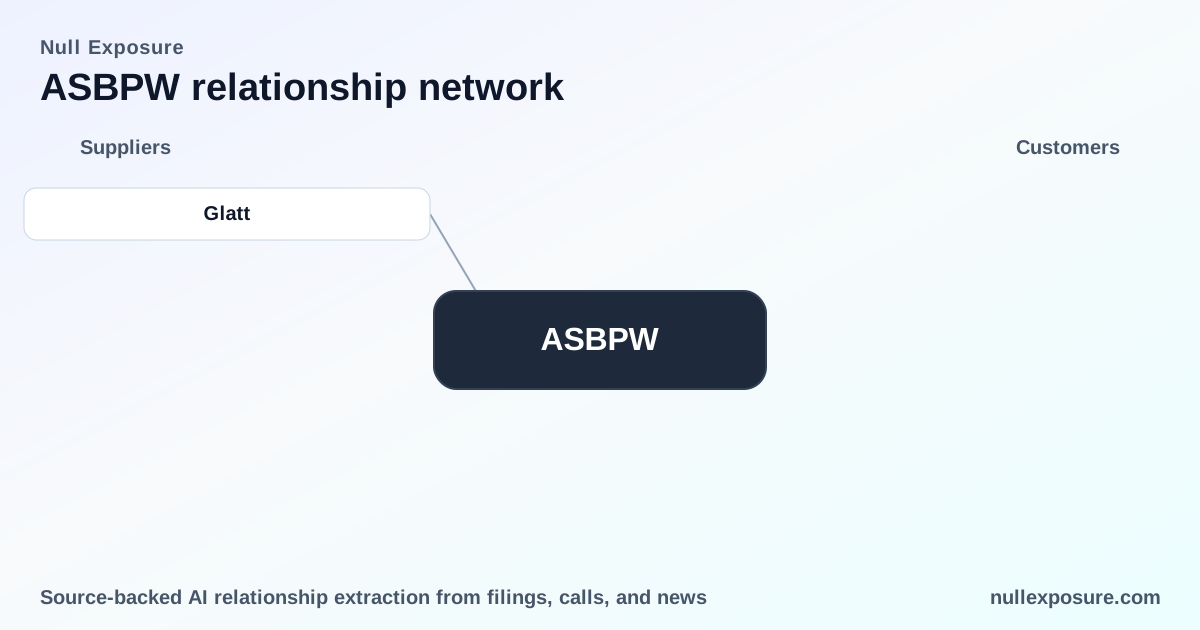
Aspire Biopharma (ASBPW) — supplier relationships and what they mean for investors
Aspire Biopharma is an early‑stage biopharmaceutical company focused on delivery mechanisms for low‑risk (“do no harm”) drugs, headquartered in Humacao, Puerto Rico. The company generates virtually all operational activity through development and limited commercial efforts, contracting third‑party manufacturers and service providers for production, clinical support and administrative services, while relying on short‑term financing and sponsor subscriptions to fund operations. Revenue is immaterial (roughly $1,941 TTM) and operating margins are deeply negative, so supplier contracts and financing posture drive near‑term viability rather than product cashflows. For a concise supplier risk overview, see https://nullexposure.com/.
What the supplier map actually contains today
Aspire’s public filings identify a small, sharply focused supplier footprint centered on contract manufacturing and a set of service relationships used for office and administrative needs. The only named external manufacturing partner in the company’s FY2024 filing is Glatt.
Glatt — cGMP batch manufacturing in New Jersey
Aspire disclosed that a cGMP batch of its patent‑pending aspirin product was manufactured by Glatt at Glatt’s New Jersey facility, confirming an active production relationship for clinical or regulated supply. This disclosure is documented in Aspire’s Form 10‑K for the year ended December 31, 2024. (Source: Aspire’s 2024 Form 10‑K.)
How the company’s documented constraints shape the operating model
Aspire’s filings reveal a set of company‑level signals that define how it contracts, funds operations, and depends on suppliers:
-
Short‑term financing posture: On September 27, 2024, Aspire issued three non‑convertible notes with a 20% original issue discount that are due the earlier of June 27, 2025 or the date of a qualified offering, reflecting reliance on near‑term debt sources rather than long‑dated supplier financing. (Source: Aspire’s 2024 Form 10‑K.)
-
Sponsor subscription funding: The company formalized subscription agreements on March 5, 2024 in which sponsors and affiliate investors contributed $1.0 million to support a related transaction and bridge obligations, indicating equity‑sponsor funding rather than contractually guaranteed customer receipts. (Source: Aspire’s 2024 Form 10‑K.)
-
U.S. manufacturing and regulatory exposure: Filings emphasize that third‑party manufacturers operate under federal, state and local U.S. laws governing hazardous materials and cGMP compliance, signaling regulatory dependency on domestic contract manufacturers for compliant supply. (Source: Aspire’s 2024 Form 10‑K.)
-
Dual role of external partners: The company treats third parties as both manufacturers for product supply and service providers for administrative, legal and clinical trial support; Aspire recorded recurring administrative fees of $10,000 per month to an affiliate for office and secretarial services, illustrating ongoing, modest scale service spend (roughly $120k per year historically). (Source: Aspire’s 2024 Form 10‑K.)
-
Active, early‑stage supplier relationships: Aspire states it currently contracts third parties for manufacture of product candidates for preclinical and clinical work and intends to continue doing so, designating supplier relationships as active but immature from a commercial scale perspective. (Source: Aspire’s 2024 Form 10‑K.)
-
Spend and scale: Administrative service fees and the documentation around sponsor subscriptions and short‑dated notes position typical supplier spend in the $100k–$1m annual band rather than multi‑million, fixed‑price supply contracts. (Source: Aspire’s 2024 Form 10‑K.)
Collectively, these signals imply a company strategy that outsources regulatory manufacturing to U.S. contract manufacturers, runs with short financing windows, and relies on sponsor‑driven capital rather than operating cashflow. For a deeper supplier risk profile, visit https://nullexposure.com/.
What that means for investors: concentration, criticality and maturity
-
Concentration risk is material. Only one named manufacturer (Glatt) is disclosed for cGMP production, so single‑source supply creates execution risk for clinical runs and any early commercialization. (Source: Aspire’s 2024 Form 10‑K.)
-
Supplier criticality is high relative to company scale. For an early‑stage biotech with negligible revenue, the contract manufacturer is a mission‑critical counterparty: production delays or compliance issues would directly degrade the company’s value proposition and fundraising prospects. (Source: Aspire’s 2024 Form 10‑K.)
-
Contract maturity is low and tenure short. Evidence of short‑term notes and sponsor subscriptions shows funding is not matched by long‑term supply agreements; supplier relationships are operationally active but commercially immature, which elevates counterparty and continuity risk. (Source: Aspire’s 2024 Form 10‑K.)
-
Regulatory risk sits with third parties. Because Aspire outsources manufacturing, quality systems and inspection readiness at its manufacturers (e.g., Glatt) are a primary control variable for investors evaluating technical de‑risking. (Source: Aspire’s 2024 Form 10‑K.)
Practical due‑diligence checklist for investors
- Confirm the scope and duration of any manufacturing agreement with Glatt and whether backup capacity or secondary suppliers are contracted.
- Audit recent cGMP batch records and inspection history for the New Jersey facility that produced Aspire’s batch.
- Map the funding runway against supplier payment terms and milestone drives; short‑term notes and sponsor subscriptions compress runway and increase supplier payment risk.
- Validate service provider agreements (administrative, CROs, legal) for termination notice, cost escalation and dependency on affiliates.
- Assess whether current spend bands ($100k–$1m) scale smoothly to commercial quantities or require renegotiation.
Bottom line and action steps
Aspire’s supplier footprint is compact and concentrated, with Glatt as the sole named cGMP manufacturer disclosed in FY2024. The company’s short‑term financing profile and sponsor subscription history make supplier continuity and compliance the primary operational risks that determine near‑term viability and investor returns. Investors must prioritize verification of manufacturing agreements, quality controls at the New Jersey facility, and the company’s financing runway before extrapolating value from product prospects.
For a tailored supplier risk brief and connected due‑diligence materials, visit https://nullexposure.com/ for analyst resources and supplier dossiers.
Act now: if your investment thesis depends on supply continuity or regulatory timelines for ASBPW, incorporate supplier contract review and manufacturing inspection into your next round of diligence; further supplier data and document summaries are available at https://nullexposure.com/.