Ardmore Shipping (ASC) — supplier relationships and what they mean for investors
Ardmore Shipping monetizes by operating a fleet of chemical and petroleum product tankers under time-charter and spot contracts, generating revenue from freight rates and vessel utilization while financing growth and liquidity through capital markets activity. The company’s external relationships—brokers for securities transactions, investor relations agencies, and investor presentation hosts—are primarily commercial and capital-marketing partners that support liquidity, access to institutional buyers, and market visibility rather than core cargo operations.
Explore full supplier and partner profiles on NullExposure
Why counterparties outside the engine room matter to shareholders
Ardmore is fundamentally a shipping operator, but two non-operational categories of third parties materially affect investor outcomes: market intermediaries that facilitate share sales and investor outreach firms that control narrative and access. These partners shape trading liquidity, the success of equity offerings or secondary sales, and institutional engagement—factors that translate directly into the company’s cost of capital and valuation multiple.
- Contracting posture: Ardmore’s public disclosures and market activity show an opportunistic capital-marketing posture—using brokers to place shares and outside IR firms to stage investor days and conference calls. This is consistent with a mid-cap, fleet-owning shipping company that accesses markets when conditions favor equity or to manage insider liquidity.
- Concentration: Institutional ownership is high (about 77% ownership), implying that a relatively concentrated buyer base requires sophisticated investor relations and targeted outreach to maintain demand.
- Criticality: The identified providers—brokers and IR agencies—are critical to the company’s ability to manage equity transactions and investor sentiment, but they are not single points of operational failure for cargo movements.
- Maturity and capital posture: Ardmore shows the hallmarks of a mature, listed shipping firm: positive profitability metrics (TTM profit margin ~13%, EBITDA ~$81M) and a small cash dividend, combined with active engagement in capital markets to maintain flexibility.
The counterparties recorded in public sources — who they are and why they matter
Below I list each observed relationship from public reporting with a concise plain-English description and the original source referenced.
Stifel Nicolaus & Company Inc.
Stifel is documented as the broker used for an equity sale disclosed in an SEC-style filing; the company listed Stifel Nicolaus as the broker for a sale of 16,000 shares (aggregate market value $120,000) on the NYSE, dated 02/20/2026. This indicates use of an established broker-dealer for insulating and executing management or insider liquidity events. Source: a StockTitan reproduction of Ardmore SEC filing (02/20/2026) — https://www.stocktitan.net/sec-filings/ASC/144-ardmore-shipping-corp-sec-filing-52ce76d09f54.html and https://www.stocktitan.net/sec-filings/ASC/144-ardmore-shipping-corp-sec-filing-fb74e5c60bde.html
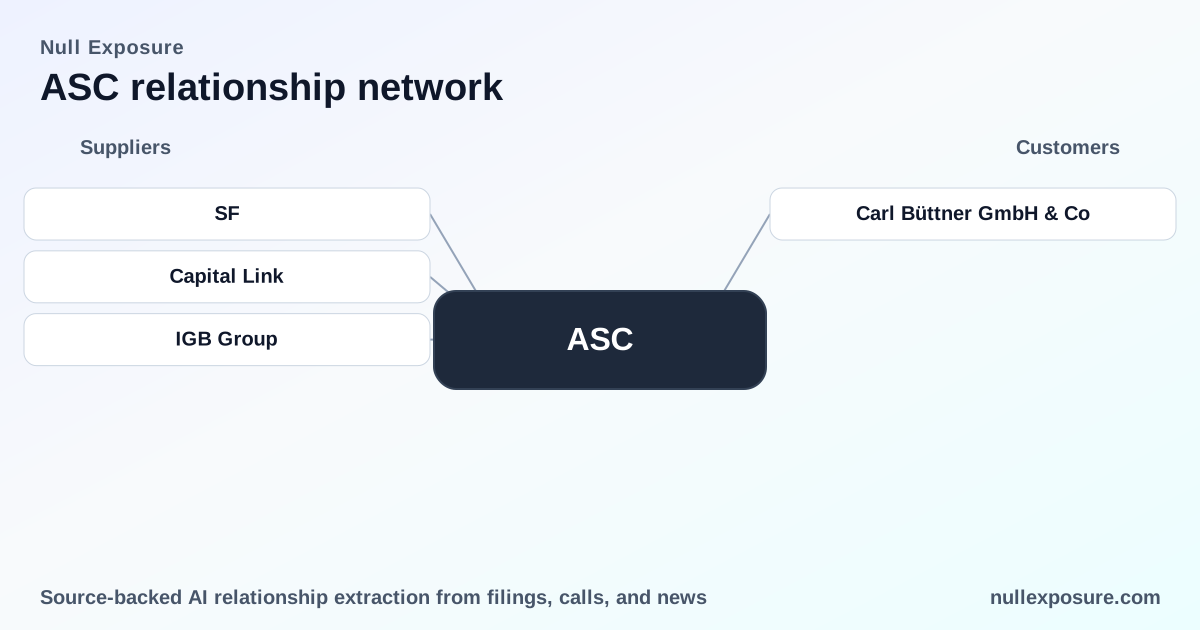
Capital Link
Ardmore has used investor presentation channels hosted by industry-focused sponsors; a trade press piece cites Ardmore presenting through Capital Link’s “Company Presentation Series” (reported in an industry article referencing FY2022). This demonstrates a strategy of reaching buy-side audiences through maritime investment forums that specialize in shipping equities. Source: gCaptain coverage referencing a Capital Link presentation series (FY2022) — https://gcaptain.com/medium-range-tankers-just-in-case/
IGB Group
IGB Group appears repeatedly as Ardmore’s retained investor relations contact for conference calls, investor day logistics, and annual report queries—names and contact emails for IGB personnel are included in multiple corporate notices (Q3 2025 conference call notice, 2026 investor day announcement, and the company’s 2025 Form 20-F/annual report filings). Using IGB Group for IR functions signals reliance on a professional IR vendor to coordinate institutional engagement and event logistics. Sources: StockTitan news and filing reproductions referencing IGB contact details in notices from 2025–2026 — https://www.stocktitan.net/news/ASC/ardmore-shipping-announces-third-quarter-2025-conference-call-and-eemynm3vsbc6.html; https://www.stocktitan.net/news/ASC/ardmore-shipping-announces-2026-investor-day-in-new-dxj10xce5xdk.html; https://www.stocktitan.net/news/ASC/ardmore-shipping-files-2025-annual-report-on-form-20-8ux1lacdcln1.html
What these relationships imply for risk and valuation
These partner links are not operational suppliers of fuel or ship management, but they are material to capital formation and market perception—two drivers of valuation for a mid-cap shipping company.
- Market-liquidity lever: Active use of brokers like Stifel for share placements reduces transaction friction for insiders and aids in managing float dynamics; investors should treat broker engagement as a signal that management is prepared to access markets when strategic.
- Narrative control: Retaining an IR firm and presenting through specialist channels like Capital Link shows an investment in investor outreach. That investment supports the company’s ability to sustain institutional interest, which is crucial given the high institutional ownership (~77%).
- Valuation sensitivity: Ardmore’s multiples (EV/EBITDA ~7.8, trailing P/E 16.2, forward P/E 3.4) reflect both current earnings and market expectations; strong IR and broker relationships reduce execution risk for equity actions that could alter capital structure or investor base.
See the full supplier and partner analysis at NullExposure
Practical takeaways for investors and operating partners
- Brokers and IR firms are strategically important: They affect the company’s cost of capital and share liquidity rather than cargo economics. Investors should monitor announcements that reference these firms for signs of upcoming equity activity or intensified investor targeting.
- High institutional ownership raises the stakes for messaging: With roughly 76.9% institutional ownership, consistent, professional investor engagement is necessary to avoid sharp re-rating events when earnings or fleet strategy shifts.
- Operational risk remains separate: These relationships do not substitute for operational counterparty analysis (charterers, shipyards, insurers), but they are a reliable window into capital-market behavior that drives valuation.
Bottom line and recommended actions
Ardmore Shipping leverages a small set of capital-market and investor-engagement service providers—Stifel, Capital Link, and IGB Group—to manage liquidity and maintain institutional attention. For investors, the presence and frequency of these engagements are a concrete signal of the company’s capital-marketing posture and its emphasis on maintaining access to the buy-side community. Monitor filings and event notices tied to these firms for early indicators of equity actions or renewed investor outreach.
For a deeper look at how supplier and service relationships influence issuer valuation and risk, visit NullExposure for extended profiles and comparative analysis: https://nullexposure.com/. If you want tailored intelligence on Ardmore’s external partners and their market impact, start a targeted investigation at https://nullexposure.com/.