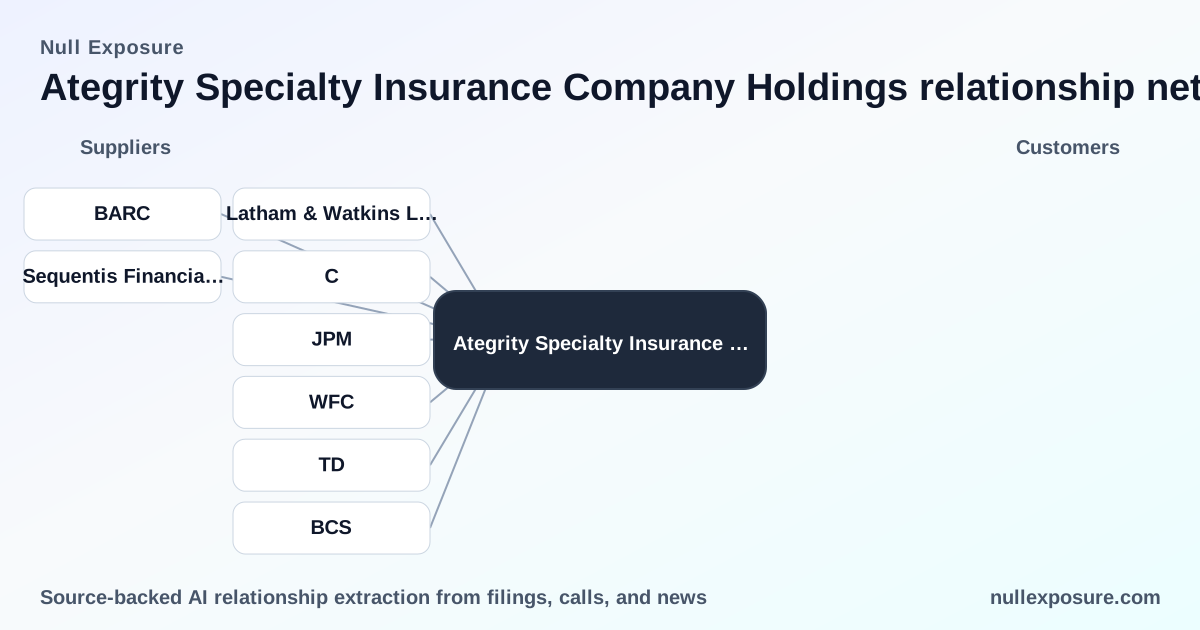
Ategrity Specialty Insurance Company Holdings (ASIC): IPO partners and supplier map investors should price into valuation
Ategrity Specialty Insurance Company Holdings underwrites excess-and-surplus (E&S) commercial property & casualty risks for small and medium-sized U.S. businesses and monetizes through written premiums, investment income and reinsurance arrangements; the company brought these capabilities public via an IPO syndicate in 2025–2026. For investors evaluating counterparty exposure and execution risk, the most relevant supplier relationships are the investment banks that managed the offering and the legal and capital partners that seeded early growth. Learn more about how these relationships shape risk and optionality at https://nullexposure.com/.
Why the partner map matters for an insurer entering public markets
Ategrity operates as a focused E&S carrier with profitable margins and a tight ownership structure. The company reported roughly $424m in trailing revenue, operating margin of 26.9% and a market capitalization near $969m at the most recent quarter-end, signalling a profitable, growth-stage insurer that is now reliant on public capital and distribution relationships to scale. The IPO underwriting group and legal counsel are not peripheral: they determine pricing access, distribution reach and the legal rigor of disclosure—factors that materially affect capital flexibility and reputational risk.
The underwriting syndicate that took ASIC public
-
J.P. Morgan — J.P. Morgan acted as a joint lead bookrunning manager and as a representative of the underwriters for Ategrity’s offering. This places a top-tier global bank at the center of the IPO distribution and pricing mechanism. Source: Ategrity pricing announcement and related press coverage in June 2025 and March 2026 (press releases and media summaries).
-
Barclays — Barclays served alongside J.P. Morgan as a joint lead bookrunning manager and underwriter representative for the offering, providing European distribution and institutional placement capabilities. Source: BizWire coverage of the offering launch (June 3, 2025) and subsequent IPO reporting in March 2026.
-
Citigroup (Citi) — Citigroup was named a joint bookrunning manager for the IPO, contributing U.S. institutional reach and middle-market placement resources. Source: A.I. Journ and market releases reporting the IPO pricing and syndicate structure (June 2025; March 2026).
-
TD Securities — TD Securities participated as a joint bookrunning manager, adding cross-border distribution into Canada and institutional networks that complement the U.S. lead managers. Source: Renaissance Capital and trading-calendar summaries of the syndicate (June 2025 press releases and March 2026 syndicate summaries).
-
Wells Fargo Securities — Wells Fargo Securities rounded out the joint bookrunning managers, providing regional distribution and additional retail/institutional placement capacity for the offering. Source: TradingCalendar, Reinsurance News and company PR on the offering (June 2025; March 2026).
(These five banks together led the offering and formed the primary market channel through which Ategrity converted private capital into public equity; press accounts and trade reporting list the full syndicate across June 2025 and March 2026 announcements.)
Legal and early-capital partners that shaped the capital event
-
Latham & Watkins LLP — Latham & Watkins served as issuer counsel for the offering, with a named corporate team advising on the IPO structure and disclosures, an important control on legal risk and documentation quality. Source: Latham & Watkins press notice reporting representation of Ategrity in March 2026.
-
Sequentis Financial LLC — Sequentis provided earlier private capital to Ategrity (a $75 million infusion in 2021) that underpinned underwriting capacity and growth prior to the public offering. That prior capital stake is a material part of the company’s capitalization history. Source: Financial Focus reporting on Ategrity’s 2022 executive changes and capital history referencing Sequentis (FY2022 coverage).
What these relationships mean for investors and operators
Ategrity’s supplier map shows a classic growth-insurer profile: established boutique underwriting with dependency on a compact set of top-tier banks for capital-market access, and high insider ownership that concentrates control. Operationally:
-
Contracting posture: The IPO syndicate and legal counsel arrangement reflect a standard, short-term transactional posture for capital raising—banks and counsel were engaged to execute a discrete offering rather than serve as long-term operational partners. That said, successful IPO execution signals market-ready governance and disclosure standards.
-
Concentration: Insider ownership exceeds 80% and institutional ownership is under 13%, creating governance concentration and a relatively small public float (shares float ~7.6m vs. ~48.1m shares outstanding). This ownership profile compresses liquidity and increases the influence of founding stakeholders on strategic choices.
-
Criticality of suppliers: The underwriting banks and counsel were critical at the moment of listing—failure or mispricing from that group would have directly impacted capital raised and market reception. Post-IPO, their role shifts to market support and analyst coverage; their initial involvement, however, materially de-risked the transaction execution.
-
Maturity and stage: Founded in 2018 and profitable on reported TTM metrics, Ategrity is best described as a growth-stage, commercially proven E&S insurer that nonetheless relies on capital-market mechanisms and retained private capital history to scale capacity.
(There are no contractual constraints disclosed in the supplier relationship feed; this absence itself is a company-level signal that public-facing supplier relationships in the sample are transactional and event-driven rather than long-term supplier contracts.)
Explore deeper relationship analytics and implications for counterparty risk at https://nullexposure.com/.
Investment implications — risk, upside, and operational checks
-
Governance and control are concentrated; investors should price a potential misalignment between public minority holders and controlling insiders into volatility and liquidity risk. The concentrated ownership also limits passive institutional influence on strategic direction.
-
Capital access is market-dependent; Ategrity has demonstrated the ability to attract top-tier banks for distribution, which supports future capital raises but also ties the company to capital markets sentiment and underwriting cycles.
-
Operational performance justifies valuation metrics today; profitability and solid operating margins underpin a mid-teens return on equity and a forward P/E below 10 according to headline metrics; investors should watch underwriting leverage, reserve adequacy and reinsurance terms as the primary operational risks.
Next steps for analysts and operators
- For portfolio managers: review insider ownership, float and coverage breadth before sizing positions; liquidity constraints and concentrated control should adjust position limits.
- For corporate development and operators: formalize ongoing engagement with at least one of the lead banks to secure follow-on capital windows and analyst coverage.
- For risk managers: request detailed reinsurance and reserve disclosures and understand how prior Sequentis capital was structured to assess legacy obligations.
If you want a structured counterparty report or ongoing monitoring on ASIC’s supplier map and market counterparties, start here: https://nullexposure.com/. For direct access to the full relationship feed and alerts, visit https://nullexposure.com/ and request the ASIC supplier profile.
Conclusion — Ategrity is a profitable, growth-stage E&S insurer whose near-term market trajectory is shaped by a concentrated ownership base and a high-quality yet transactional IPO syndicate. Investors should treat the underwriting group and legal counsel as execution enablers and focus diligence on governance, liquidity and underwriting economics as the determinants of upside and downside.