AdvanSix (ASIX) — Supplier relationships that shape margins, cash flow and operational risk
AdvanSix manufactures and sells polymer resins and related chemicals from an integrated U.S. platform, monetizing through product sales with formula‑based pricing that passes raw‑material cost changes to customers while operating as a significant net purchaser of key feedstocks. For investors, the combination of long‑term supplier contracts, concentrated domestic procurement, and sizable purchase commitments is the core driver of margins, working capital dynamics and downside operational risk. Explore full supplier coverage on NullExposure.
What investors need to know in one paragraph
AdvanSix’s commercial model is industrial and contract‑driven: it manufactures in the U.S., sells primarily to domestic customers, and relies on medium‑ and long‑term, formula‑based contracts to manage commodity exposure while accepting substantial forward purchase obligations for feedstocks and services. This posture supports margin stability when formula mechanics work, but it also locks the business into multi‑year cash flows and counterparty relationships that require active monitoring.
Company‑level operating signals that matter
- Contracting posture — long term: AdvanSix discloses that it mitigates commodity price risk through medium‑ and long‑term, formula‑based supplier contracts and formula‑based customer agreements; this is a structural feature of the business and explains why raw‑material volatility translates differently to cash flow than for spot‑purchased peers (source: company FY2024 disclosure language).
- Geographic concentration — U.S. centric: All manufacturing is located in the U.S. and roughly 86% of sales are domestic, which reduces multi‑jurisdictional supply chain complexity but increases exposure to U.S. commodity and regulatory cycles (source: company FY2024 filings).
- Buyer posture and input criticality: The company explicitly records purchase commitments for cumene, sulfur, natural gas and long‑term export handling services for ammonium sulfate, signaling these inputs are both high‑volume and operationally essential (company disclosures).
- Spend magnitude and maturity: Future unconditional purchase obligations total roughly $986.2 million (table of minimum payments as of Dec 31, 2024), indicating substantial locked‑in cash outflows over the next multi‑year period (company FY2024 purchase obligation table).
These are company‑level signals: they describe how AdvanSix contracts and operates rather than being tied to any single counterparty, and they influence counterparty risk, working capital strain and capital allocation decisions.
Active supplier and counterparty relationships to monitor
Below I cover every supplier/counterparty relationship referenced in the record; each entry is a plain‑English takeaway with source context.
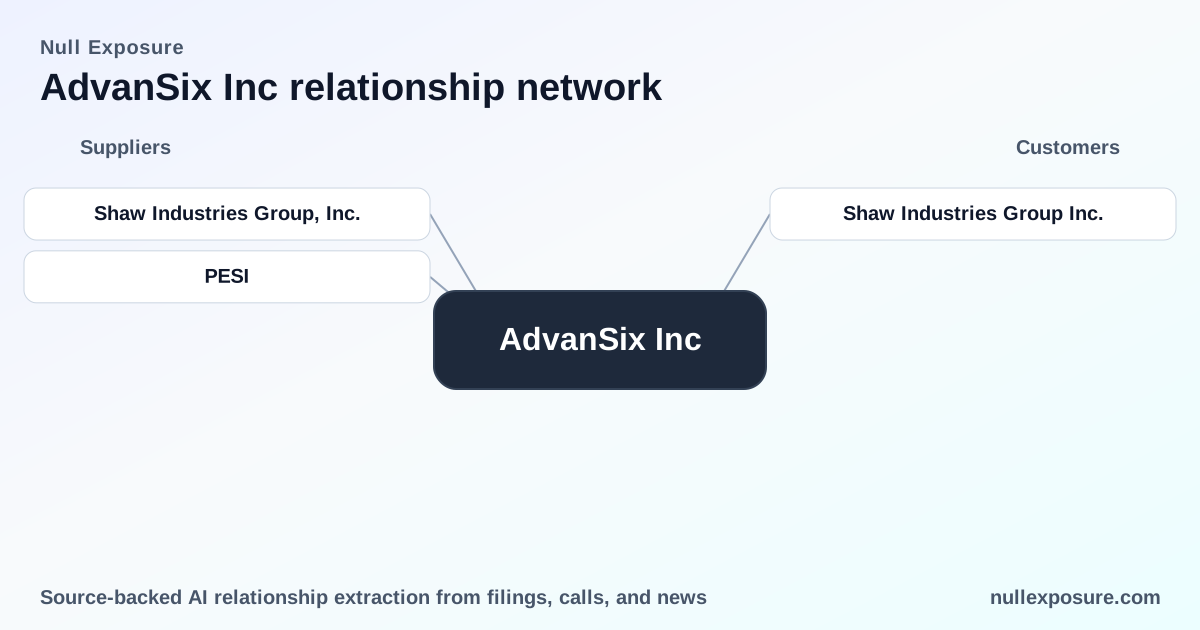
Shaw Industries Group, Inc.
AdvanSix and Shaw Industries have amended a long‑running caprolactam and polymer supply agreement, with Amendment No.1 dated Oct 1, 2021 and Amendment No.2 dated Jan 1, 2023 — evidence of a negotiated, longer‑term commercial relationship for nylon intermediates and resins that embeds formula pricing and contractual amendments over time. This is disclosed in AdvanSix’s FY2024 10‑K filing (filed Dec 31, 2024), indicating Shaw is a material commercial partner for caprolactam/polymer supply (source: FY2024 10‑K).
PES (inferred PESI)
AdvanSix recorded a settlement related to a prior supplier shutdown claim tied to PES, receiving $26.0 million in settlement proceeds in Q1 2025 and also referenced additional 45Q carbon tax credits; the company cited this outcome while reporting Q4 2025 results, highlighting both legal/settlement resolution and tax‑credit advancement as cash‑flow events. The detail is drawn from the Q4 2025 earnings call transcript published in March 2026 (press release/earnings transcript reporting) where management described the PES settlement and related cash receipts (source: Q4 2025 earnings call transcript, March 2026).
Why each relationship matters to valuation and operations
- Shaw Industries is an example of a contractually stable downstream/upstream relationship that reduces demand volatility for certain products while embedding price formula mechanics; investors should view this as a positive for revenue predictability but also as an anchor for counterparty concentration risk if a small set of large customers or suppliers control volumes (documented in the FY2024 10‑K).
- PES settlement is a discrete cash event that improves near‑term liquidity and illustrates legal/operational risk in the supply chain; resolving large supplier disputes can be beneficial to free cash flow but also signals past operational fragility that warrants monitoring (reported on the Q4 2025 earnings call, March 2026).
Financial context that ties to supplier risk
AdvanSix’s market capitalization ($435m) and EV/EBITDA ($128.8m) show scale but thin absolute margins. Large, multi‑year purchase obligations (~$986m) imply meaningful forward cash commitments that should be reconciled with operating cash flow and capital spending plans when assessing leverage and liquidity. These figures are drawn from the company’s market metrics and FY2024/FY2025 filings and public market data (latest quarter Sep 30, 2025).6.35) reflect a manufacturing business with modest valuation multiples relative to cyclicals, while trailing revenue ($1.49bn) and EBITDA (
Track supplier exposures and counterparty events on NullExposure — this is where you can monitor amended agreements (like Shaw) and material settlement disclosures (like PES) in context.
Practical checklist for investors and operators
- Monitor contract roll dates and formula reset mechanics for key feedstocks (cumene, sulfur, natural gas).
- Track purchase obligation amortization and how it aligns with free cash flow and servicing capacity.
- Observe legal and settlement developments that create one‑time cash inflows or indicate operational litigation risk (the PES settlement is a recent example).
- Watch counterparty concentration metrics: the presence of long‑term amendments with large industrial partners (e.g., Shaw) reduces demand volatility but increases single‑counterparty dependence.
Bottom line and recommended actions
AdvanSix’s supplier profile is defined by long‑term formula contracts, U.S. manufacturing concentration, and large forward purchase obligations — a combination that supports margin stability when contracts function as intended but creates structural cash commitments that increase sensitivity to input price trajectories and operational disruptions. For investors, the right focus is on contract economics (formula pass‑through detail), the schedule and counterparties behind the ~$986m of purchase commitments, and any repeatable legal/settlement patterns that affect cash flow. For operators, prioritize resilience in feedstock logistics and active renegotiation or hedging where formula mechanics create timing mismatches.
For full supplier relationship tracking, updated filings and event alerts, visit NullExposure. For a deeper review of how supplier contracts feed into valuation and liquidity models, check NullExposure’s supplier coverage hub — subscribe or request a tailored briefing.