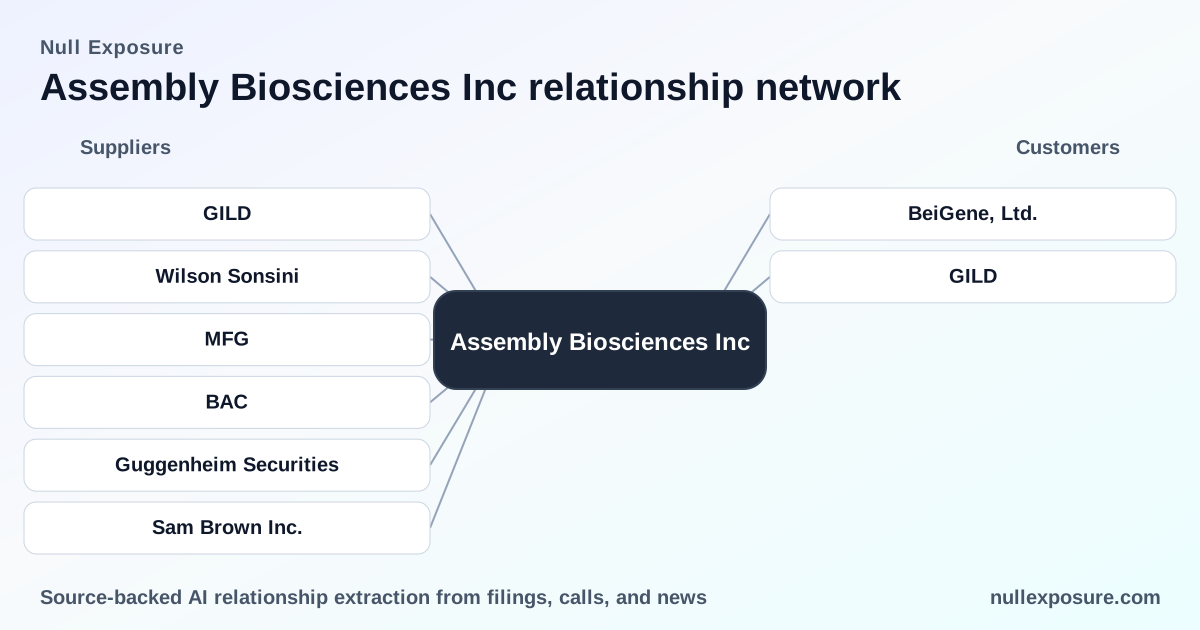
Assembly Biosciences (ASMB): supplier and partner landscape investors need to map now
Assembly Biosciences is a clinical‑stage biotechnology company that develops antiviral and other therapeutics and monetizes primarily through collaborative licensing and milestone-driven partnerships, clinical‑stage asset development, and capital markets activity to fund R&D. Assembly advances internal programs while contributing and receiving program assets through strategic collaborations; the company supplements in‑house capabilities with third‑party CROs and CMOs and periodically raises capital through underwritten offerings. For investors evaluating supplier exposure, the critical vectors are collaboration income potential, third‑party manufacturing dependency, and the stability of capital markets relationships that support near‑term funding needs.
Explore more supplier intelligence at https://nullexposure.com/.
How Assembly operates and where supplier relationships matter
Assembly is headquartered in South San Francisco and operates as a developer of clinical candidates rather than a vertically integrated manufacturer. Its economics today depend on partnership arrangements (contributions and license rights), milestone and potential royalty outcomes, and investor financing to sustain clinical programs. Revenue is modest relative to development spend (FY TTM revenue ≈ $37.2M; operating and profit margins are negative), which makes access to reliable CRO/CMO capacity and stable capital markets partners critical to program continuity and valuation realization.
- Contracting posture: Assembly carries long‑term occupancy commitments (sublease through 2029) and outsources core development tasks, reflecting a lean internal operating model that relies on external service providers.
- Concentration and criticality: The company relies on a small set of commercial and financial partners for legal, underwriting and program contributions; disruptions to key CROs/CMOs or to financing channels would be material to timelines.
- Maturity: Assembly is clinical‑stage: suppliers provide near‑term execution (clinical manufacturing, trial conduct, investor syndication) rather than recurring mass production.
If you evaluate supplier risk for portfolio construction, focus on counterparty quality for CRO/CMO execution, contractual tenure for facilities and advisors, and the depth of financial underwriters supporting liquidity. Learn how we map supplier criticality at https://nullexposure.com/.
Who Assembly works with — partner summaries investors should know
Below are the named external relationships surfaced in recent reporting and press releases; each entry states the partner role in plain English with a concise source reference.
-
Gilead Sciences — strategic collaborator and contributor of programs. Assembly has an active collaboration with Gilead in which Gilead contributed specific candidates (for example ABI‑1179) and Assembly advances those programs alongside its internal portfolio, reflecting a transfer of program rights and shared development duties. (See FierceBiotech coverage of the collaboration and contributor details, March 9, 2026: https://www.fiercebiotech.com/biotech/gilead-pays-100m-first-dibs-all-assembly-bio-assets-bolting-antiviral-engine-its-rd-group; and GlobeNewswire/ManilaTimes press release on interim clinical results and the ABI‑1179 contribution, Dec 2025: https://www.manilatimes.net/2025/12/09/tmt-newswire/globenewswire/assembly-biosciences-reports-positive-interim-results-from-phase-1b-clinical-studies-of-long-acting-helicase-primase-inhibitor-candidates-abi-1179-and-abi-5366-showing-reductions-in-viral-shedding-rate-and-virologically-confirmed-genital-lesion-rate-in-recurrent-genital-herpes/2239365).
-
Wilson Sonsini — legal counsel to Assembly. Assembly engages Wilson Sonsini for corporate and transactional legal services connected to partnerships and public company matters, indicating established external legal support for deal execution. (See PharmiWeb press release, Oct 17, 2023: https://www.pharmiweb.com/press-release/2023-10-17/gilead-and-assembly-biosciences-establish-partnership-to-develop-next-generation-therapeutics-for-se).
-
Mizuho Securities (Mizuho) — book‑running manager and underwriter role. Mizuho acted as a book‑running manager on a recent underwritten offering, demonstrating an ongoing capital markets relationship that facilitates cash‑raising events. (See Mintz announcement on the $175M underwritten offering, FY2025: https://www.mintz.com/insights-center/news-press/mintz-advises-underwriters-assembly-biosciences-175-million-underwritten).
-
BofA Securities, Inc. — financial advisor and syndicate participant. BofA served as a financial advisor alongside Mizuho for partnership and financing activities, providing strategic advisory and underwriter positioning for Assembly’s capital strategies. (See PharmiWeb press release, Oct 17, 2023: https://www.pharmiweb.com/press-release/2023-10-17/gilead-and-assembly-biosciences-establish-partnership-to-develop-next-generation-therapeutics-for-se).
-
Mizuho Securities USA LLC — co‑advisor/underwriting participant. Mizuho Securities USA LLC partnered with BofA as financial advisor, reinforcing Mizuho’s broader role in underwriting and syndication support for Assembly’s financing. (See PharmiWeb press release, Oct 17, 2023: https://www.pharmiweb.com/press-release/2023-10-17/gilead-and-assembly-biosciences-establish-partnership-to-develop-next-generation-therapeutics-for-se).
-
Guggenheim Securities — lead book‑running manager on offering. Guggenheim acted as the lead book‑running manager on an equity offering, signaling another primary capital markets relationship that underpins Assembly’s liquidity profile. (See Mintz announcement on the underwritten offering, FY2025: https://www.mintz.com/insights-center/news-press/mintz-advises-underwriters-assembly-biosciences-175-million-underwritten).
-
Sam Brown Inc. — external media/communications contact. Sam Brown Inc. is listed as the media contact firm handling announcements and public relations, which centralizes external communications for clinical and corporate milestones. (See PharmiWeb press release, Oct 17, 2023: https://www.pharmiweb.com/press-release/2023-10-17/gilead-and-assembly-biosciences-establish-partnership-to-develop-next-generation-therapeutics-for-se).
What the constraints say about Assembly’s operating model
The disclosed constraint excerpts provide investor‑grade signals about how Assembly structures its supplier relationships:
-
Long‑term facility commitments. Assembly has a sublease for corporate and laboratory space that extends through September 2029; this shows multi‑year occupancy cost commitments and reduces short‑term location risk but increases fixed‑cost exposure if capital runs short.
-
Dependence on third‑party manufacturing. The company explicitly relies on CMOs for clinical trial materials, establishing manufacturing as a critical outsourced function rather than an internal competency; supply disruptions would directly delay clinical milestones.
-
Significant CRO reliance for trials. Assembly contracts with CROs for much of its nonclinical and clinical trial work, meaning trial execution and regulatory timelines are materially tied to external service providers.
These are company‑level operating signals: they describe the organization’s contracting posture (outsourced execution, medium‑term facility lease), concentration (dependence on external CMOs/CROs), and maturity (clinical execution phase reliant on partners).
Investment implications — what to watch and when to act
-
Execution risk is concentrated in CRO/CMO relationships. Given the firm’s reliance on external manufacturers and trial operators, investor diligence should include supplier track records, redundancy plans, and contractual protections for timelines and quality. Supplier failure equals program delay.
-
Capital markets partners enable near‑term runway. The participation of Guggenheim, Mizuho and BofA in recent underwritings signals active underwriting capacity; continued access to those syndicates dictates the company’s ability to fund multiple trials. Watch upcoming financing events and underwriter commitments.
-
Collaborations drive upside without manufacturing capex. The Gilead relationship both derisks and accelerates certain programs by transferring assets and shared development responsibilities; such collaborations compress time to pivotal data on selected candidates. Positive partner contributions translate directly into valuation catalysts.
If you require a structured supplier risk assessment or counterparty scoring for ASMB, see our service overview at https://nullexposure.com/.
Final takeaways for investors and operators
Assembly operates as a clinical developer that intentionally outsources execution and taps capital markets and strategic partners for growth. Key investor considerations are: the health of CRO/CMO relationships, the terms and stability of capital markets underwriters, and the strategic value of collaborations such as the one with Gilead. Monitor supplier performance metrics, upcoming financing windows, and milestone timelines as the primary drivers of near‑term valuation movement.
For a deeper supplier exposure analysis or to benchmark ASMB against peer outsource profiles, visit https://nullexposure.com/ and request our supplier mapping briefing.