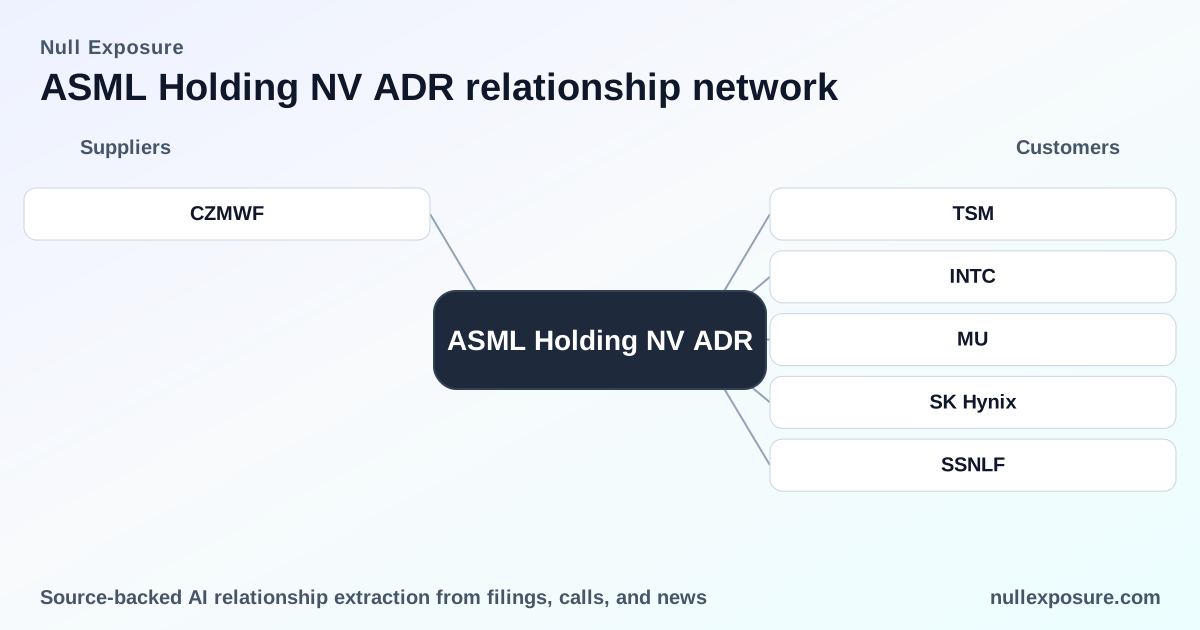
ASML’s Supplier Footprint: Optics Dependence and What Investors Should Price In
ASML builds and monetizes a capital‑intensive duopoly in semiconductor lithography by selling extremely high‑value lithography systems and recurring service, software and parts contracts that extend the lifetime economics of each tool. Revenue is driven by system shipments and a high‑margin, annuity‑like services stream, while capital intensity, long lead times and supplier criticality create both durable competitive advantages and concentrated operational risk for investors and operators.
Explore more supplier intelligence at https://nullexposure.com/ to benchmark ASML against peers and counterparties.
Why suppliers matter to ASML’s economics
ASML’s product is a systems integrator’s product: a complex assembly of optics, light sources, wafer stages, software and metrology. That operating model creates a contracting posture dominated by long, capital contracts and tightly integrated supplier relationships rather than simple transactional purchasing. The result for investors is twofold:
- High margin capture at the systems and services level. Company results show operating margin around 35% and net profit margins near 29%, reflecting pricing power and post‑sale revenue streams that monetize installed bases.
- Concentration and criticality risks embedded in the supply chain. Few suppliers provide components that meet ASML’s performance envelope; when a supplier provides unique optical or EUV components, its importance is structural rather than marginal.
These characteristics translate into a predictable revenue base but concentrated operational risk — a profile that favors long‑term holders who price in supplier resilience and contractual protections while penalizing underestimation of single‑supplier failure modes. According to company‑reported results through FY2025, ASML carries > $32.6B revenue TTM and a $540B market capitalization, underscoring how supplier issues scale materially into equity value.
What the public results show — partner by partner
The available supplier hits in the public feed show a single, high‑profile relationship that matters materially to ASML’s product architecture.
- Carl Zeiss: Systems like the NXE:3600D combine ASML’s EUV light source with ultra‑precise optics supplied by Carl Zeiss, and wafer stages capable of nanometer positioning, making Zeiss a structural supplier for ASML’s EUV platforms. A March 9, 2026 Ad‑Hoc News article referenced the optics contribution specifically in FY2026 commentary. This relationship is fundamental: ASML’s EUV performance is inseparable from Zeiss optics, and any production or R&D disruption at Zeiss translates directly into ASML delivery and yield risk. (Ad‑Hoc News, March 9, 2026).
That relationship is the only direct supplier mention surfaced in the results set; investors should treat this as confirmation of a concentrated supplier topology rather than evidence of a diversified parts roster.
Operating model signals investors need to weight
With constraints data not provided in the feed, company‑level signals are the basis for operating model assessment:
- Criticality: ASML’s products integrate components (notably optics) that are not easily substitutable. The Carl Zeiss mention confirms that criticality is not theoretical — it is operational.
- Concentration: The systems business concentrates revenue into discrete, high‑value shipments; supplier concentration is the logical mirror. Expect a small number of suppliers to carry outsized operational leverage.
- Contracting posture: Sales are capital equipment purchases with embedded long‑term service agreements. That structure gives ASML pricing power on consumables and maintenance but also creates customer expectations for uptime and predictable spare parts availability.
- Maturity and margins: High operating and net margins indicate a mature pricing model and durable product premium. However, high margins amplify the financial impact of supply disruptions.
These company‑level signals guide valuation sensitivity: when supplier risk increases, the expected uptime, spare parts revenue and multi‑year service margins compress — a direct hit to ASML’s premium multiple.
Explore supplier risk scoring and engagement playbooks at https://nullexposure.com/ to deepen due diligence.
Risk vectors crystallized by the Zeiss relationship
The Carl Zeiss relationship clarifies specific risk vectors investors and operators must monitor:
- Single‑sourcing of mission‑critical optics creates a throughput and delivery dependency; any capacity or regulatory interruption at Zeiss produces a first‑order impact on ASML deliveries and backlog conversion.
- Co‑development and IP entanglement mean that remedies (e.g., rapid supplier replacement) are not effective; building alternate optical capacity requires long lead time and aligned R&D investment.
- Geopolitical and export control exposure is amplified because optics and EUV systems sit at the intersection of advanced manufacturing and technology controls, so supplier and end‑market geopolitics will directly influence cadence.
Each of these is not an abstract possibility — the Zeiss connection makes them investment realities that must be priced into expected growth and multiple expansion.
Actionable steps for operators and procurement teams
Operators managing supplier risk with ASML exposure should implement three disciplined actions:
- Harden contracts around continuity and visibility. Insert explicit supply‑continuity clauses, joint inventory commitments and escalation paths tied to production milestones.
- Invest in demand smoothing and modular spares. Build staged buffer inventories for optics subassemblies and prioritize modular spares that materially shorten mean time to repair.
- Coordinate R&D and capacity planning with key suppliers. Where optics are co‑developed, formalize roadmaps and capacity commitments to avoid misalignment on ramp timing.
These are not theoretical best practices — they are executional priorities that preserve ASML’s revenue cadence and protect the long tail of service economics that drive valuation.
Final read for investors
ASML’s moat is real and monetized through capital systems plus recurring services, but that moat rides on a narrow supplier architecture. The publicly surfaced relationship with Carl Zeiss demonstrates how critical supplier partnerships are to ASML’s product performance and delivery. For investors, the proper framing is straightforward: value ASML as a high‑margin systems business subject to concentrated supply‑side shocks; allocate accordingly and monitor supplier capacity, contractual protections, and geopolitical exposures as primary risk indicators.
For a deeper, comparative supplier analysis and to build tailored exposure reports, visit https://nullexposure.com/ and see how supplier concentration changes equity risk and operational playbooks.
Investors and operators who price in supplier criticality and lock in contractual continuity will capture the upside of ASML’s powerful business model while insulating portfolio or production risk. Get started at https://nullexposure.com/ to convert supplier intelligence into actionable decisions.