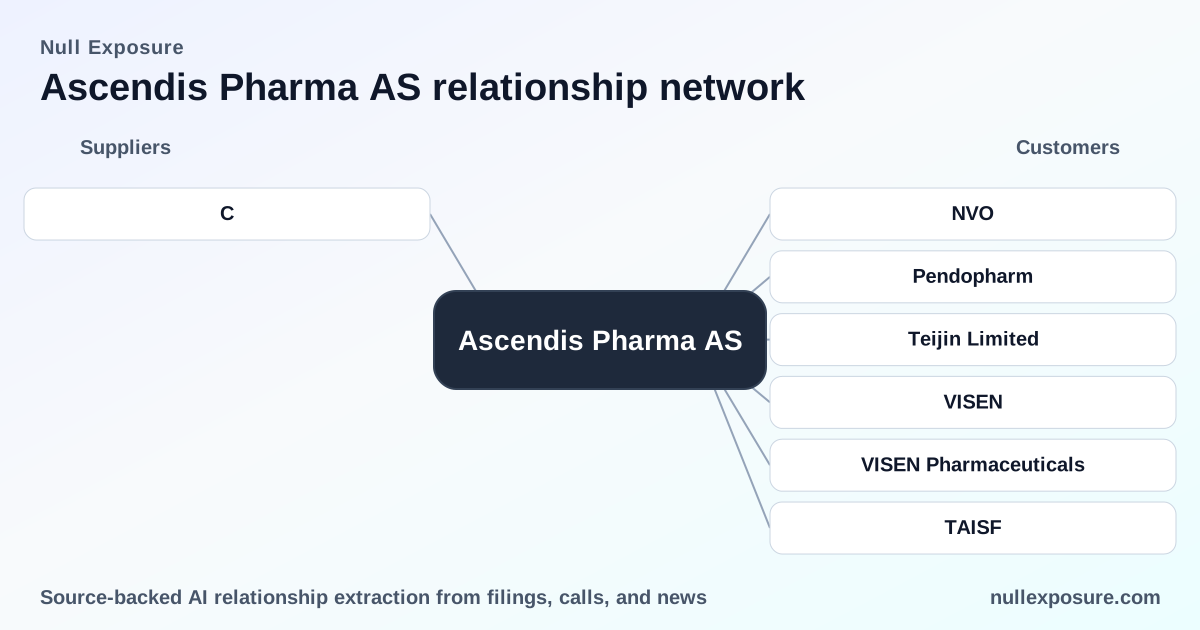
Ascendis Pharma (ASND) — supplier relationship brief for investors and operators
Ascendis Pharma develops and commercializes specialty endocrinology therapies and monetizes through product sales and licensing while relying on third-party service providers for capital markets execution, manufacturing partnerships, and distribution support. The supplier footprint visible in public records is narrow and transactional, dominated by capital markets services recorded as broker activity; this profile influences contracting posture, operational concentration, and vendor criticality for counterparties evaluating supplier risk. For a concise vendor-risk view and sourcing intelligence, visit https://nullexposure.com/.
Quick read: what this relationship profile means for investors
Ascendis’s publicly disclosed supplier relationships in the supplier scope are limited in number and primarily financial-market facing rather than core manufacturing or R&D contracting. That concentration of visible suppliers into capital markets services reduces the signal set available to assess operational dependency, but it also signals that market execution and liquidity provision are material touchpoints that require active vendor governance. For vendor monitoring and deeper supplier mapping, see https://nullexposure.com/.
One explicit supplier relationship on record — what it is and why it matters
Citigroup Global Markets. Citigroup acted as an executing broker selling ordinary shares on Nasdaq; the filing lists 1,800 shares sold with an aggregate market value of $435,762 and an outstanding share count of ~61.98 million, with the sale recorded on 2026-03-02. This is a capital-markets execution relationship, not a manufacturing or clinical supply contract, and signals routine broker-dealer activity rather than an operational vendor dependency. According to a March 2026 SEC-related filing collected by StockTitan, Citigroup Global Markets is identified as the broker for that transaction (StockTitan / SEC filings, March 2026).
How to read this broker entry in supplier due diligence
- The listing of a major global broker as a supplier indicates Ascendis uses institutional capital markets intermediaries for equity transactions, consistent with a public company managing liquidity, block trades, or shareholder programs.
- This relationship is transactional and high-frequency by nature: broker services are critical for capital access and shareholder trading but are not typically long-term strategic supply contracts like manufacturing agreements.
- Given the singular public supplier entry in the supplier scope, governance should focus on counterparty credit, trade execution terms, and documentation continuity rather than complex operational SLAs.
Company-level signals and operating constraints (company-wide, not tied to any single vendor)
- Contracting posture: Publicly disclosed vendor activity is transactional; contract terms for broker-dealers are standard market agreements focused on execution, custody, and compliance. This implies a lighter negotiation burden relative to long-term strategic suppliers, but higher sensitivity to regulatory and market execution risk.
- Concentration: Visibility shows limited supplier disclosure in the supplier scope. That can reflect low external supplier concentration in public records or consolidated procurement through undisclosed partners; both scenarios increase the importance of tracking off-record dependencies and one-off counterparties.
- Criticality: Capital markets providers are critical to capital access and share liquidity, particularly during financing events, block trades, or secondary offerings. Operational suppliers that do not appear in public supplier disclosures (e.g., contract manufacturers, CROs, or distributors) may still be operationally critical, so absence of public supplier entries should not be equated with absence of risk.
- Maturity and formality: The cited broker relationship is mature in form (regulated broker-dealer agreements) and governed by standard market protocols, which reduces bespoke contractual risk but increases exposure to market volatility and regulatory compliance demands.
Strategic implications for investors and operators
- Operational risk perspective: With public supplier disclosure concentrated in capital markets services, investors should press management and procurement for a fuller supplier map covering manufacturing, clinical, and distribution agreements; operational continuity risks often lie off-balance-sheet in contract manufacturing and partner R&D arrangements.
- Counterparty risk management: Broker-dealer relationships are straightforward to replace but require robust KYC, settlement processes, and continuity plans during volatility; governance should ensure backup execution channels and documented contingency procedures.
- Focus areas for due diligence: Active commercial-stage biotech companies like Ascendis warrant focused review on manufacturing capacity, regulatory milestones, and third-party clinical partners—areas not reflected in the supplier record here but central to revenue and margin continuity (company financials through 2025 show revenue TTM of $720.1M and gross profit of $625.2M).
Relationship list — concise plain-English entries (every relationship from the results)
- Citigroup Global Markets: Citigroup acted as the executing broker for an equity sale of Ascendis ordinary shares on Nasdaq, recorded on March 2, 2026, showing 1,800 shares sold at an aggregate market value of $435,762 against an outstanding share base of roughly 61.98 million; this filing is captured via StockTitan’s SEC filing collection (StockTitan / SEC filings, March 2026).
Risk checklist operators should run now
- Confirm whether this broker activity is part of a recurring dealer panel or a single trade; establish coverage agreements and backup dealers.
- Request a full schedule of third-party manufacturing and clinical vendors for operational continuity review and concentration analysis.
- Validate settlement and custody arrangements for equity and financing events to avoid execution risk during capital raises.
Bottom line and next steps
Ascendis’s supplier disclosures in the public record for the supplier scope are narrow and financial-market focused, anchored by a broker-dealer entry with Citigroup Global Markets. That profile emphasizes the need for investor and operator diligence on off-record operational suppliers (manufacturing, CROs, distributors) that drive clinical and commercial delivery even if they are not surfaced in this supplier listing. For a deeper supplier map and continuous vendor monitoring to support investment and operational decisions, explore our platform at https://nullexposure.com/.
For acquisition teams and risk officers: prioritize obtaining the full vendor schedule and contracts for manufacturing and clinical partners, then overlay those with financial counterparties like the broker in the public record to form a comprehensive supply-and-finance risk view. Visit https://nullexposure.com/ for actionable supplier intelligence and monitoring solutions.