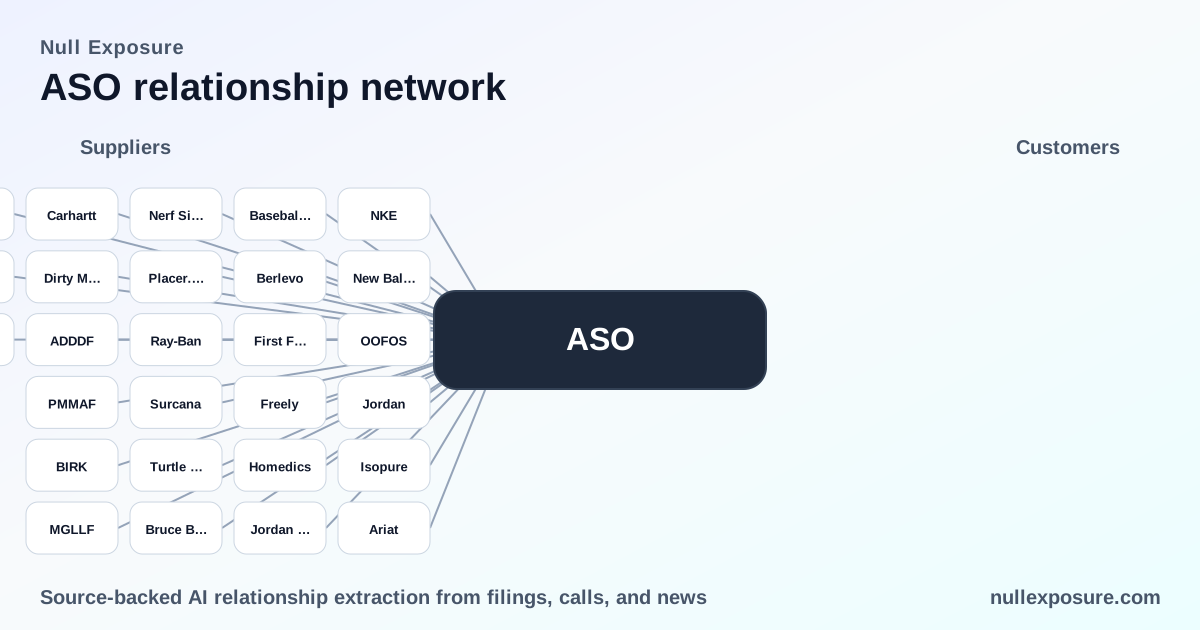
Academy Sports & Outdoors (ASO): the supplier ecosystem that drives traffic and margins
Academy Sports & Outdoors is a U.S. specialty sporting-goods retailer that monetizes through in-store and e‑commerce merchandise sales, combining national-brand assortments with private-label lines and long-term leased store footprint. The company sources inventory from roughly 1,500 vendors, invests in inventory and assortment to drive traffic, and extracts margin leverage through category mix and operating improvements — a model that ties supplier relationships directly to top-line traffic and mid‑cycle margin expansion. For a structured supplier risk view and sourcing intelligence, visit https://nullexposure.com/.
How Academy’s supplier posture shapes the investment case
Academy is a buyer-first retail operator: the firm purchases inventory at scale from a broad roster of vendors to stock more than 200+ stores (leased on long-term contracts) and its website, generating revenue from retail margins and private-brand penetration. Academy’s operating model is characterized by high vendor breadth (about 1,500 vendors), long-duration real estate leases (15–20 years), and an active vendor risk-management program that uses third-party data and service providers to tune assortment and traffic. These features create three persistent dynamics for investors:
- Concentration vs. diversification: reliance on major footwear/apparel brands such as Nike and Jordan is a traffic lever that increases revenue sensitivity to national-brand availability and promotional cadence.
- Contract maturity and fixed cost exposure: long-term lease commitments embed occupancy cost leverage and reduce real estate flexibility when consumer behavior changes.
- Data and service dependency: Academy uses third-party analytics and security service providers to optimize inventory and protect systems, elevating supplier criticality outside pure merchandise supply.
Key company-level signals from filings and disclosures reinforce this picture: Academy’s lease terms are typically 15–20 years, it purchases merchandise inventories from approximately 1,500 vendors, and it maintains a software vulnerability management program supported by third‑party providers. These are active, ongoing characteristics of the business rather than one-off items.
For supplier diligence and a consolidated view of counterparties, see https://nullexposure.com/.
Supplier map: brand-by-brand, what matters to an investor
Below are the relationships captured in public reporting and media coverage, with concise plain-English summaries and source references.
Nike / Jordan / Jordan brand
Nike and the Jordan brand drive footwear and apparel traffic for Academy; management cited improved assortments of Nike and Jordan as contributors to margin expansion and to attracting higher‑income shoppers. This relationship is central because Nike/Jordan are core traffic drivers in the footwear category. Source: Q3 2025 earnings call coverage and news commentary (Finviz and InsiderMonkey, FY2025) and a SahmCapital promotion (March 2026).
New Balance
Academy cited New Balance as a performance running brand that helped footwear growth and comparable-store strength in FY2025. Source: InsiderMonkey transcript (Q3 FY2025).
OOFOS
OOFOS was included in Academy’s performance assortment during a promotional “Run Month” event, showing the company’s tactical use of third‑party recovery/comfort brands to round out assortments. Source: SahmCapital press release (March 5, 2026).
adidas
adidas appeared in Academy’s Run Month assortment list, underscoring its role in seasonal promotional programs that drive traffic. Source: SahmCapital press release (March 5, 2026).
Brooks
Brooks is listed among performance running brands supporting footwear comps and featured in Run Month promotions, reflecting its role in performance running assortments. Source: InsiderMonkey (Q3 FY2025) and SahmCapital (March 2026).
ASICS
ASICS is cited as a performance running brand that contributed to footwear growth and was also part of Run Month merchandising. Source: InsiderMonkey (Q3 FY2025) and SahmCapital (March 2026).
Puma
Puma was included in seasonal Run Month merchandising, indicating participation in Academy promotional assortments. Source: SahmCapital press release (March 5, 2026).
Birkenstock
Academy highlighted rolling out Birkenstock more deeply into stores, signaling selective expansion of premium footwear brands into the footprint. Source: InsiderMonkey (Q3 FY2025).
Magellan
Magellan is a private-brand mentioned as contributing to apparel growth alongside national brands, highlighting Academy’s mix between private labels and nationals. Source: InsiderMonkey (Q3 FY2025).
Freely
Freely, a private brand, was called out as part of apparel growth and assortment strategy, reinforcing private-label contribution to margins. Source: InsiderMonkey (Q3 FY2025).
Carhartt
Carhartt is listed among strong national apparel brands supporting a 3% apparel sales increase in FY2025. Source: InsiderMonkey (Q3 FY2025).
Ariat
Ariat was identified as a key national brand supporting apparel strength during the quarter. Source: InsiderMonkey (Q3 FY2025).
Berlevo
Berlevo was named among national brands contributing to apparel sales growth, part of a broad national-brand assortment. Source: InsiderMonkey (Q3 FY2025).
Isopure
Isopure was cited in commentary about expanded health-and-wellness offerings (clear proteins) aimed at customers using GLP‑1 weight-loss drugs — an example of Academy leaning into adjacent wellness categories. Source: InsiderMonkey (Q3 FY2025).
First Form
First Form was referenced as part of Academy’s expanded protein and wellness assortment strategies, showing attention to emerging consumer trends. Source: InsiderMonkey (Q3 FY2025).
Homedics
Homedics portable saunas were noted as part of post-workout recovery assortments, indicating inventory allocation into wellness hardware. Source: InsiderMonkey (Q3 FY2025).
Turtle Box
Turtle Box speakers were cited among holiday items with enhanced technology, demonstrating opportunistic sourcing of consumer electronics in-store. Source: InsiderMonkey (Q3 FY2025).
Ray‑Ban / Oakley / Meta AI glasses
Ray‑Ban (and Oakley) Meta AI glasses were mentioned as examples of tech-enhanced holiday products, reflecting Academy’s willingness to carry trendy, higher‑ticket items. Source: InsiderMonkey (Q3 FY2025).
Nerf Silent Sports
Nerf Silent Sports was mentioned in the assortment of sports toys, reflecting toy-category sourcing for youth traffic. Source: InsiderMonkey (Q3 FY2025).
Bruce Bowl / Baseball 101 / Dirty Mid’s
Bruce Bowl, Baseball 101 and Dirty Mid’s were noted as part of youth baseball and soccer assortments, highlighting targeted category expansion for youth sports. Source: InsiderMonkey (Q3 FY2025).
Placer.ai
Academy leverages Placer.ai traffic data to monitor store-level visitation and prioritize merchandising decisions, demonstrating reliance on third-party footfall analytics. Source: InsiderMonkey (Q3 FY2025).
Surcana
Surcana provides market-share data across categories (roughly 60–70% coverage), used by Academy to benchmark assortment and share gains — a strategic data dependency. Source: InsiderMonkey (Q3 FY2025).
What the mix means for risk and value capture
Academy’s supplier mix is weighted toward a small set of national brands that drive traffic (notably Nike/Jordan), combined with a broad long tail of specialty brands and private labels that contribute margin and differentiation. This creates a two-sided risk profile: upside from improved assortment execution and inventory management; downside from supplier availability or promotional actions by major brands that change traffic patterns.
Operational constraints that matter to investors:
- Long-term lease exposure is a company-level structural constraint that reduces near-term flexibility but locks in physical distribution economics.
- Buyer role with large vendor base creates scale purchasing advantages but requires sophisticated inventory systems and third-party analytics.
- Active risk management with third-party service providers indicates reliance on external security and data partners to maintain operations.
For a consolidated supplier risk dashboard and further commercial diligence, explore https://nullexposure.com/.
Investment implications and next steps
- Positive: Academy’s mix of national brands and private labels, plus targeted assortment investments, supports margin expansion and traffic diversification. Higher gross profit contribution from private labels and better inventory technology are primary value drivers.
- Negative: Heavy reliance on national footwear/apparel brands for traffic and long-term lease rigidity raises the company’s exposure to category volatility and changes in consumption patterns.
Bold action for investors and operators: prioritize monitoring supplier availability of Nike/Jordan, track third-party analytics contracts (Placer.ai, Surcana) for signal changes, and incorporate lease maturity timelines into scenario stress tests.
For an integrated supplier risk view and ongoing updates, visit https://nullexposure.com/ — the quickest way to convert supplier intel into actionable investment signals.