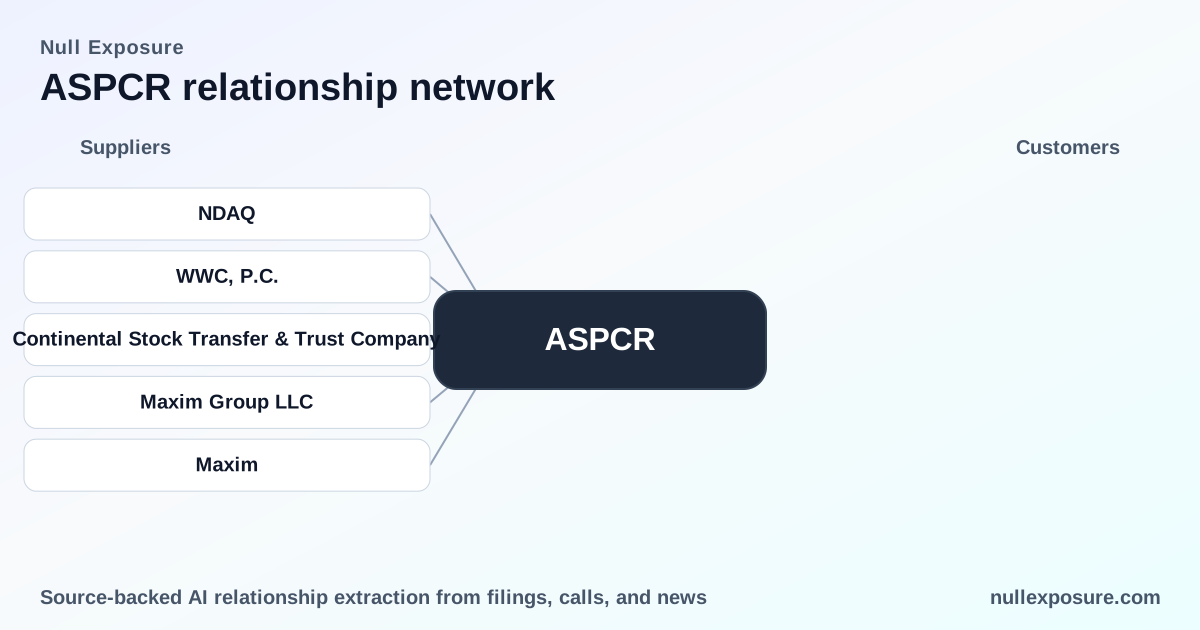
ASPCR (A SPAC III Acquisition Corp. Right): supplier relationships that determine execution risk and financing optionality
A SPAC III Acquisition Corp. Right (ASPCR) monetizes by assembling public capital through a SPAC structure, parking sponsor proceeds in a trust account, and then converting that capital into equity exposures through a business combination. The company’s economics are derived from IPO proceeds, underwriting arrangements and the value created (or destroyed) in a de-SPAC transaction; supplier agreements — trustees, transfer agents, underwriters and auditors — therefore have outsized influence on execution, timing and credibility. Read on for a concise supplier map with practical implications for investors and operators. For more coverage of supplier risk across small-cap and SPAC issuers, visit https://nullexposure.com/.
How ASPCR operates in plain language
ASPCR is a classic SPAC vehicle: it raised Units in an IPO, placed the net proceeds into a trust account, and lists the public instruments to give management time to identify and merge with a target company. Revenue generation is indirect — returns to public holders depend on the eventual merger outcome and subsequent market re-rating, while sponsor returns are driven by sponsor shares and deal economics. The balance between funded trust assets, underwriting economics and operational suppliers (auditor, transfer agent) governs the company’s ability to close a credible business combination.
Who supplies the critical plumbing (and what they do)
Nasdaq — public listing and market infrastructure
According to ASPCR’s FY2026 annual report, the company’s Units began trading on the Nasdaq Capital Market under the symbol ASPCU on December 29, 2023, establishing the public listing and trading venue for the securities. (FY2026 filing hosted on StockTitan, March 2026: https://www.stocktitan.net/sec-filings/ASPC/10-k-aspac-iii-acquisition-corp-files-annual-report-30fb2368c1ed.html)
WWC, P.C. — independent auditor and financial gatekeeper
WWC, P.C. served as ASPCR’s principal independent registered public accounting firm for the years ended December 31, 2025 and 2024, and has acted as auditor since 2024, providing the financial attestations necessary for filings and investor confidence. (FY2026 10‑K filing, March 2026: https://www.stocktitan.net/sec-filings/ASPC/10-k-aspac-iii-acquisition-corp-files-annual-report-30fb2368c1ed.html)
Continental Stock Transfer & Trust Company — trustee and transfer agent for the trust account
The company placed $60,000,000 of IPO net proceeds into a trust account with Continental Stock Transfer & Trust Company acting as trustee; Continental is also the transfer agent required to process separation of Public Units into Class A ordinary shares and Rights. This entity holds the cash that backs public redemptions and therefore controls the gating mechanics of the de-SPAC timeline. (FY2026 10‑K filing, March 2026: https://www.stocktitan.net/sec-filings/ASPC/10-k-aspac-iii-acquisition-corp-files-annual-report-30fb2368c1ed.html)
Maxim Group LLC — IPO representative and over-allotment execution
The underwriting agreement dated November 8, 2024 designates Maxim Group LLC as representative of the underwriters; Maxim partially exercised the over‑allotment option, purchasing an additional 500,000 Units on November 15, 2024, which augmented the IPO size and absorbed distribution risk. (Underwriting agreement and Form 8‑K exhibits referenced in the FY2026 10‑K, March 2026: https://www.stocktitan.net/sec-filings/ASPC/10-k-aspac-iii-acquisition-corp-files-annual-report-30fb2368c1ed.html)
Maxim (Representative Shares) — compensation and sponsor economics
Pursuant to the underwriting agreement, ASPCR issued 247,500 Class A ordinary shares to Maxim at the IPO closing as Representative Shares, and the underwriting arrangement included cash commissions and share-based compensation to the underwriter. This issuance is part of the upfront economics that influence sponsor dilution and alignment. (FY2026 10‑K filing, March 2026: https://www.stocktitan.net/sec-filings/ASPC/10-k-aspac-iii-acquisition-corp-files-annual-report-30fb2368c1ed.html)
(You can explore more supplier maps and supplier-risk profiles at https://nullexposure.com/.)
Constraints and what they reveal about ASPCR’s operating model
ASPCR’s public filing highlights several operating-model constraints that inform supplier risk and execution dynamics:
- Third-party service dependence is structural. The company explicitly depends on external technologies, personnel and processes for cybersecurity, information systems and cloud infrastructure; that dependence creates operational control and continuity risk because ASPCR does not maintain those capabilities in-house.
- Contracting posture is service-provider oriented. The language around underwriting commissions and representative-share issuance indicates a standard market contracting posture: ASPCR pays market fees and compensates distribution partners with both cash and equity, reflecting a transactional supplier relationship rather than a strategic, long-term integration.
- Spend band and upfront economics matter. The underwriting commission cited in filings totaled $600,000 (plus representative-share issuance), consistent with a mid-range spend band (roughly $100k–$1m) for such IPO services, signaling that underwriting and distribution are significant single-event costs but not ongoing large-scale operational spend.
- Infrastructure and services are dual risk vectors. Filings single out infrastructure and services (information systems, cloud) as critical external dependencies; this elevates the criticality of those suppliers and implies that service maturity and controls are important due diligence topics for investors.
- Maturity and concentration are typical for a newly public SPAC. Auditor tenure began in 2024 and the company’s operating history is short; this implies limited in-house maturity and potential concentration of supplier relationships that can create single points of failure.
These are company-level signals extracted from public disclosure; they reflect how supplier economics, control and technical reliance combine to shape ASPCR’s execution profile.
What investors should watch next — a focused checklist
- Trust account control: Continental’s role as trustee means cash availability for redemptions and closings is centralized; audit liaison with the trustee should be scrutinized in any deal diligence.
- Underwriting economics and dilution: The $600k commission and representative-share issuance are non-trivial for sponsor economics; quantify how these upfront costs change sponsor alignment in any proposed business combination.
- Auditor continuity and scope: WWC, P.C.’s engagement is recent; evaluate the auditor’s PCAOB standing, inspection history and experience with SPAC transactions.
- Operational IT and cybersecurity posture: Given explicit third-party dependence, demand evidence of vendor SOC/attestations and incident response arrangements.
- Concentration risk: A small roster of critical suppliers creates operational leverage; confirm fallback plans and contractual SLAs before underwriting credit or committing capital.
Bottom line — calibrated exposure and active supplier diligence
ASPCR is a textbook SPAC that depends on a small set of specialist suppliers to deliver listing, custody, audit and distribution functions. The core operational risks are supplier concentration, third-party infrastructure dependence, and upfront underwriting economics that shape sponsor incentives. For investors evaluating exposure, the right play is not passive ownership alone but active diligence on trustee controls, audit quality, underwriter compensation and vendor cybersecurity posture.
If you evaluate SPACs professionally, incorporate supplier-level checks into your deal playbook — start with trustee confirmations, auditor PCAOB reviews and underwriter transaction economics. For a structured review of supplier risk across small-cap issuers, visit https://nullexposure.com/.
For ongoing supplier intelligence and supplier-mapping tools that help quantify execution risk, see the full resource center at https://nullexposure.com/.