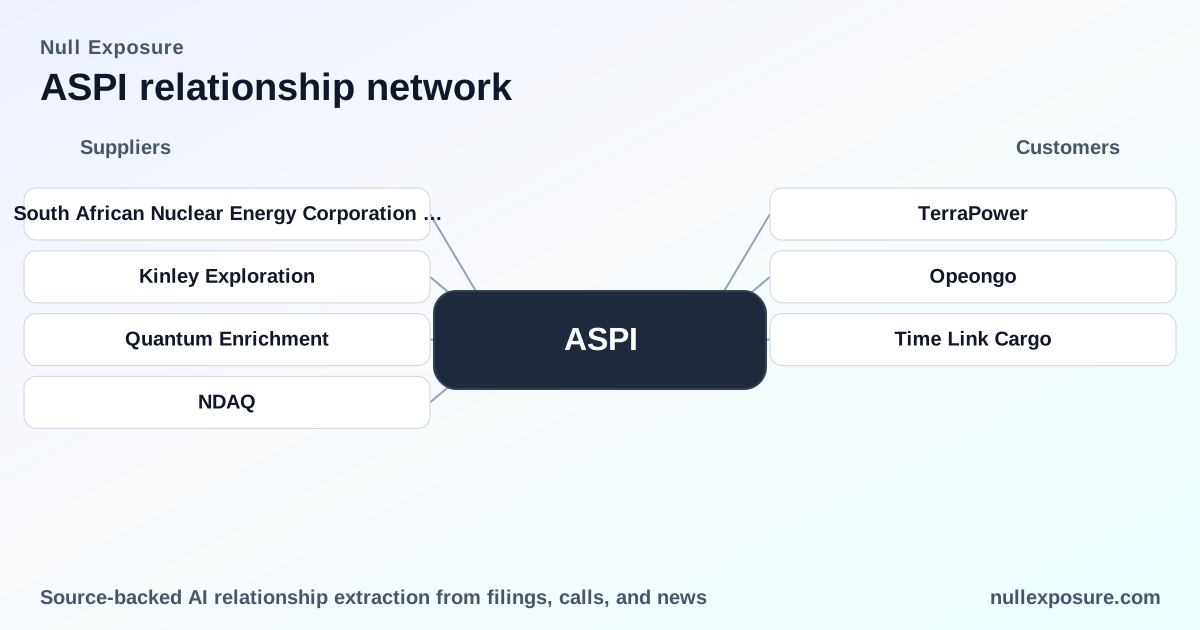
ASPI Supplier Landscape: Strategic partners, contracts, and operating constraints that will determine commercialization
ASP Isotopes operates as a project-driven producer and technology licensor in advanced isotope separation and related services, monetizing through project development, long-term site and services contracts, and commercial sales of isotopes and related process technology. Revenue generation today is project-centric and capex-intensive; future upside depends on scaling enrichment and separation projects secured through strategic industrial partnerships and service contracts. For an operational view of supplier relationships and contract exposure, see https://nullexposure.com/.
What investors need to know in one paragraph
ASP Isotopes is an early-revenue, capital-hungry specialty materials business with a market capitalization near $668 million against TTM revenue of roughly $8.4 million and negative EBITDA, signaling a growth-for-capex profile rather than a cash-generative supplier business. Strategic collaborations with national nuclear entities and technology partners are the commercial lever; any disruption or delay in those supplier and site arrangements directly delays product commercialization and revenue scale.
Explore supplier signals and contract metadata at https://nullexposure.com/.
Key relationships that shape commercialization and operations
The company’s external relationships fall into two classes: project/site partnerships that enable scale (industrial host and infrastructure) and technical/service partners that execute field work and technology integration. Below are all relationships disclosed in the review set, each with a concise take and source.
South African Nuclear Energy Corporation (Necsa)
ASP Isotopes’ Quantum Leap Energy subsidiary secured a Services Contract where Necsa provides facilities, infrastructure, utilities and services for siting, design, construction, commissioning and operation of an enrichment facility on the Necsa site at Pelindaba; this gives ASP Isotopes an industrial host with operational infrastructure for enrichment projects. According to a GlobeNewswire press release in FY2026, the contract covers use of Necsa site facilities and services for QLE SA’s enrichment facility development (press releases in English and German detail the same arrangement).
Kinley Exploration
Kinley Exploration has been engaged as an independent specialist to support seismic interpretation, reservoir modelling, well placement, well design and drilling execution on ASP’s helium project, signaling the use of third-party drilling and subsurface expertise rather than in-house execution capability. ASP Isotopes disclosed this operational engagement in a production update published via GlobeNewswire on 29 January 2026.
Quantum Enrichment / Quantum Leap Energy (QLE)
QLE will leverage ASP technologies alongside Quantum Enrichment capabilities to target uranium enrichment, lithium isotope separation and waste treatment—positioning ASP as a technology contributor within a broader enrichment and isotope platform rather than a sole-build operator. TradingView coverage of the QLE advisory board announcement in FY2026 states that QLE will use ASP and Quantum Enrichment technologies to pursue enrichment and separation targets.
Nasdaq (market visibility partner)
Nasdaq provided media and ceremony coverage for ASP Isotopes’ listing activities, increasing market visibility and signaling public-market positioning and governance expectations. A TradersUnion news item in FY2026 reported that Nasdaq supplied video of the listing ceremony, reflecting the company’s public-market outreach.
Operating-model constraints and what they imply for supplier risk
Several company-level constraints from filings and disclosures reveal how ASP structures its supplier footprint and cost base:
- Long-term real estate/operational commitment. One lease commenced in October 2021 with an initial term through December 2030, covering office, production and laboratory space. This indicates a multi-year fixed-cost base and a capitalized posture toward on-site production capacity rather than a purely asset-light approach.
- Heavy reliance on third-party service providers for critical systems. Company disclosures state reliance on external suppliers for cloud infrastructure, encryption/authentication, email and other essential functions. This is a direct operational dependency and increases vendor concentration and continuity risk for IT and operational controls.
- Active supplier relationships. The supplier engagements cited are current and operational, not merely exploratory: the company identifies these relationships as active and integrated into production and development workflows.
Collectively, these constraints signal a hybrid operating model: ASP takes on mid-to-long-term capital commitments for production capacity while outsourcing specialized technical execution and critical IT functions. That posture reduces the need to vertically integrate expensive drilling, encryption or cloud services, but it raises concentration and supplier continuity risk where single vendors or host-site partners control access to capacity or critical systems.
Financial context that colors supplier exposure
Use of third-party hosts and technical partners is consistent with ASP Isotopes’ financial profile. The firm reported roughly $8.38 million in trailing revenue and negative EBITDA around -$41.5 million, with high valuation multiples (price-to-sales near 80, EV/Revenue ~80) and a high beta (~3.57). These metrics frame the partnerships as essential to de-risking commercialization timelines rather than primary cash generators today. The company’s analyst consensus target price sits at $12, reflecting growth assumptions tied to successful project execution and partner-enabled scale.
Practical implications for investors and operators
- Counterparty criticality: The Necsa services contract is the single most critical industrial dependency because it provides the physical site and utilities to advance enrichment capacity; any regulatory, political, or operational delay at Pelindaba directly impacts project timelines.
- Execution risk is outsourced: Engagement of Kinley Exploration demonstrates reliance on external drilling and reservoir expertise for resource projects—this reduces internal capex on expertise but increases scheduling and vendor performance risk.
- Technology pathway is partnership-dependent: The Quantum Enrichment / QLE relationship positions ASP as a technology supplier within a consortium; commercialization outcomes depend on successful integration and IP allocation across partners.
- Public-market scrutiny and funding access: Nasdaq visibility supports institutional engagement (institutions account for ~53% ownership) which can ease capital access, but the company’s negative profitability requires continued financing to execute long-term leases and project construction.
Key risk and opportunity areas you should track:
- Contract execution milestones at Pelindaba and any host-site permit developments.
- Performance and delivery metrics from third-party technical contractors (drilling schedules, well results).
- Funding rounds or convertible financings tied to project capex.
- Changes in vendor concentration for critical IT/operational systems.
If you want a deeper, transaction-level read on how these supplier contracts affect cash burn and timeline risk, review the compiled supplier intelligence at https://nullexposure.com/.
Bottom line and recommended investor actions
ASP Isotopes is a project-development company that monetizes through site-host contracts, technology partnerships, and eventual product sales; its supplier relationships are strategic and materially influence timing and scale of revenue. For investors, the presence of a Necsa services contract and active technical engagements reduces certain build risks but replaces them with partner-performance and geopolitical exposure that must be monitored continuously.
For operators and procurement teams, prioritize contract performance clauses, contingency access to alternate suppliers for critical IT and operational services, and clear service-level expectations with drilling and site partners.
To review the raw relationship entries and monitor changes in real time, visit https://nullexposure.com/.