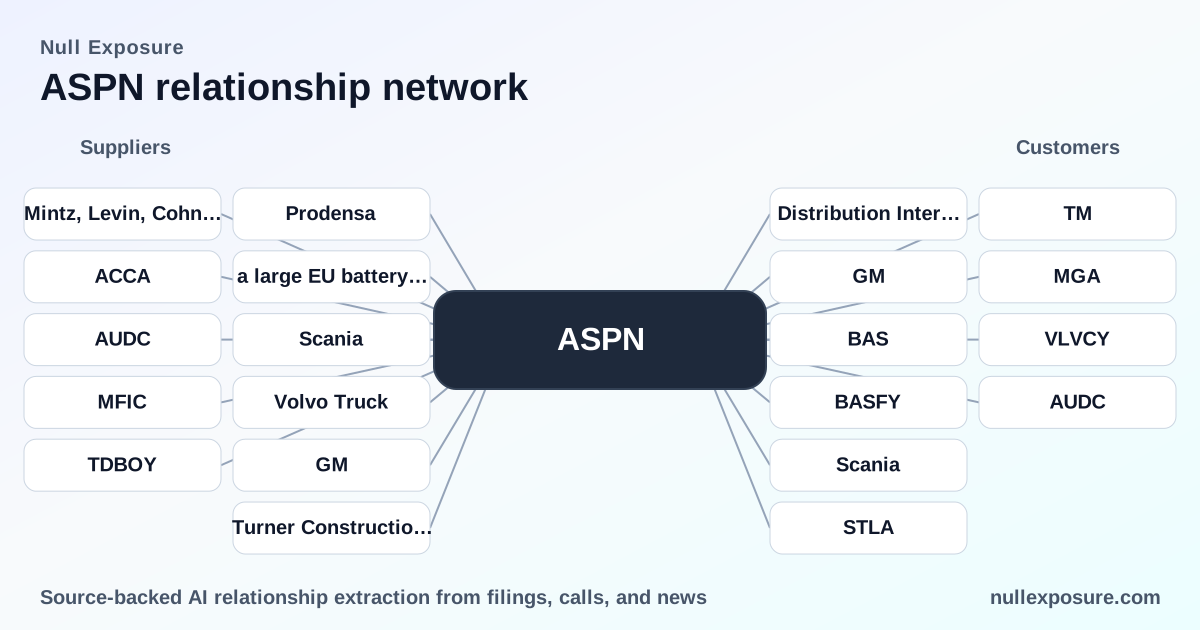
Aspen Aerogels (ASPN): supplier relationships that determine production and revenue quality
Aspen Aerogels designs, manufactures and sells aerogel insulation and thermal barrier products, monetizing through direct product sales and multi-year production contracts with energy and automotive OEMs. The company generates most revenue from physical product shipments (Revenue TTM $271.1M) and scales by expanding manufacturing capacity and lock‑in production contracts with vehicle and industrial customers. For investors, the critical lens is operational execution—capacity, contract footprint with large OEMs, and the financing and legal relationships that underwrite scale. Learn more about supplier risk intelligence at https://nullexposure.com/.
What Aspen sells and how supplier relationships affect margins
Aspen’s core product set is aerogel-based thermal insulation and battery thermal barriers sold into energy infrastructure, building materials and electrified vehicle supply chains. The business model is capital‑light in recurring sales but capital‑intensive to scale because manufacturing capacity and tight quality controls govern delivery timelines and gross margin expansion: gross profit TTM $46.0M on revenue of $271.1M.
Two company-level operational signals stand out from corporate disclosures:
- Manufacturer posture and capacity constraints: Aspen self-identifies as a manufacturer and acknowledges historical inability to meet demand and ongoing dependence on both internal capacity expansion and external manufacturing partners, including facilities in China. This is a company-level operational constraint that increases execution risk around order book fulfillment (source: Aspen’s FY2024 Form 10‑K).
- Use of third‑party service providers: Aspen engages third‑party vendors to store and process certain data, which is a governance and operational dependency for non‑manufacturing functions (source: FY2024 Form 10‑K).
Those structural characteristics translate into concentrated, high‑criticality supply and customer relationships—a single large contract can swing near-term revenue and utilization. For detailed supplier monitoring and counterparty exposure, visit https://nullexposure.com/.
The supplier and partner relationships to track now
Prodensa
Aspen engaged Prodensa to establish OPE Manufacturer Mexico S de RL de CV, a maquiladora in Mexico that assembles PyroThin thermal barrier products, signaling a strategic move to regionalize manufacturing and reduce unit costs. This is documented in Aspen’s FY2024 Form 10‑K.
A large EU battery manufacturer
In 2023 Aspen entered thermal barrier production contracts with a large EU battery manufacturer to supply a next‑generation vehicle platform for a major EU luxury sports car brand, indicating deep integration into premium EV value chains. This relationship is disclosed in the company’s FY2024 10‑K.
Scania
Aspen entered thermal barrier production contracts with Scania in 2023, expanding its commercial vehicle footprint and diversifying end‑market exposure into heavy transport. Source: Aspen FY2024 Form 10‑K.
Volvo Truck
Contracts with Volvo Truck were established in 2023 for thermal barrier production, demonstrating Aspen’s positioning as a supplier to global truck OEMs where scale and reliability are essential. Source: Aspen FY2024 10‑K.
General Motors (GM)
Aspen entered contracts with GM in 2020 and 2021 to supply thermal barrier products for EV battery systems, representing one of the earlier large OEM integrations into North American electric vehicle programs. This is disclosed in the FY2024 10‑K.
Turner Construction Co.
Turner Construction Co. served as the contractor on a high‑profile EV battery component plant project discussed in industry press, illustrating Aspen’s links into major construction and project‑execution ecosystems for production facilities. The contractor role was noted in an ENR news item covering the cancelled Georgia plant project (news report, FY2025).
Mintz, Levin, Cohn, Ferris, Glovsky and Popeo, P.C.
Mintz advised Aspen in a $75 million private placement in a PIPE transaction with an affiliate of Koch Strategic Platforms, documenting legal and capital markets support for prior financing activity. That advisory engagement is detailed in a Mintz case study (2021).
ACC
Aspen entered thermal barrier production contracts with ACC in 2023, signaling another industrial OEM tie‑in that broadens Aspen’s automotive and component manufacturing customer base. Source: Aspen FY2024 Form 10‑K.
Audi
Aspen executed thermal barrier production contracts with Audi (a Volkswagen Group brand) in 2023, aligning Aspen with premium European OEM supply chains and validating product fit for luxury EV platforms. Source: Aspen FY2024 Form 10‑K.
MidCap Financial
Aspen announced an amendment to its Credit, Security and Guaranty Agreement with MidCap Financial, reflecting active credit facility management and lender engagement to support operations and growth. The amendment was reported in a Globe and Mail press release (FY2025).
Toyota
Aspen entered thermal barrier production contracts with Toyota in 2023, indicating penetration into one of the largest global OEMs and providing meaningful revenue optionality if production ramps on Toyota EV programs. Source: Aspen FY2024 Form 10‑K.
What these relationships mean for investors: concentration, criticality and contracting posture
Aspen’s relationship map is dominated by production contracts with global OEMs and strategic manufacturing partners. That results in a specific risk profile:
- Concentration and criticality: A small number of large OEM contracts (GM, Toyota, Audi, a major EU battery manufacturer) create concentrated revenue streams where ramp timing and manufacturing uptime determine near‑term cash generation. These are high‑criticality relationships because OEM programs have strict qualification and delivery standards.
- Contracting posture: Aspen operates as both manufacturer and contract supplier; the company uses external manufacturing (maquiladora in Mexico and previously in China) to manage capacity. Contracting terms with OEMs and contract manufacturers are core levers to control margin and capital intensity.
- Maturity and scalability: The 2023 production contracts mark a transition from developmental proofs to production scale, but Aspen’s historical failure to fully meet demand and ongoing engagement with external facilities indicate the company is still in the scaling phase rather than a mature, low‑risk supplier role (source: FY2024 10‑K).
- Financial support and covenants: The MidCap amendment and the 2021 PIPE with a Koch affiliate show active financing partnerships that underpin operational expansion and working capital needs (Globe and Mail press release, Mintz case study).
How to act on this intelligence
- Monitor production ramp milestones with GM, Toyota and European OEMs; shipment timing will materially affect quarterly revenue and utilization.
- Track capacity additions in East Providence, the Mexican maquiladora and any China‑based external facilities; these directly influence gross margin expansion and back‑log fulfillment.
- Review credit agreement amendments and covenant activity with MidCap for liquidity signals and potential restrictions on capex or dividend policy.
For tailored counterparty exposure reports and alerts on Aspen Aerogels, visit https://nullexposure.com/. If you need ongoing monitoring of Aspen’s supplier contracts and credit relationships, start a subscription at https://nullexposure.com/ for continuous coverage.
Conclusion: Aspen’s supplier relationships are definitive drivers of near‑term revenue variability and long‑term margin potential. The company sits at the intersection of manufacturing scale risk and high‑value OEM partnerships; execution on capacity expansion, contract fulfillment and financial flexibility will determine whether current production contracts translate into durable profitability.