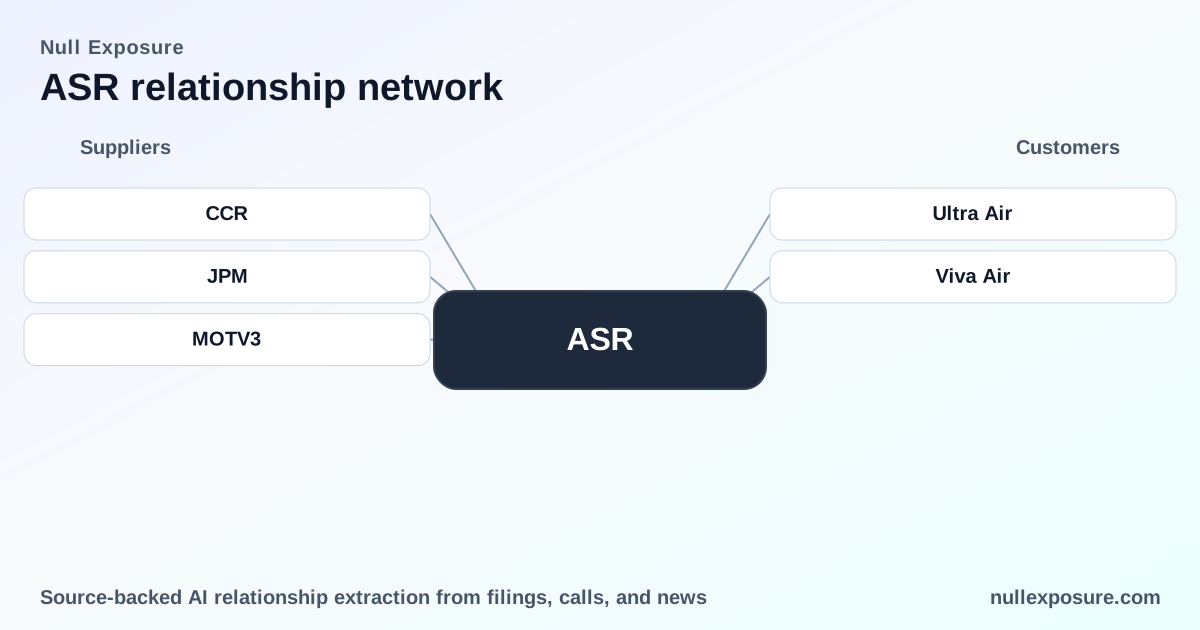
ASR (Grupo Aeroportuario del Sureste) — supplier relationships and strategic implications for investors
Grupo Aeroportuario del Sureste (ASR) operates long-term concessions to develop, operate and monetize airports in southeast Mexico and related assets. The company generates cash through aeronautical charges, retail and concessions, parking and real estate development tied to passenger volumes, and it funds expansion with a mixture of operating cashflow and external financing. ASR is a capital-intensive, concession-centric operator with market capitalization of roughly $9.8 billion and trailing revenue near $37.2 billion, which frames how supplier and financing relationships influence both growth and downside risk. For a quick view of supplier exposure and analysis, visit the NullExposure homepage.
How ASR’s operating model drives supplier behavior and counterparty importance
ASR’s business is not a spot services market — it is a concession model that locks in long-duration revenue rights and corresponding operating obligations. That structure generates a predictable cashflow profile but also creates concentrated supplier and financier needs.
- Contracting posture: ASR operates under long-term concession contracts that favor stable, multi-year supplier relationships for construction, retail concessions, ground handling and IT systems. That creates high switching costs and predictable procurement cycles.
- Concentration: Airports are location-specific assets; revenue concentration is geographic and passenger-volume dependent, exposing ASR to idiosyncratic traffic shocks but giving suppliers recurring, high-value contracts when operations are stable.
- Criticality: Suppliers and financiers are mission-critical — construction contractors, concession partners and lenders directly affect capacity to expand or integrate acquisitions.
- Maturity: ASR’s financial and operational profile is mature: EBITDA of about $20.2 billion and operating margin of ~34.5%, implying a platform capable of funding routine reinvestment but reliant on external capital for larger acquisitions or bolt-ons.
These characteristics mean investors must evaluate not just the counterparty name, but the role each supplier or bank plays in capacity, expansion financing and operational continuity.
Three partner relationships that change the playbook
Motiva S.A. — acquisition of Quiport stake (Quito airport)
ElDiario reported that ASR acquired Motiva S.A.’s stake in Corporación Quiport, the operator of Mariscal Sucre International Airport in Quito, with ASR taking ownership of the holding previously controlled by Motiva S.A. This transaction expands ASR’s geographic footprint beyond Mexico and converts a regional concession exposure into an equity stake in a major Andean airport operator (ElDiario, November 26, 2025).
JPMorgan Chase — financing partner for the acquisition
A Q3 2025 earnings call transcript published on InsiderMonkey stated that the acquisition was financed by JPMorgan Chase, signaling ASR’s willingness to use global banking partners for transaction-level debt financing. The involvement of a major global bank like JPMorgan underscores the structural importance of institutional financing to ASR’s growth strategy (InsiderMonkey, Q3 2025).
Motiva Infraestrutura de Mobilidade S.A. — prior purchase agreement for concessions assets (BRL 5 billion)
SimplyWallSt documented that ASR entered a purchase agreement to acquire Companhia de Participações em Concessões from Motiva Infraestrutura de Mobilidade for BRL 5 billion (transaction noted in FY2022 reporting). This historical transaction demonstrates ASR’s playbook of buying concession portfolios from infrastructure owners to scale operations in adjacent markets (SimplyWallSt, FY2022).
Why these relationships matter to investors: strategic implications
These three relationships together reveal a deliberate M&A and financing pattern. ASR is using acquisition to diversify geographic exposure and grow non-Mexican aeronautical revenue, while relying on global banks to fund lumpy capex and purchase consideration.
- Capital allocation signal: ASR’s use of acquisition to add concession assets shows management prioritizes share of stable, concession-derived cashflows over purely organic passenger-growth strategies.
- Financing mix: The role of JPMorgan indicates access to institutional lending at scale, which supports larger transactions but increases the company’s leverage and counterparty complexity.
- Supplier/partner concentration: Repeated dealings with entities related to Motiva indicate a sourcing channel for concession portfolios; that channel is strategically valuable but concentrates counterparties in the acquisition pipeline.
These are material for investors because concession acquisitions change the revenue mix, regulatory exposure and capital structure. ASR’s margins and EBITDA give it capacity to absorb acquisitions, but the balance sheet impact and financing terms determine shareholder dilution and cashflow risk.
For a focused view on supplier and financing linkages, see the NullExposure homepage.
What to watch next — operational and financial red flags
Investors should monitor the following indicators to assess whether these supplier and financing relationships are creating durable value or raising risk:
- Passenger traffic trends across the expanded footprint — revenue is directly tied to passenger volumes.
- Financing terms and covenant profiles on any acquisition debt provided by banks like JPMorgan — look for cross-default language and amortization schedules.
- Integration execution on acquired concession portfolios — operational synergies are the main source of value in these deals.
- Concentration of counterparties in concession acquisitions — overreliance on a single seller channel increases strategic risk.
Key monitoring checklist for quick reference:
- Confirm debt pricing and maturities on acquisition financings.
- Track quarterly traffic and non-aeronautical revenue contribution from new assets.
- Watch regulatory approvals or local concession renegotiations in newly acquired jurisdictions.
Risk factors, in plain English
- Leverage risk: Acquisition financing increases debt load and interest service obligations, directly testing ASR’s leverage capacity despite strong EBITDA.
- Geographic and regulatory risk: Cross-border concessions introduce new regulatory frameworks and political risk that dilute the predictability inherent in domestic operations.
- Counterparty dependency: Repeated purchases from the same seller groups or reliance on the same financing sources concentrates execution risk.
Bottom line and recommended investor action
ASR is executing a clear expansion-led strategy built on buying concession assets and funding these deals with institutional lenders. The company’s concession model delivers predictable operating cashflow, but the value of new relationships depends on integration success, financing terms, and traffic recovery across the expanded footprint. Investors should evaluate acquisition-level debt terms and regulatory exposure before assuming the current EBITDA margin profile will scale linearly.
For investors and operators wanting a deeper read on supplier linkages and transaction-level exposure, visit NullExposure for ongoing monitoring and relationship intelligence.
For a concise summary: ASR is a mature concession operator with strong operating margins and a growth-by-acquisition playbook; its strategic partners—Motiva entities and JPMorgan—are central to that playbook and therefore critical to monitor for execution and financing risk.