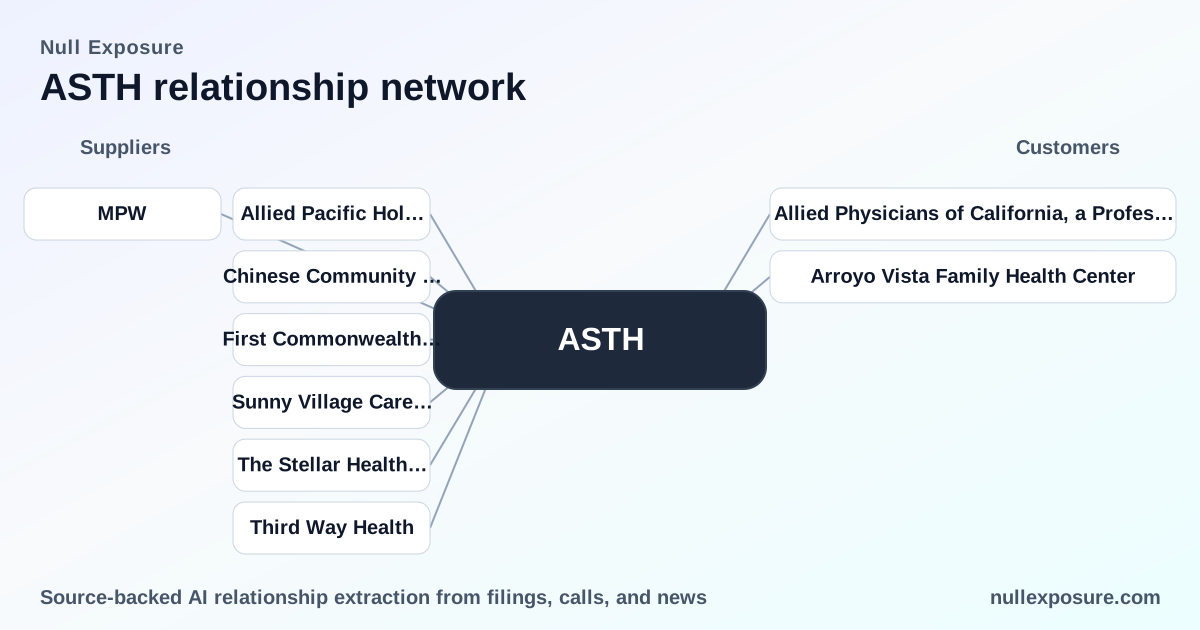
Astrana Health (ASTH): Supplier relationships that shape operating leverage and real estate risk
Astrana Health is a physician-centric, technology-enabled healthcare manager that monetizes by contracting with provider groups and payors to deliver care, capturing revenue through managed services, fee-for-service collections, and platform-driven practice management. The company scales by acquiring provider networks and embedding operational services—leasing office space, outsourcing credentialing and call-center functions, and centralizing payment processing—which converts clinical capacity into recurring revenue streams and enables margin improvement across acquired assets. For investors evaluating counterparty and operational risk, the supplier roster in Astrana’s 2024 SEC filing highlights concentrated real-estate leasing, recurring service vendors for patient intake and collections, and acquisition-related financing assumptions that materially affect cash flow stability. Learn more at https://nullexposure.com/.
What the supplier list tells investors about Astrana’s operating model
Astrana runs a capital-light clinical services model on top of acquired facilities and networks: real-estate leases provide locations and give landlords cash visibility, third-party service providers deliver non-clinical functions (call centers, credentialing, payment processing), and acquisition-era obligations carry legacy financing relationships. These supplier relationships drive two structural features investors must price into valuation: operational leverage (outsourced services scale with patient volume) and fixed-cost lease exposure (rent is largely fixed and can compress margins if revenue per visit declines). According to Astrana’s Form 10‑K for the year ended December 31, 2024, the company recognized material expenses tied to these categories (FY2024 10‑K).
Supplier ledger — each relationship and what it means
Allied Pacific Holdings Investment Management, LLC
Astrana recorded approximately $4.0 million in rent expenses to Allied Pacific for the year ended December 31, 2024, up from $3.8 million in 2023 and $2.2 million in 2022, indicating multi-year leased locations under management. This is a material landlord relationship that represents fixed cash outflows tied to Astrana’s facility footprint (Astrana 2024 Form 10‑K, FY2024).
Chinese Community Health Care Association (CCHCA)
As part of an acquisition, Astrana assumed a promissory note payable to the Chinese Community Health Care Association, signalling a legacy financing obligation carried through M&A. This contractual assumption influences debt service and counterparty exposure originating from the acquired entity (Astrana 2024 Form 10‑K, FY2024).
First Commonwealth Property, LLC
Astrana incurred roughly $0.2 million in rent expense to First Commonwealth Property in FY2024 (and $0.1 million in FY2023) for office leases, reflecting small but recurring office lease commitments that add to fixed operating costs concentrated in specific landlords (Astrana 2024 Form 10‑K, FY2024).
Sunny Village Care Center
Payments to Sunny Village Care Center were approximately $0.5 million in FY2024 (down from $2.6 million in FY2023 and $1.9 million in FY2022), representing provider services purchased by Astrana and indicating shifting utilization or contract re-pricing across years. This is a direct clinical services supplier relationship that affects cost of care and provider network continuity (Astrana 2024 Form 10‑K, FY2024).
The Stellar Health Group, Inc.
Astrana paid approximately $0.2 million in FY2024 to The Stellar Health Group for payment processing services, demonstrating reliance on third-party billing and payment platforms to collect revenue and manage cash flow timing (Astrana 2024 Form 10‑K, FY2024).
Third Way Health
Third Way Health provided call-center and credentialing services to Astrana, with expenses of about $3.6 million in FY2024 and $1.3 million in FY2023. This highlights a scaled outsourcing relationship for patient intake and provider credentialing that is operationally critical to revenue capture (Astrana 2024 Form 10‑K, FY2024).
Medical Properties Trust (MPW) — Prospect Medical Holdings’ managed-care platform
In a large strategic move covered by trade press, Astrana agreed to acquire the majority of Prospect Medical Holdings’ managed-care platform, a transaction tied to Medical Properties Trust for roughly $745 million as reported in late 2025. This transaction materially expands Astrana’s footprint and brings significant lease/asset transfer implications and integration risk (LA Business Journal, November 2025).
Constraints and what they imply about contractual posture and risk
Astrana’s public disclosures include constraint signals that translate into actionable operational views. First, lease terms are long-dated: monthly rental payments cited range from roughly $1,000 up to $0.1 million with expirations stretching to December 2045, and extension options in place. This indicates long-term fixed-cost commitments and a landlord-oriented contracting posture that reduces short-term flexibility but secures locations for network continuity (company 10‑K lease disclosures, FY2024). Second, Astrana relies on third-party service providers for core non-clinical functions—collection agencies, hosted software, credentialing, and call centers—showing a sourcing model built on outsourcing non-core operations. These are company-level signals about contracting choices: Astrana centralizes operations through external vendors, which reduces headcount but increases vendor concentration and third-party operational risk (company 10‑K service descriptions, FY2024).
Risk profile and concentration themes investors should price
- Real-estate fixed-cost risk: Long-term leases amplify margin sensitivity to volume downturns; landlords like Allied Pacific and First Commonwealth represent concentrated cash obligations.
- Vendor concentration risk: Large line-item vendors for call center, credentialing, and payment processing (Third Way Health, The Stellar Health Group) are operationally critical; interruptions can directly impair revenue capture.
- Acquisition and legacy finance risk: Assumed promissory notes and the MPW-related Prospect Medical transaction expand balance sheet complexity and integration execution risk.
These factors interact with Astrana’s scale metrics—FY2024 revenue of roughly $3.18 billion and operating margin near 1.85%—so small service disruptions or higher-than-expected lease costs can have outsized margin impact (Astrana FY2024 financials).
If you are modeling counterparty exposure or preparing diligence on supplier termination risk, use these direct disclosures as the baseline and prioritize vendor continuity and lease step-ups in scenario stress tests. For further research on supplier concentration and counterparty scoring, visit https://nullexposure.com/.
Investment implications and next steps for operators and buyers
Astrana’s model converts clinical assets into recurring revenue using third-party vendors and long-term leased locations. That structure produces scalable topline growth with embedded fixed-cost leverage, but also supplier-concentration and long-term lease exposure that investors must underwrite. For operators planning partnerships with Astrana, negotiate clear SLAs for credentialing and collections and understand landlord transfer provisions; for investors, stress-test cash flows against 10–20% volume declines to see lease and vendor impact on liquidity.
For a deeper look at supplier relationships, counterparty scoring, and how Astrana’s procurement posture changes valuation under stress, explore the research tools at https://nullexposure.com/.
Bold exposures are visible in the 2024 Form 10‑K and contemporary reporting—use those filings to validate vendor revenue sensitivity and lease maturities when constructing your model.