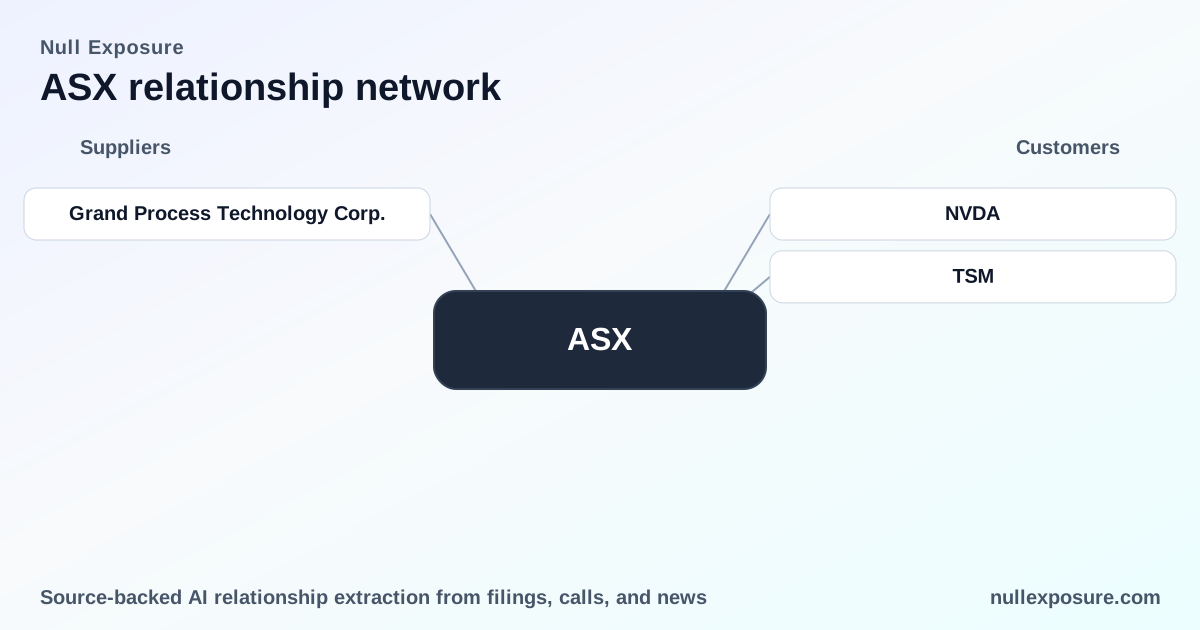
ASE Industrial (ASX): Supplier Footprint, a Machinery Purchase, and What Operators Should Price In
ASE Industrial Holding Co Ltd (ticker ASX) is a contract provider of advanced semiconductor assembly and test services that generates revenue by selling manufacturing capacity, engineering expertise and packaging/test services to OEMs across telecommunications, consumer electronics and automotive. ASE monetizes through high-volume, capital-intensive manufacturing contracts and value-added packaging solutions; margins reflect scale in assembly/test services and continued investment in R&D and equipment. For investors and procurement leaders, the company’s supplier choices reveal where capital is being deployed and which vendors capture recurring commercial exposure to ASE’s expansion.
Explore supplier intelligence and monitoring for semiconductor leaders at https://nullexposure.com/ — a practical starting point for sourcing counterparty risk and procurement signals.
How ASE runs its business and why supplier relationships matter
ASE operates as a large, capital-heavy contract manufacturer. The company’s 12-month revenue of $645.39B and market capitalization around $47.07B (figures per latest reported TTM) reflect a business that scales through facility throughput and expensive test/assembly machinery. Profitability is modest relative to revenue (profit margin ~6.3%, operating margin ~9.94%), which is typical for a services-and-capex model: high fixed costs, recurring equipment investment, and customer contracts that drive utilization.
Key public financial signals investors should note:
- Capital intensity: Frequent machinery purchases and R&D spend are embedded in the operating model, creating direct vendor exposure to equipment makers.
- Margin profile and leverage: Operating margins under 10% indicate sensitivity to utilization rates and pricing, elevating the importance of reliable suppliers and maintenance partners.
- Valuation dynamics: A trailing P/E of 38.4 versus a forward P/E of 12.3 suggests market expectations for earnings acceleration or margin improvement over the forward horizon.
Supplier ledger: what our scan found
Below is every supplier relationship returned in our review period. Each entry is a plain-English summary with the primary source cited.
- Grand Process Technology Corp.: ASE disclosed a machinery purchase from Grand Process Technology Corp. for business use in a Taiwan filing, signalling a direct equipment procurement relationship in FY2026. A news report at ts2.tech captured the filing and coverage on March 9, 2026 (FY2026 disclosure). Source: ts2.tech report of ASE Taiwan filing, March 9, 2026 — https://ts2.tech/en/ase-technology-stock-in-focus-after-unit-logs-nt1-03-billion-machinery-buy/.
What a machinery purchase from Grand Process Technology implies
A disclosed purchase of machinery from Grand Process Technology is a straightforward indicator that ASE sources specialized capital equipment from third-party vendors rather than developing all tooling in-house. For operators and investors this has three practical implications:
- Vendor criticality: Machinery suppliers are strategic partners — equipment uptime and spare-part availability affect ASE’s production continuity and margins.
- Contracting posture: ASE, as a large buyer, negotiates terms that often include maintenance, upgrades and spare parts — these contracts create ongoing revenue streams for machinery vendors and ongoing counterparty dependency for ASE.
- Capex cadence signal: Public filings that record machinery buys provide a real-time read on ASE’s capacity expansion or replacement cycle, which directly influences near-term cash flow and depreciation schedules.
Pause to evaluate how vendor concentration affects contract risk and service-level exposure: explore supplier due diligence tools at https://nullexposure.com/.
Operational constraints and business-model signals for procurement teams
The filings and financials combine into a profile investors and sourcing leads should treat as company-level signals, not relationship-specific judgments.
- Contracting posture: ASE runs buyer-dominant procurement for large-volume production, but specialized machinery vendors retain negotiation leverage where proprietary tooling or know-how is required.
- Concentration and criticality: Customer and supplier concentration risk is present by design—large OEM contracts on the revenue side and specialized equipment vendors on the cost side—so single-vendor disruptions carry outsized operational effects.
- Maturity and scale: As an established player in assembly/test, ASE’s vendor base will include both long-tenured global suppliers and niche technology vendors; procurement sophistication is high, but legacy equipment refresh risk persists.
- Capital and working-capital sensitivity: Because ASE’s model requires continuous capex, liquidity and covenants are sensitive to capex scheduling; vendor terms that accelerate or defer cash outflows materially affect financial flexibility.
These signals should shape contract clauses, SLAs, and inventory strategies: prioritize suppliers with service footprints and spare-parts guarantees that align to ASE’s throughput-critical operations.
Practical investor takeaways and tactical notes for operators
- Supply-chain exposures are actionable. A disclosed machinery purchase is not merely a spend line — it is a forward indicator of capacity and technical direction. Investors should track subsequent filings for warranty, maintenance, and financing terms that create multi-year supplier revenue.
- Negotiate beyond price. For operators, the commercial value lies in maintenance, spare-parts commitments and upgrade paths; these terms reduce downtime risk and protect margins.
- Monitor vendor concentration. Even single-item suppliers can become critical; maintain scenarios for supplier failure and alternative sourcing pathways.
If you need structured monitoring of supplier filings, machinery purchases and counterparty risk to support investment or operational decision-making, see how NullExposure integrates these signals at https://nullexposure.com/.
Bottom line
ASE’s disclosed machinery purchase from Grand Process Technology is a clear reminder that supplier relationships are core to operational continuity and margin management in semiconductor manufacturing. For investors, these disclosures are actionable signals of capex cadence and vendor reliance; for operators, they specify where procurement rigor and contingency planning must be strongest. Track filings, prioritize service-level commitments in contracts, and model capex-driven cash flows when valuing ASE’s forward earnings.
For a deeper review of supplier relationships and proactive monitoring options, visit https://nullexposure.com/ and request the supplier intelligence brief tailored to semiconductor OEMs.