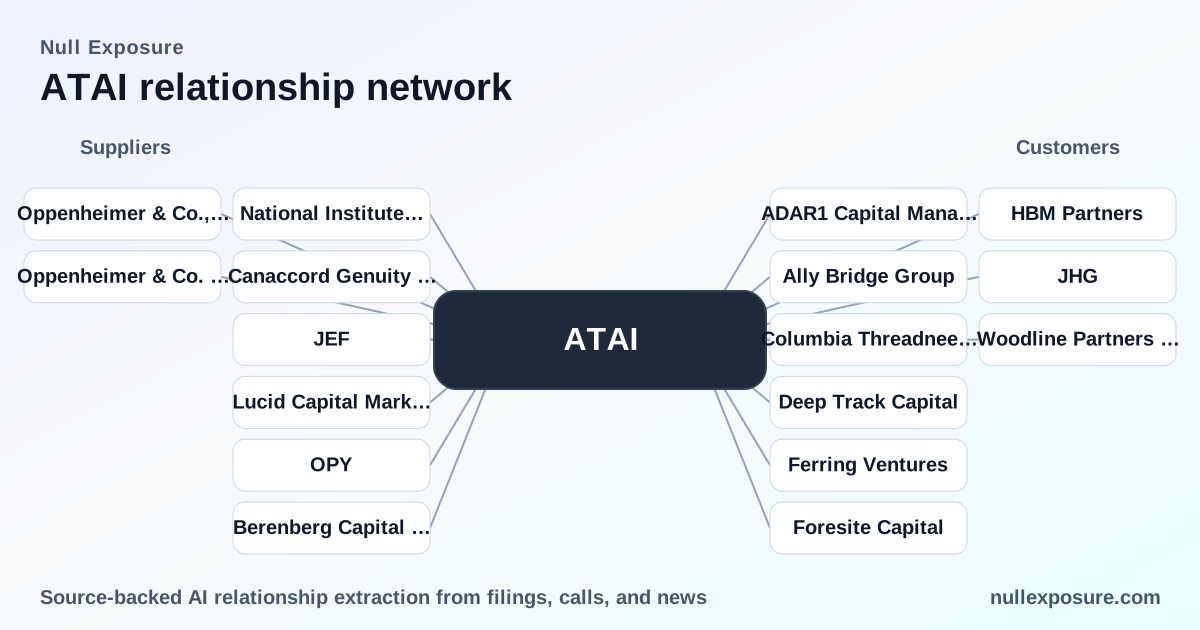
ATAI Life Sciences: supplier network and capital partners investors should track
ATAI Life Sciences operates as a clinical-stage pharmaceutical platform focused on developing psychedelic and related neuropsychiatric therapeutics; it monetizes through grant funding, licensing of intellectual property, and equity offerings to finance clinical development and manufacturing capacity. Key cash inflows over the last 12 months include a multi-year government grant and an underwritten public offering, underscoring a dual funding strategy of non-dilutive grants plus capital markets access. For an investor-focused supplier and counterparty view, see more at https://nullexposure.com/.
How ATAI runs the R&D and supply chain — the operating model in one paragraph
ATAI organizes as a holding-like platform of subsidiaries and partnered research units that outsource most development, clinical operations and manufacturing to third parties. Contracting is a mix of short-term, cancelable agreements for CRO/CMO services and longer framework arrangements tied to strategic acquisitions, with material reliance on third-party manufacturers and service providers to move candidates through clinical milestones. This structure preserves capital flexibility but concentrates operational risk in external providers and the timing of clinical progress.
- For investor diligence, ATAI’s operating posture means near-term program execution risk is supplier-dependent, while financing risk is managed through periodic equity raises and grant awards. See the supplier signal summaries below and a detailed operating-constraint read later in the piece. If you want a supplier-risk briefing tailored to portfolio needs, visit https://nullexposure.com/.
Who ATAI is partnering with right now (plain-English summaries)
National Institute on Drug Abuse (NIDA), part of the NIH
ATAI was awarded a multi-year, milestone-driven grant valued up to $11.4 million from NIDA to support clinical research activities, which provides non-dilutive funding and validates public-sector interest in its programs. This was announced in an InvestingNews release in March 2026.
Jefferies LLC
Jefferies acted as the lead bookrunner for ATAI’s recent public offering, indicating a primary underwriting relationship that facilitated the equity raise used to fund development and operations. This role is disclosed across ATAI press releases and a GlobeNewswire filing in October 2025.
Canaccord Genuity LLC
Canaccord served as a co-manager on ATAI’s offering, participating in distribution and syndicate responsibilities alongside Oppenheimer and others, showing ATAI’s use of a multi-bank syndicate to broaden investor distribution. This was disclosed in InvestingNews and GlobeNewswire communications (October 2025).
Oppenheimer & Co., Inc.
Oppenheimer participated as a co-manager in the equity offering, supporting syndicate execution and placement in the U.S. institutional market. The company’s role is documented in the October 2025 GlobeNewswire and subsequent investing news summaries.
Berenberg Capital Markets LLC
Berenberg operated as a passive bookrunner in the proposed offering, providing additional European placement capability and signaling ATAI’s reach into cross-border investor bases. Berenberg’s role is noted in the October 2025 GlobeNewswire announcement.
Lucid Capital Markets
Lucid acted as a financial advisor for the offering, supporting transaction structuring and advisory oversight rather than lead underwriting responsibilities. Lucid’s advisory role is described in InvestingNews and the closing announcement in October 2025.
(Each of the above roles is disclosed in ATAI press releases and market filings; see InvestingNews and GlobeNewswire coverage dated October 2025 through March 2026 for original notices.)
What the relationships collectively tell an investor
The supplier and capital relationships together paint a clear, two-track corporate strategy: secure non-dilutive public research funding where available (NIDA grant) while maintaining ready capital-market channels through a stable syndicate of underwriters and advisors to finance development and absorb dilution. That approach reduces immediate cash burn pressure but increases dependency on clinical and supplier execution.
Mid-cycle implications for portfolio managers
- Grant funding strengthens runway for specific programs and derisks near-term dilution for those programs. The NIDA award is a direct example of non-dilutive support for clinical activities (InvestingNews, Mar 2026).
- Underwriting relationships confirm access to capital: Jefferies, Canaccord, Oppenheimer, Berenberg and Lucid collectively provided execution for ATAI’s October 2025 offering and closing announcements, demonstrating durable market access (GlobeNewswire and InvestingNews, Oct 2025).
- Supplier dependency is operationally material: clinical and manufacturing outcomes hinge on third-party providers and CMOs, creating program-level binary events that drive valuation swings.
If you are evaluating counterparties or building a monitoring list for ATAI, find a specialty supplier-risk briefing at https://nullexposure.com/.
Operating constraints and what they mean for execution risk
ATAI’s public disclosures surface several company-level signals that are relevant for supplier diligence:
- Contracting posture: a mixture of framework agreements and short-term, cancelable contracts. The company discloses both longer strategic arrangements tied to acquisitions and routine cancelable CRO/CMO contracts, implying flexible but potentially unstable supply continuity.
- Geography and concentration: material operational footprint in North America (Canada) with clinical activity also in EMEA, which creates cross-border supply and regulatory complexity for manufacturing and trials.
- Role concentration: ATAI identifies third parties as manufacturers and service providers for critical functions (CMOs, CROs, clinical sites), and it holds both licensee and licensor positions across its subsidiaries, indicating bi-directional IP dependencies.
- Materiality and criticality: Supplier failure is classified as material — an inability to replace a CMO quickly could delay trials and revenue events.
- Maturity/termination signals: Prior to its October 2024 acquisition of IGX, ATAI engaged IntelGenx under a Strategic Development Agreement; that supplier relationship was terminated on acquisition, which shows strategic reconfiguration of supplier relationships following M&A.
Taken together, these signals define a company that trades outsourced execution risk for capital efficiency, which is standard for asset-light biotech but crucial for assessing near-term catalysts and downside.
Bottom line: how investors should position
- Positive catalyst: The NIDA grant provides program-specific funding and public validation; the underwriting syndicate demonstrates capital access. These reduce immediate financing stress for funded programs.
- Primary risk: Operational execution is supplier-dependent and classified as material; short-term contracts increase the risk of interruption and timing slippage for clinical milestones.
- Actionable investor steps: Monitor supplier qualifications and manufacturing status for lead candidates, track NIH milestone receipts, and follow underwriter communications around future equity raises.
For a concise supplier-risk monitor or to request an ATAI supplier-profile, go to https://nullexposure.com/.
Sources and reading
- InvestingNews coverage of ATAI’s NIH/NIDA grant announcement (March 2026) and offering closing (March 2026).
- GlobeNewswire press releases announcing proposed offering and closing (October 16 and October 20, 2025).
- StockTitan and related market wire republishing of ATAI offering close (October 2025).
If you need a tailored counterparty map or an ongoing monitoring feed for ATAI suppliers and capital partners, NullExposure provides subscription-grade supplier intelligence at https://nullexposure.com/.