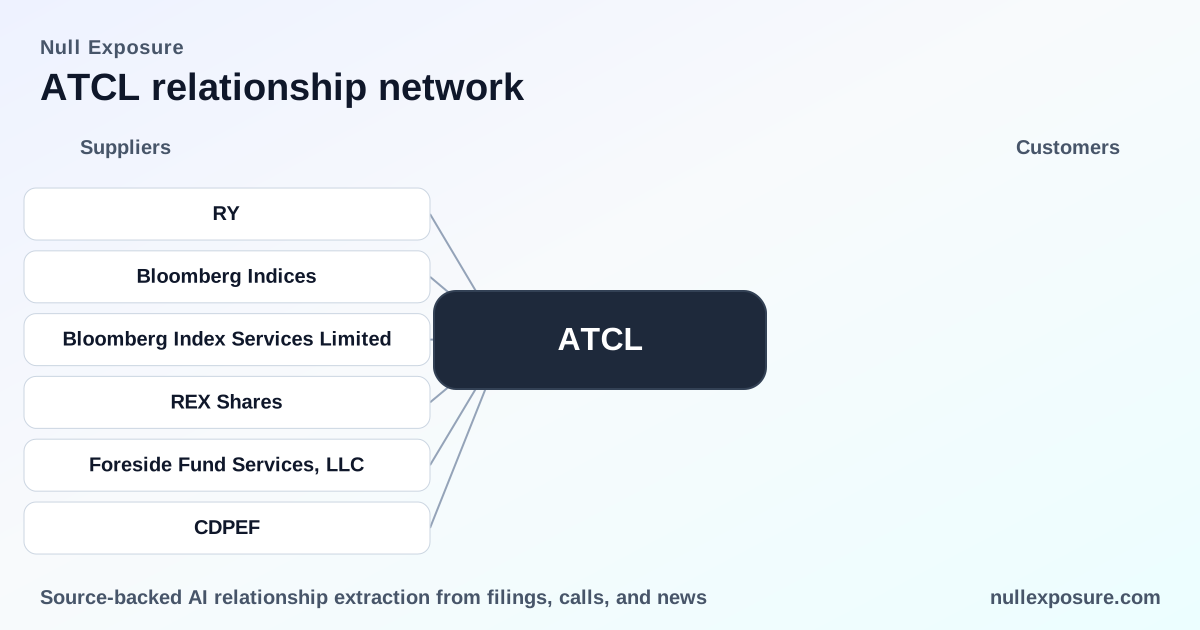
ATCL: A concise partner map for investors and operators
ATCL operates by sponsoring and supporting an outcome-oriented ETF that leverages third-party index licensing and derivatives to deliver a structured return profile; the fund collects management and distribution fees while outsourcing index construction, swap execution, platform marketing, and distribution to specialist providers. Revenue is driven by fund assets under management and fee rates, while costs and execution depend on a small set of high‑criticality counterparties. For a quick look at the supplier footprint, see the official partner notices and press coverage linked below.
Explore more supplier intelligence at https://nullexposure.com/.
How ATCL monetizes the product and runs its platform
ATCL’s operating model is a classic asset-management-as-orchestration play: the sponsor designs the outcome strategy and captures management/distribution fees, but execution and exposure are delivered through licensed indices and swap counterparties rather than internal proprietary engines. This structure reduces fixed investment in trading infrastructure but increases reliance on counterparties for pricing, replication and distribution. The FY2026 launch context positions ATCL as a relatively new issuer that scales by placing its strategy on established distribution platforms and leveraging partner credibility.
The partner map: who does what, in plain English
RBC Capital Markets — swap counterparty and execution partner
RBC enters into swap agreements with the fund to provide exposure to the underlying Bloomberg index, acting as the derivatives counterparty that converts index performance into the ETF’s payout structure. A press release from ETFGI in February 2026 describes the fund’s swap arrangements with RBC Capital Markets for exposure to the underlying index (FY2026). (Source: ETFGI, Feb 2026; see https://etfgi.com/news/stories/2026/02/rex-partners-cais-rbc-capital-markets-and-bloomberg-indices-launch)
Bloomberg Index Services Limited / Bloomberg Indices — index licensor
Bloomberg Index Services supplies the underlying reference: the Bloomberg US Large Cap VolMax Autocallable Total Return Index, which defines the fund’s systematic payoff and triggers. ETFGI’s announcement identifies Bloomberg Indices as the index provider supporting the ETF’s structure (FY2026). (Source: ETFGI, Feb 2026)
REX Shares — strategy manager and designer
REX manages the strategy and provides the outcome‑oriented product design and day‑to‑day fund management functions that investors interact with, positioning the product within its suite of structured ETFs. ETFGI’s coverage states that REX manages the strategy and brings outcome design expertise to the fund (FY2026). (Source: ETFGI, Feb 2026)
CAIS — platform and marketing partner
CAIS serves as the fund’s core platform and marketing partner, supporting advisor education and access to the product through its alternative-investment distribution channels. News coverage of the launch highlights CAIS as the supporting platform and marketing partner for advisor distribution (FY2026). (Source: ETFGI, Feb 2026; additionally noted in StockTitan coverage, Mar 2026: https://www.stocktitan.net/news/ATCL/)
Foreside Fund Services, LLC — distributor and regulatory conduit
Foreside is named as the fund distributor, handling distribution logistics and certain compliance/notice functions that facilitate placement with intermediaries. ETFGI’s launch announcement lists Foreside Fund Services as the distributor for the funds (FY2026). (Source: ETFGI, Feb 2026)
What the partner configuration tells you about ATCL’s operating characteristics
- Contracting posture: outsourced and counterparty-dependent. ATCL relies on licensed intellectual property (the Bloomberg index) and a large financial institution (RBC) for swaps, indicating a contracting model built around vendor-delivered critical capabilities rather than in-house replication.
- Concentration: high vendor concentration but limited roster. The launch roster shows a small number of high-impact suppliers—index provider, swap counterparty, manager, distribution platform and distributor—so operational or commercial friction with any partner would have outsized effects on product economics and availability.
- Criticality: index and swap counterparty are mission-critical. The index defines payoff mechanics; the swap counterparty delivers economic exposure. Those functions are core to the product’s value proposition and directly affect investor returns and risk.
- Maturity: product-level infancy with established partners. The relationships are disclosed in FY2026 launch coverage, signaling a new product lifecycle stage but with established counterparties to accelerate distribution and credibility.
No explicit supplier constraints were disclosed in the public launch materials, so these operating signals reflect observable architecture rather than contractual extracts.
Explore supplier intelligence and partner impact analyses at https://nullexposure.com/.
Key risk and governance checkpoints for investors and operators
Investors and operators should track several concrete risk vectors tied to the partner map:
- Counterparty credit and operational risk from RBC — swaps concentrate replacement and credit exposure with a single large bank; monitor credit spreads, collateral terms, and fallback provisions.
- Index dependency for payoff integrity — Bloomberg index methodology and licensing terms determine how the strategy behaves under stress; governance over index changes is a direct risk to delivered outcomes.
- Distribution concentration through CAIS and Foreside — marketing, access and distribution logistics are funneled through a small set of intermediaries, which affects growth velocity and channel resilience.
- Execution and liquidity risk during stress events — outsourced replication and derivative execution can introduce slippage, especially in autocallable structures tied to volatility regimes.
- Operational oversight by REX — manager governance, trade oversight, and transparency are the levers investors will use to hold the sponsor accountable for counterparty selection and contract terms.
Each of these points has immediate monitoring actions: review swap confirmations and ISDA collateral schedules, assess index governance documents, and track distribution agreements and placement schedules in periodic filings.
Practical next steps for due diligence
- Request the fund prospectus and swap counterparty schedules to verify collateralization and default ladders.
- Review Bloomberg’s index factsheet and governance procedures for the US Large Cap VolMax Autocallable Total Return Index.
- Evaluate REX’s track record managing outcome‑oriented ETFs and CAIS’s distribution channels for advisor penetration.
These checks align operating reality with the sponsor’s fee capture and scalability assumptions.
For more supplier-level analysis and ongoing monitoring signals, visit https://nullexposure.com/.
Bottom line
ATCL’s product is a leanly staffed sponsor model that monetizes through fees while relying on a compact set of specialized suppliers—Bloomberg for index construction, RBC for swaps, REX for management, CAIS for platform access and Foreside for distribution. That design accelerates go‑to‑market but concentrates execution and counterparty risk. Investors should prioritize confirmation of swap terms, index governance, and distribution commitments as the primary levers that will determine performance delivery and scalability. For targeted supplier due diligence and continuous monitoring, start at https://nullexposure.com/.