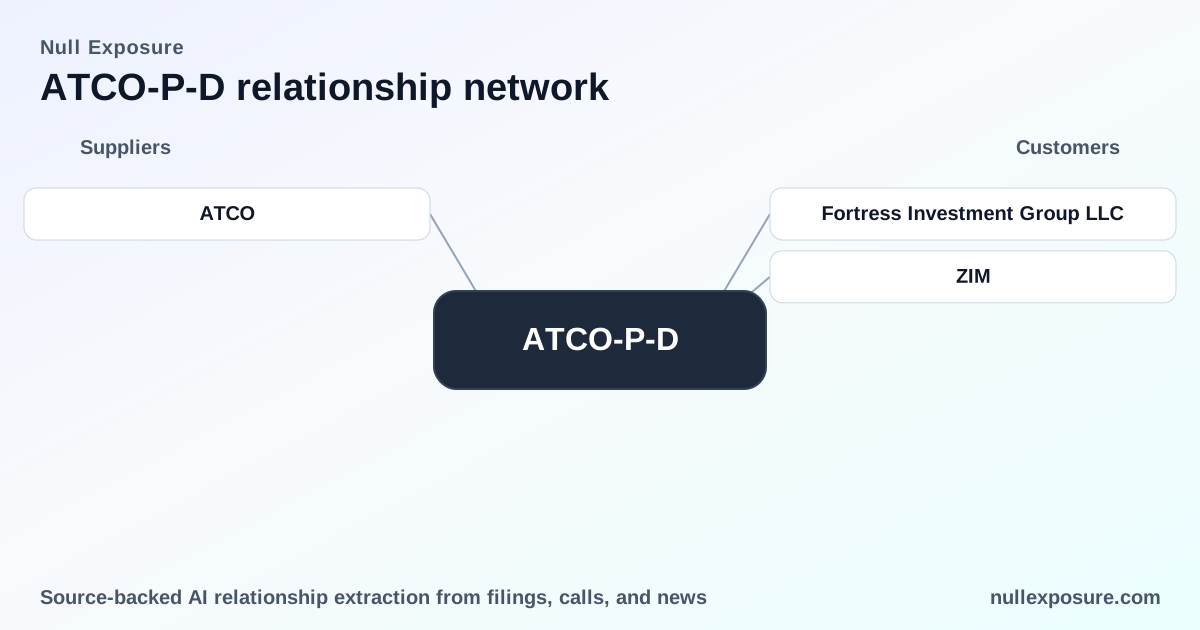
ATCO-P-D: What the advisor roster reveals about supplier posture and transaction risk
ATCO-P-D’s supplier record captures a concentrated set of professional-service engagements used to execute a material corporate transaction. The company sources high‑caliber financial and legal advisors to drive M&A outcomes, and those supplier choices directly influence deal execution speed, governance toughness, and cost structure — all of which matter to investors evaluating control events or counterparty exposure.
Explore supplier intelligence and relationship mapping at https://nullexposure.com/ for a complete view of advisor networks and governance signals.
A short read for investors: how these suppliers fit into the monetization model
ATCO-P-D’s monetization is driven by the underlying operating enterprise (listed as ATCO/Atlas in public reporting), while the supplier records document how the company buys transactional competence — external financial advice and legal defense — to protect shareholder value during strategic events. Supplier spend is event-driven and concentrated, so investors should treat these relationships as high-impact, short-duration investments in execution capability rather than recurring operating vendors.
What the named advisors tell you about transaction posture
The named suppliers — a bulge‑bracket financial adviser and two top-tier law firms — signal a formal, high‑stakes sale or strategic review handled by a Special Committee. That posture implies:
- High criticality: External advisors are central to valuation, deal structure, and regulatory navigation.
- Concentrated contracting: Few, elite providers are engaged rather than a broad roster of boutique vendors.
- Transactional maturity: Use of established global firms indicates a sophisticated governance approach and standard M&A playbook.
These are company-level signals about contracting posture and maturity rather than permanent supplier dependence.
The relationships investors need to track now
CityBiz reported on the transaction and the Special Committee’s advisor appointments on March 9, 2026 (https://www.citybiz.co/article/341751/atlas-corp-to-be-acquired-by-poseidon-acquisition-corp-for-10-9-billion/). The record lists three professional-service suppliers; each is summarized below.
Morgan Stanley & Co. LLC — financial adviser to the Special Committee
Morgan Stanley is serving as financial adviser to the Special Committee overseeing the transaction, a role that places the firm at the center of valuation, negotiation strategy, and fairness assessments. CityBiz reported the appointment in its March 9, 2026 coverage of the Atlas Corp acquisition (https://www.citybiz.co/article/341751/atlas-corp-to-be-acquired-by-poseidon-acquisition-corp-for-10-9-billion/).
Gibson, Dunn & Crutcher LLP — legal adviser to the Special Committee
Gibson Dunn is named as one of the legal advisors to the Special Committee, responsible for structuring deal terms and managing material legal risk tied to the sale process. The firm’s role was documented in the same CityBiz article covering the transaction on March 9, 2026 (https://www.citybiz.co/article/341751/atlas-corp-to-be-acquired-by-poseidon-acquisition-corp-for-10-9-billion/).
Morris, Nichols, Arsht & Tunnell LLP — legal adviser to the Special Committee
Morris Nichols is the other legal advisor engaged by the Special Committee, complementing Gibson Dunn with Delaware corporate and litigation expertise that is frequently decisive in public-company M&A. CityBiz’s March 9, 2026 article lists this appointment alongside the other advisor disclosures (https://www.citybiz.co/article/341751/atlas-corp-to-be-acquired-by-poseidon-acquisition-corp-for-10-9-billion/).
How these supplier choices change the investment checklist
Investors and operators should convert advisor names into actionable diligence items:
- Deal completion probabilities and timing: The presence of top-tier advisors shortens time-to-close and reduces procedural friction, increasing the probability of a clean outcome. Track filings and Special Committee disclosures for pacing signals.
- Cost of execution: High-caliber advisors carry premium fees; allocate projected deal costs into NAV and transaction break‑even calculations.
- Legal backstops: Dual legal representation — one national, one Delaware-specialist — reduces legal exposure on governance or disclosure claims.
- Governance signal: A named Special Committee with independent advisors is a governance-positive indicator for minority investors.
For deeper supplier mapping and governance scoring, visit https://nullexposure.com/ to compare advisor networks across comparable transactions.
Company-level constraints and operating model signals
There are no explicit constraint excerpts attached to the supplier records; however, the advisor roster itself generates several company-level signals that reflect ATCO-P-D’s operating model:
- Contracting posture — event-driven and concentrated: Supplier engagements are short-lived, targeted, and centered on strategic transactions rather than long-term operational sourcing.
- Concentration risk — low number of high-impact suppliers: A small set of advisors implies single-point exposures around execution competence and fee negotiation leverage.
- Criticality — transaction-critical: These suppliers are mission-critical for material corporate events; failure or poor performance would materially affect deal outcomes.
- Maturity — institutional governance: Hiring Morgan Stanley, Gibson Dunn, and Morris Nichols signals mature governance practices and preparedness for complex regulatory and litigation scenarios.
Treat these as structural characteristics of supplier behavior at the company level rather than permanent vendor commitments.
Risk factors and monitoring cadence for operators and investors
- Fee exposure: Premium advisory fees compress transaction returns; quantify expected advisor cost against deal premium.
- Execution concentration: Relying on a narrow advisor cohort accelerates decision-making but concentrates counterparty risk; monitor advisor conflicts disclosed in Special Committee filings.
- Regulatory and litigation runoff: Legal work often continues post‑close; budget for follow‑on counsel and dispute-resolution costs.
- Disclosure cadence: Special Committee filings and press releases are the primary windows into changing supplier roles — establish a weekly to biweekly monitoring cadence during active processes.
Bold takeaway: advisor quality reduces execution uncertainty but increases near-term cash outflow and concentrates counterparty dependency.
Explore comparative advisor and supplier histories to benchmark fee and outcome performance across transactions at https://nullexposure.com/.
Final read for busy investors
The ATCO-P-D supplier footprint is a classic, transaction-focused advisor stack: a leading investment bank paired with national and Delaware-focused law firms. That structure accelerates deal execution, elevates governance standards, and centralizes legal and valuation risk into a few measurable touchpoints. Investors should incorporate advisor fees, Special Committee disclosures, and post-close legal runoff into valuation modeling and monitoring routines.
For continuous supplier intelligence and to map advisor exposure across your portfolio, visit https://nullexposure.com/ — actionable supplier insight that converts advisory rosters into investment signals.