A10 Networks (ATEN): Supplier posture and what it means for operators and investors
A10 Networks sells secure application services and infrastructure — primarily through a mix of hardware appliances, licensed software and recurring support and services — and monetizes via product sales, software subscriptions, and services contracts. The company outsources hardware manufacturing and regional deliveries while retaining product design, software development, and go-to-market control, which creates a low-capex, variable-cost operating model that supports an attractive gross margin profile (Gross Profit TTM: $230.5M on Revenue TTM: $290.6M). For investors and operators, supplier posture drives the trade-off between capital efficiency and supply-chain dependency: better margins at the cost of outsized counterparty and logistics risk. Learn more at https://nullexposure.com/.
What the public record says about who makes and moves A10 products
A10’s filings and public disclosures describe a clear outsourcing strategy. Manufacturing is outsourced to original design manufacturers (ODMs) rather than kept in-house, and the company explicitly states it does not have long-term manufacturing contracts that guarantee fixed capacity or pricing. That contract posture is consequential: A10 benefits from low fixed manufacturing costs but accepts short-term supplier commitments that increase exposure to capacity tightness and price volatility when demand spikes.
- Contracting posture: A10 uses agreements that automatically renew on one-year terms, and the company says it has no long-term manufacturing contracts guaranteeing capacity or price. This establishes a short-term contracting profile with annual renewals and operational flexibility, but limited capacity guarantees.
- Manufacturing role and maturity: The company outsources hardware to named partners, and the agreements referenced go back more than a decade, indicating mature, established supplier relationships rather than ad hoc sourcing. Evidence cites agreements with AEWIN Technologies and Lanner Electronics, which supports a view of recurring ODM partnerships rather than spot buying.
- Logistics and delivery: A10 outsources deliveries in at least one important market (Japan) to third‑party logistics providers, demonstrating a regional logistics dependency that is operationally critical for APAC fulfillment.
These constraints create a supplier profile with low capital intensity and predictable product roadmaps but elevated counterparty and logistics risk at times of supply stress. For firms with recurring ARR-like revenue from subscriptions and support, this structure supports margin expansion while exposing operations to single-source or regional logistics disruptions.
Learn more about supplier mapping and risk signals at https://nullexposure.com/.
Every external relationship found in public reporting
-
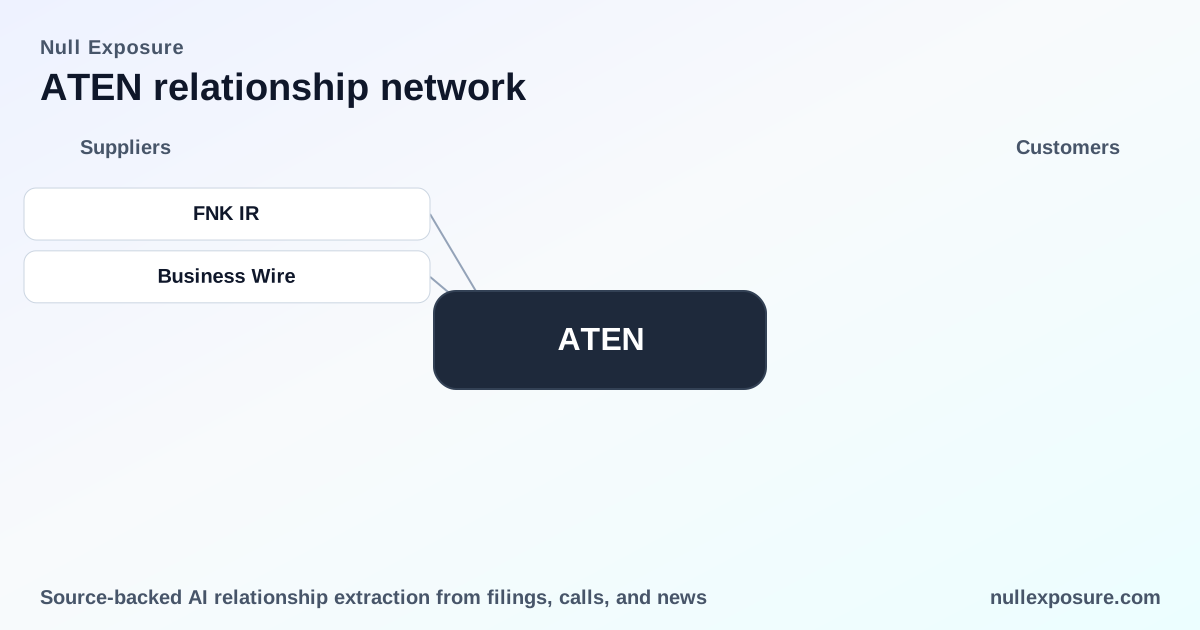
FNK IR — Investor contact and PR support. The company listed Rob Fink and Tom Baumann of FNK IR as investor contacts and provided an investor relations email (aten@fnkir.com) in FY2026 communications, signaling outsourced investor-relations support for event coordination and media handling. (Source: company investor announcement republished via StockTitan/press release chain, March 2026.)
-
Business Wire — Distribution channel for material public announcements. A10 used Business Wire in February 2026 to announce an Investor Day in San Francisco (Feb 19, 2026), showing that the company leverages established press-distribution services for major investor events. (Source: Business Wire press release, Feb 2026.)
Both items are communications and IR relationships rather than supply-chain partners, but they matter because investor-facing cadence and message control influence liquidity and reputational exposure during supplier incidents or product-cycle shifts.
How supplier choices affect the business model and risk profile
A10’s supplier signals are consistent with a strategic choice: prioritize product innovation, software subscriptions, and recurring services while minimizing capital and factory ownership. That delivers clear operating advantages and a specific set of risks:
- Cost structure and margins: Outsourcing manufacturing keeps fixed costs low and supports strong gross margins (Gross Profit TTM $230.5M on Revenue TTM $290.6M), while letting the company scale software and services with limited incremental capex.
- Supply concentration and criticality: Manufacturing dependency on ODMs and use of a regional 3PL for Japan create critical single points. Contracts are short-term and renewable annually, which reduces lock-in but increases the company’s exposure to OEM pricing and capacity cycles.
- Negotiation leverage and flexibility: Short-term, auto-renewing agreements provide flexibility to shift suppliers or adjust terms annually, which is useful in high-innovation hardware markets. However, without guaranteed capacity commitments, the company faces execution risk when demand accelerates or when OEMs reallocate capacity.
- Maturity of relationships: The presence of longstanding agreements (for example, agreements with AEWIN and Lanner cited in filings) signals operational continuity and supplier familiarity, which mitigates some replacement risk but does not eliminate exposure to market-wide constraints (component shortages, shipping disruptions).
Near-term monitoring priorities for investors and operators
Operators and investors should track a short list of high-impact indicators that will reveal when supplier posture shifts from benign to constraining:
- Supplier capacity data points: any public notice of capacity limits or new multi-year OEM commitments.
- Regional logistics performance: lead times into APAC, particularly Japan, since A10 outsources deliveries there to a third‑party logistics provider.
- Pricing and gross margin trends: watch gross margin and component cost commentary in quarterly calls; the short-term contracting posture makes gross margin sensitive to supplier price moves.
- IR cadence and messaging: investor communications distributed through FNK IR and Business Wire provide an early read on how management frames supplier or fulfillment issues.
Key considerations: short-term contracting gives flexibility but amplifies execution risk, long-tenured ODM relationships lower transition risk, and regional logistics outsourcing concentrates exposure in APAC markets.
Bottom line and recommended next steps
A10 Networks runs a capital-light manufacturing model that supports healthy margins and recurring revenue growth, but that same model embeds supplier and logistics concentration risk due to short-term manufacturing contracts and outsourced delivery in important markets. For active investors and operators, the priority is monitoring supplier capacity statements, margin trajectory, and logistics lead times as early warning indicators.
- If you cover or evaluate A10, add supplier capacity and APAC logistics metrics to your watchlist and review investor communications distributed through FNK IR and Business Wire for tone and frequency changes.
- For operators, map second-source options and contractual levers with current ODMs to reduce the single-point risk from short-term contracts.
For a deeper supplier-risk briefing and continuous monitoring tools, visit https://nullexposure.com/. If you want a tailored supplier map for ATEN or comparable infrastructure vendors, start here: https://nullexposure.com/.