Aterian Inc (ATER): supplier relationships and what they mean for investors
Aterian operates as a technology-enabled consumer products company that sources finished goods primarily from Asia, aggregates inventory in third-party warehouses, and monetizes by selling branded consumer products through digital channels while outsourcing a large portion of platform, logistics and customer experience functions. Revenue generation depends on volume-driven e‑commerce sales, low-cost manufacturing from China, and third-party partners that execute order fulfillment and customer support. For investors evaluating counterparty risk, vendor concentration and the ongoing strategic review are the primary value drivers today. Learn more about how we surface supplier signals at https://nullexposure.com/.
How Aterian contracts and where supply risk lives
Aterian’s operating model is built for flexibility: the company discloses that it does not maintain long-term purchase contracts and operates mainly on a purchase‑order/spot basis. This contracting posture reduces fixed commitments but raises exposure to input-price volatility, tariffs and shipping disruptions. The company also reports heavy procurement from China and maintains material inventory purchase orders in the single-digit millions ($6.5M in 2023; $9.2M in 2024), which positions vendors in the mid-range spend band and creates concentrated fulfillment risk during demand spikes or supply interruptions.
- Short‑term and spot contracting dominates — Aterian runs on purchase orders and has advisory engagements that are explicitly short-term.
- Geographic concentration in APAC (notably China) amplifies tariff and logistics exposure.
- Operational criticality is high because the company relies on a single unnamed vendor to provide its sales platform, logistics/fulfillment and collections.
These signals together imply a supplier posture that is flexible but concentrated: low contractual maturity, moderate spend per vendor, and at least one critical service-provider dependency that can materially affect revenue flows.
For additional vendor intelligence and to monitor evolving supplier risk, visit https://nullexposure.com/.
Supplier and advisor relationships investors should track
Below I list each relationship identified in public reporting and news, with a plain-English take and a source reference.
-
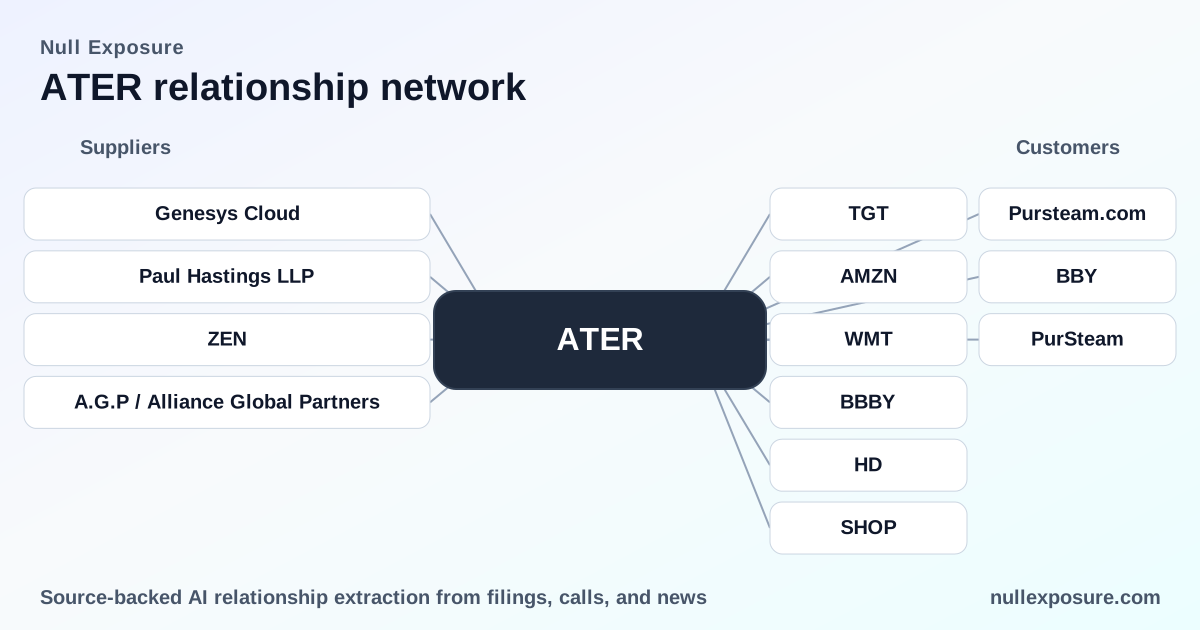
Genesys Cloud — Aterian consolidated its customer-experience operations onto the Genesys Cloud platform, shifting telephony and buyer messaging into a unified third‑party CX stack to streamline interactions. Source: No Jitter, March 9, 2026 — https://www.nojitter.com/contact-centers/aterian-consolidates-cx-with-genesys-cloud
-
Zendesk — Historically, some Aterian buyer messages and support channels ran through Zendesk; the company has transitioned many of those interactions as part of the move to a consolidated CX platform. Source: No Jitter, March 9, 2026 — https://www.nojitter.com/contact-centers/aterian-consolidates-cx-with-genesys-cloud
-
Paul Hastings LLP — Paul Hastings is serving as legal counsel during Aterian’s announced strategic review to explore alternatives for maximizing shareholder value. Source: GlobeNewswire press release, December 8, 2025 — https://www.globenewswire.com/news-release/2025/12/08/3201596/0/en/Aterian-Announces-Exploration-of-Strategic-Alternatives-to-Maximize-Shareholder-Value.html
-
A.G.P / Alliance Global Partners — Aterian has engaged A.G.P / Alliance Global Partners to assist in exploring strategic alternatives, indicating the company has retained a financial advisor to evaluate sale, merger or other value-enhancing options. Source: Quiver Quant / company announcement (reported December 2025) — https://www.quiverquant.com/news/Aterian%2C+Inc.+Initiates+Strategic+Review+to+Explore+Alternatives+for+Maximizing+Shareholder+Value
Each of these relationships has a distinct operational or strategic purpose: Genesys and Zendesk are operational suppliers; Paul Hastings and A.G.P. are advisors in a strategic review.
What the relationship map implies for valuation and downside
Aterian’s financial profile is stressed: Revenue TTM ~$78.45M, gross profit $46.27M, negative EBITDA ($10.2M) and negative EPS (-$1.59). Market capitalization sits near $6.08M while the analyst target price (where published) suggests a different long-term view. The engagement of A.G.P and Paul Hastings signals a formal strategic review — this is a liquidity/valuation event that investors must treat as a binary catalyst: either the company secures a transaction that addresses balance-sheet and scale constraints, or it remains exposed to operating losses and concentrated vendor risk.
Operationally, moving CX to Genesys Cloud and previously using Zendesk shows a deliberate outsourcing of customer-facing infrastructure, which reduces fixed headcount costs but increases dependency on third-party platform uptime and contractual terms for support and telephony. The company’s disclosure that one unnamed vendor handles sales platform, warehousing, invoicing and collections is a major single-point-of-failure that investors must monitor through contract disclosures and any forthcoming strategic-sale documentation.
Constraints and what they tell you about vendor maturity and concentration
The public excerpts provide company-level signals that explain the operating posture:
- Contracting posture: Predominantly short-term and spot (purchase‑order) commitments; advisor agreements are explicitly six months with possible extensions.
- Counterparty types: The company uses individual advisors (example: William Kurtz under an Advisor Agreement) and professional firms (audit and legal) for high‑specialty services.
- Geography: The majority of finished goods sourcing is from China, concentrating logistical risk in APAC.
- Materiality / criticality: Aterian acknowledges reliance on one principal vendor for sales platform, fulfillment and collections — a critical dependency that elevates operational risk.
- Spend profile: Inventory POs indicate mid-range vendor spend ($6.5M–$9.2M outstanding POs), while professional services spending (audit fees) is lower, consistent with ad hoc professional engagements.
These are company-level characteristics that shape commercial risk: low contract duration, concentrated fulfillment dependency, and APAC sourcing combine to produce asymmetric downside if the unnamed key vendor changes terms or service quality.
Practical next steps for investors
- Monitor filings and press releases tied to the strategic review (A.G.P and Paul Hastings updates) for timing and deal structure. For ongoing supplier monitoring solutions, see https://nullexposure.com/.
- Request granular disclosure around the unnamed “key vendor” in any investor Q&A: contract length, exit terms, back-up providers, and revenue dependence.
- Stress-test scenarios where supply or CX vendors incur outages or price increases; given Aterian’s thin market cap and negative EBITDA, operational disruptions can rapidly compress enterprise value.
Aterian is at a strategic inflection: outsourced operations reduce fixed costs but create concentrated counterparty risk, and the strategic review is the immediate catalyst that will determine whether value is realized or the company remains challenged by scale and supplier dependence. For structured supplier intelligence and to track these relationships continuously, visit https://nullexposure.com/.