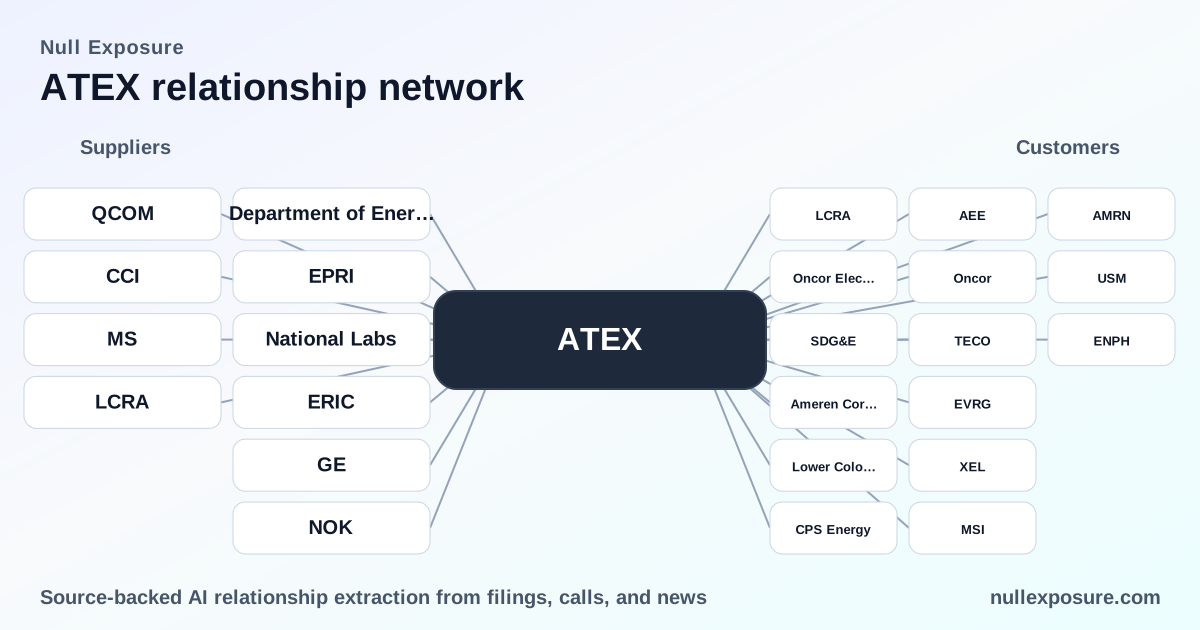
Anterix (ATEX): A supplier play anchored in licensed 900 MHz private wireless for utilities
Anterix operates a focused, asset-led business that monetizes licensed 900 MHz spectrum and an expanding partner ecosystem to sell private, utility-grade wireless networks and access services to electric utilities and grid operators. The firm generates revenue by licensing spectrum, selling network access and infrastructure products, and co-developing deployment channels with tower owners and chipset vendors; these relationships are central to growth and execution. For investors, the question is whether Anterix’s commercial partnerships and technology alliances convert scarce spectrum ownership into recurring, scalable revenue. For a concise exploration of partner risk and opportunity, see https://nullexposure.com/.
Why partners move the revenue needle for Anterix
Anterix’s operating model is platform-plus-partner: the company owns a differentiated regulatory and physical asset (licensed 900 MHz band) and relies on third-party vendors, tower operators, standards bodies, and utilities to commercialize it. This results in a contracting posture that is collaborative and channel-dependent rather than vertically integrated, with a heavy focus on enterprise utility customers and ecosystem validation. Financially, the company shows small absolute revenue today (Revenue TTM ~$5.9M) but elevated market value (MarketCap ~$682M), which implies investor expectation that partnerships will scale network deployments and monetization. Anterix reported quarter metrics through FY2026 Q3 in public commentary and filings that underpin these claims. Learn more at https://nullexposure.com/.
Partnership map — concise takeaways for every named relationship
Department of Energy
Anterix explicitly positions the Department of Energy as a collaborator that reinforces its leadership in utility innovation; this is a credibility signal for grid-focused programs mentioned on the 2025 Q3 earnings call. According to the 2025 Q3 earnings call commentary, the DOE is cited among national partners supporting utility innovation.
EPRI (Electric Power Research Institute)
EPRI is referenced as an industry research partner helping validate private-network use cases and standards for utilities; Anterix cites EPRI on its 2025 Q3 earnings call as part of its ecosystem of leading utility research organizations.
National Labs
Anterix lists the National Labs alongside EPRI and DOE as partners advancing utility innovation and testbeds, strengthening its technical validation in national grid projects per the 2025 Q3 earnings call.
Ericsson (ERIC)
Ericsson is named among approximately 20 technology companies supporting an evolution of the band to enable private, secure networks, indicating OEM-level ecosystem support for radio and core network elements; this was discussed on Anterix’s 2025 Q4 earnings call.
GE (GE)
GE appears in Anterix’s filings of stakeholder support for band evolution and private network adoption, suggesting interest from large industrial systems integrators and grid OEMs; this reference came from the 2025 Q4 earnings call.
Nokia (NOK)
Nokia is cited as a supporting technology company advocating for band evolution to accommodate private utility networks, as mentioned on the 2025 Q4 earnings call—implying vendor readiness to supply equipment for 900 MHz deployments.
Qualcomm / Qualcomm Technologies (QCOM)
Qualcomm is a technology partner supplying Snapdragon SDX35-3 and SDX32-3 IoT modems that deliver 4G/5G connectivity on Anterix’s 900 MHz platform, enabling device-level interoperability and edge intelligence; this collaboration was detailed in a GlobeNewswire press release in February 2026 and reported by industry outlets in March 2026.
Crown Castle (CCI)
Crown Castle is a tower-access partner under Anterix’s TowerX initiative, offering utilities access to a broad network of 40,000+ sites to accelerate 900 MHz private network rollouts; this arrangement is documented in a GlobeNewswire press release on November 12, 2025 and subsequent coverage.
Morgan Stanley Smith Barney LLC
Morgan Stanley Smith Barney LLC shows up as the named broker-dealer on a Form 144 filing associated with ATEX insider or secondary sales activity in FY2026 filings, indicating institutional brokerage involvement in liquidity events reported in SEC filing summaries in March 2026.
LCRA
Anterix’s disclosures show narrowband spectrum license receipts tied to the LCRA agreement, recording a $1,430 line item in fiscal results—this accounting detail was included in Anterix’s FY2026 Q3 results published via GlobeNewswire in February 2026.
(Each item above is drawn from Anterix’s quarterly earnings calls and public press releases and filings during FY2025–FY2026 as cited in company commentary and public press distribution.)
What these partnerships imply about Anterix’s business model and constraints
Anterix’s relationship set highlights several company-level operating characteristics:
- Contracting posture: The company operates as a spectrum landlord and channel orchestrator, relying on OEMs, tower operators, and national labs for technical validation and deployment scale rather than owning end-to-end deployment teams.
- Concentration: Customer concentration risk is meaningful because the primary addressable market is U.S. utilities; partner relationships serve to broaden addressability but do not eliminate core-sector concentration.
- Criticality: For utilities adopting private wireless, Anterix provides a critical asset (licensed 900 MHz) that is difficult to substitute at scale, giving the company strategic leverage in negotiations and pricing.
- Maturity of the ecosystem: Vendor endorsements (Ericsson, Nokia, Qualcomm) and tower partnerships (Crown Castle) indicate an accelerating commercialization phase—the market is moving from pilots to initial deployments, but absolute revenue remains small today.
- Commercial cadence: The business model will produce lumpy revenue tied to spectrum licensing deals, tower access contracts, and multi-year utility rollouts, requiring patient capitalization from investors.
Investment implications: what to watch and why it matters
- Upside: If Anterix converts partner support into repeatable utility contracts and device ecosystems (Qualcomm-enabled chipsets and OEM support), the company can leverage scarce licensed spectrum into recurring access revenues and equipment/installation margins.
- Risk: Execution depends on channel scale and utility procurement cycles; failure to convert vendor endorsements into signed utility contracts or delays in tower access rollout will compress growth expectations. Insider and Form 144 activity tied to Morgan Stanley can signal shareholder liquidity but also potential dilution timing—monitor filings.
- Financial posture: Market capitalization (
$682M) relative to trailing revenue ($5.9M) embeds high growth expectations; investors should track sequential customer wins, revenue cadence, and how TowerX and chipset partnerships translate into contracted revenue.
For ongoing diligence and to see how partner dynamics evolve into commercial revenue, visit https://nullexposure.com/.
Final recommendation for investors evaluating supplier relationships
Assess Anterix as a strategic infrastructure supplier where partner validation matters as much as regulatory ownership. Focus on pipeline-to-contract conversion, tower access rollouts with Crown Castle, chipset integration progress with Qualcomm, and signed utility contracts that demonstrate scalable monetization. Positive vendor endorsements are necessary but not sufficient; contracts and revenue trajectory are the decisive signals.
If you want a deeper partner-risk map or a synthesis of filings and call transcripts tied to ATEX partnerships, start here: https://nullexposure.com/.