Alpha Technology Group (ATGL) — supplier relationships and operating signals investors should track
Alpha Technology Group is a Hong Kong–based IT development and consulting firm that monetizes professional services through client engagements and the public markets. The company generates revenue from consulting and development contracts, reports a trailing twelve‑month revenue of $7.4 million and gross profit of $3.64 million, but operates at a negative EBITDA and deeply negative returns on equity and assets. For investors evaluating supplier relationships and counterparty risk, the combination of high insider control, an extremely small public float, stretched valuation multiples, and negative operating leverage creates a concentrated, execution‑risk profile that demands active monitoring. Learn more at NullExposure.
How ATGL gets paid and why that matters for counterparties
Alpha Technology Group is an investment holding company that provides IT development and consulting services from its base in Kwun Tong, Hong Kong. According to company disclosures through the latest reported quarter (2025-12-31), revenue is concentrated at a modest scale — $7.4 million TTM — with negative EBITDA of $57.7 million and an operating margin of -12%. Those figures reflect a business model that currently loses money at the operating level despite positive gross margins, indicating project-level revenue recognition but limited operating scale.
Company-level signals important to suppliers and commercial partners:
- Contracting posture: a services firm profile implies project-by-project engagements and limited recurring revenues; contract terms will drive near-term cash flow volatility.
- Concentration and control: insiders hold ~82.5% of shares, while institutional ownership is effectively nil, which concentrates strategic control with founders/insiders.
- Criticality to clients: as a professional services supplier, the company’s offerings are substitutable across the market, so client retention and contract economics are central to risk assessment.
- Maturity and scale: small revenue base, negative operating cash performance, and low institutional investment mark the company as early‑stage or transitional in maturity.
These company-level signals should be read as supplier-risk characteristics, not as attributes of any single counterparty or underwriting relationship.
Financial footprint: valuation and governance amplify supplier risk
ATGL is publicly listed on NASDAQ with a market capitalization around $321 million while reporting $7.4 million in revenue TTM, yielding an extremely high price-to-sales multiple (Price/Sales ≈ 43.4) and a Price/Book of ~102.4. Enterprise-value metrics are likewise stretched (EV/Revenue ≈ 336.2). The company has a very small public float (2,675,000 shares) against 15,262,500 shares outstanding, compounding liquidity risk for counterparties that rely on market access.
Key governance and financial details investors should internalize:
- High insider ownership (82.47%) reduces takeover risk but increases single‑party control over supplier strategy and contract approvals.
- Minimal institutional presence (0.002%) limits independent analyst coverage and market scrutiny.
- Beta of 5.53 signals outsized market volatility that can affect counterparties whose contracts contain market‑linked covenants or deliverable timelines.
Those elements turn routine supplier diligence into an assessment of operational execution and founder incentives, rather than a checks-and-balances evaluation of market governance.
The supplier and capital-market relationship inventory you must know
Renaissance Capital and other IPO reporting captured a single materially disclosed relationship tied to ATGL’s market listing:
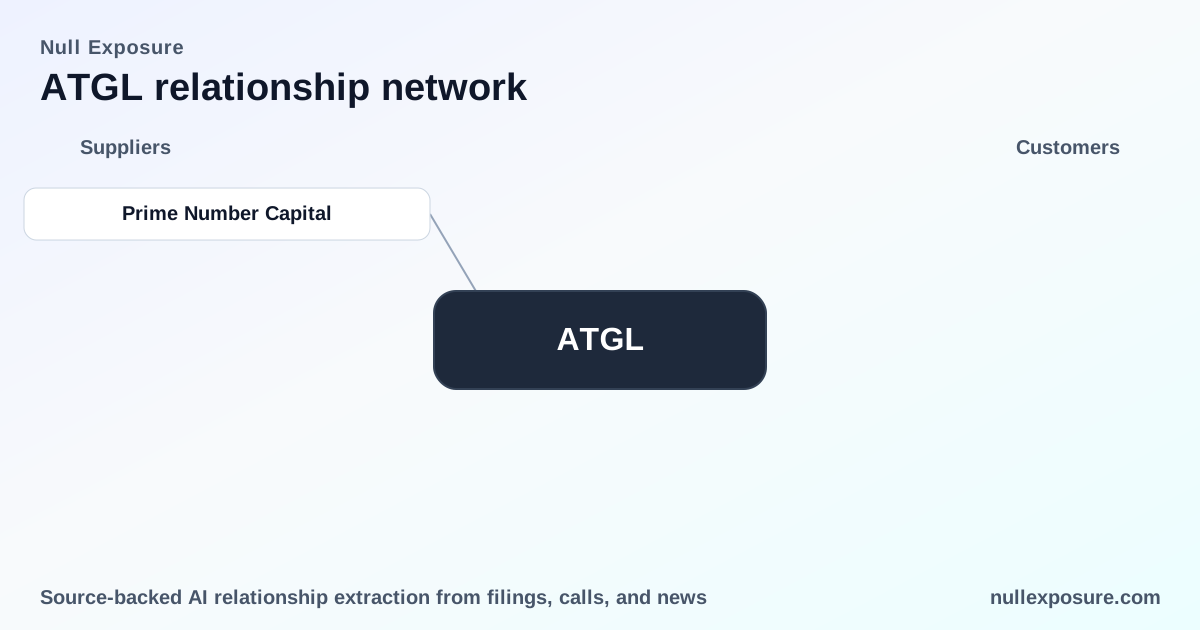
- Prime Number Capital acted as sole bookrunner on ATGL’s U.S. IPO. Renaissance Capital reported on March 9, 2026 that Prime Number Capital served as sole bookrunner for Alpha Technology Group’s U.S. offering (source: Renaissance Capital IPO news, March 9, 2026 — https://www.renaissancecapital.com/IPO-Center/News/101644/Hong-Kong-based-tech-services-provider-Alpha-Technology-Group-prices-US-IPO).
This relationship is transactional and capital-market facing: it signals that Prime Number Capital handled the underwriting and placement mechanics for the listing rather than an ongoing operational supplier engagement. For operators, that means the relationship is relevant for understanding ATGL’s access to capital and initial public distribution, not for continuity of IT services or delivery.
What the underwriting relationship implies for counterparties and procurement
An underwriting role by Prime Number Capital conveys two practical implications for suppliers and partners:
- Access to liquidity was secured through a sole bookrunner structure, which concentrates initial distribution and could influence lockup, float dynamics, and subsequent trading liquidity.
- The underwriting does not create an operational dependency; suppliers negotiating contracts should underwrite counterparty credit and execution risk based on ATGL’s operating metrics and insider control rather than the presence of an IPO bookrunner.
For procurement and credit teams, the underwriting disclosure is a signal to focus diligence on cash flow timing, contract terms, and counterparty concentration rather than expecting broad market support for receivables or operational guarantees.
Explore a structured view of these supplier signals at NullExposure to incorporate capital-market relationships into counterparty risk models.
Actionable investor and operator takeaways
- Prioritize cash-flow covenants and short payment cycles. The company’s negative EBITDA and small revenue base increase the importance of payment certainty in supplier contracts.
- Treat counterparty concentration as a governance risk. High insider ownership and low institutional oversight create single‑party decision authority; include escalation clauses and termination triggers tied to governance events.
- Monitor float and trading liquidity. Very small float and extreme valuation multiples create price volatility that can feed into margin and covenant triggers for capital‑intensive partners.
- Separate capital-market signals from operational continuity. Underwriting relationships like the one with Prime Number Capital influence equity liquidity, not service delivery guarantees.
If you manage supplier risk or run procurement operations, incorporate these factors into credit approval matrices and contract templates.
For an in-depth supplier relationship framework tied explicitly to public-market disclosures, visit NullExposure.
Conclusion: where ATGL stands as a supplier counterparty
Alpha Technology Group operates a small, founder-controlled services business with modest revenues, negative operating income, and highly concentrated ownership. The sole disclosed market relationship — a bookrunner role by Prime Number Capital at IPO — is relevant for liquidity and ownership dynamics but not for service delivery. Investors and operators should treat ATGL as a high‑execution‑risk supplier: contract terms, payment mechanics, and governance triggers will determine whether that risk converts into receivable or performance exposure.
For practitioners building a supplier‑level risk scorecard that integrates these capital-market signals, see additional resources at NullExposure.