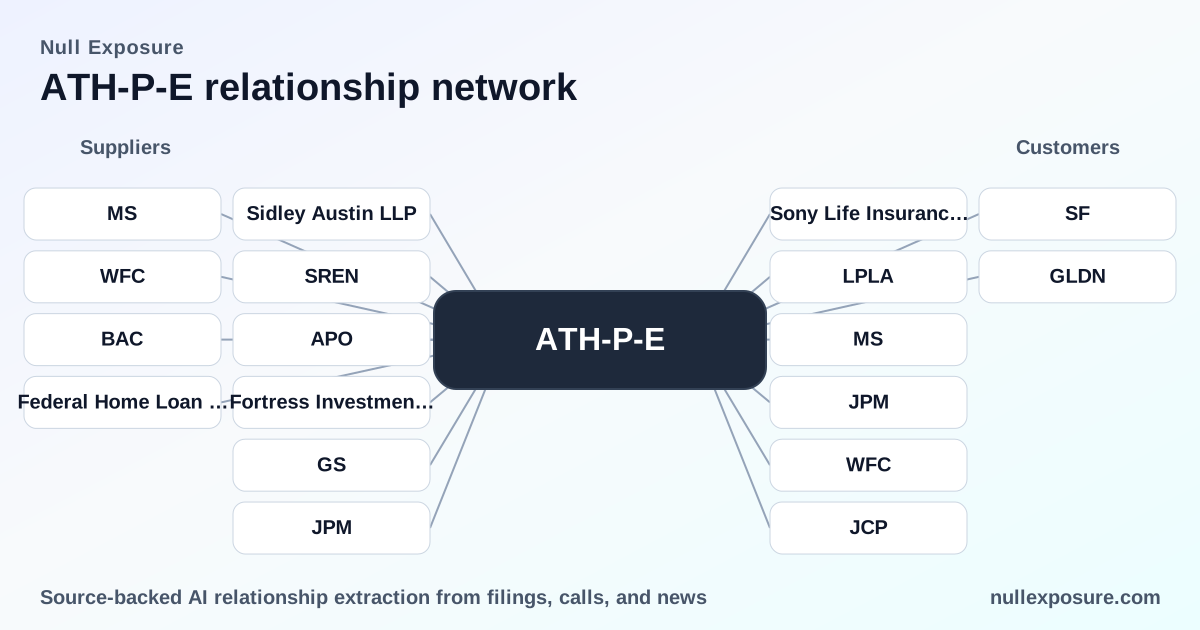
ATH-P-E supplier relationships: a concise map for investors
Athene operates as a life re/insurance and retirement-services platform that monetizes by underwriting and reinsuring blocks of life business, leveraging capital markets and partner-originated assets, and accessing bank-led financing and syndications to fund portfolio growth. The supplier relationships under ATH-P-E reveal a pattern: legal and advisory partners, large global banks as capital-market conduits, strategic asset-manager alignments, and retrocession/reinsurance counterparties that underwrite mortality and longevity exposure. For a decision-maker evaluating counterparty risk and strategic dependency, this roster is a practical lens on Athene’s operating posture.
Explore the full supplier map at https://nullexposure.com/.
What the relationship roster implies about how Athene runs the business
Athene contracts broadly for three core needs: legal/regulatory support, capital-market distribution, and risk transfer. The repeat presence of top-tier investment banks as book-runners signals a capital-markets-first funding model; repeated references to Swiss Re and retrocession arrangements show a conservative, layered approach to mortality risk transfer; and ties to Apollo/asset-originators demonstrate reliance on partner-sourced, recurring asset flows rather than one-off purchases.
No formal constraints were provided in the supplier dataset; treat the following as company-level operating signals derived from the relationship evidence:
- Contracting posture — outsourced and syndicated: Athene uses external book-runners and legal counsel rather than internal origination for capital raises and structuring.
- Concentration — diversified among top-tier counterparties: multiple global banks (Goldman, JPM, Morgan Stanley, Wells Fargo, BofA) reduce single-bank dependency but create a systemic link to wholesale markets.
- Criticality — high for a small set of relationships: Swiss Re (retrocession) and top-tier banks (funding) are operationally critical because they directly affect capital and risk-transfer capacity.
- Maturity and continuity — evidence spans FY2021–FY2025, indicating sustained, multi-year commercial ties rather than ephemeral arrangements.
If you want a structured export of these relationship signals for diligence, visit https://nullexposure.com/ for more detail.
The relationship roster — one-by-one, plain-English and sourced
Sidley Austin LLP
Athene engages Sidley Austin LLP as legal counsel in transactions involving minority investments and structuring, reflecting a reliance on external law firms for deal execution. This relationship is cited in a PR Newswire release covering Athene’s involvement in a FY2021 minority investment in Challenger Limited (PR Newswire, FY2021).
Swiss Re (SREN) — reinsurance and retrocession (FY2025 & FY2023)
Swiss Re is contractually partnered with Athene to retrocede mortality risk on in-force blocks (a formal retrocession arrangement tied to whole-life reinsurance); this relationship underpins Athene’s mortality-risk transfer strategy (ReinsuranceNews, FY2025; Bermuda Reinsurance Magazine, FY2023).
Apollo Global Management / Apollo (APO) — asset origination and investment alignment (FY2021)
Apollo is both an investment partner and a source of origination platforms that supply Athene with recurring assets, with Apollo overseeing or coordinating certain investments and platform acquisitions linked to Athene’s balance-sheet deployments (National Mortgage News, FY2021; ReinsuranceNews, FY2021).
Fortress Investment Group — portfolio acquisition (FY2021)
Athene acquired a U.K. housing-finance business from Fortress as part of its portfolio build-out strategy, indicating willingness to buy third-party originators or platforms to scale assets (National Mortgage News, FY2021).
Goldman Sachs & Co. LLC — joint book-running manager (FY2023)
Goldman Sachs acted as a joint book-running manager on Athene capital offerings, evidencing the bank’s role in placement and distribution of Athene debt or capital securities (Royal Gazette; Bermuda Reinsurance Magazine, FY2023).
J.P. Morgan — joint book-running manager (FY2023)
J.P. Morgan participated as a joint book-running manager on Athene offerings, supporting Athene’s access to wholesale debt markets and investor syndication (Royal Gazette; Bermuda Reinsurance Magazine, FY2023).
Morgan Stanley — joint book-running manager (FY2023)
Morgan Stanley likewise served as a joint book-runner for Athene’s bond/offering activity, reinforcing the multi-bank syndicate strategy for capital raises (Royal Gazette; Bermuda Reinsurance Magazine, FY2023).
Wells Fargo Securities — joint book-running manager (FY2023)
Wells Fargo Securities was listed among the joint book-runners for Athene’s capital issuance, consistent with Athene’s use of multiple underwriters to distribute paper (Royal Gazette; Bermuda Reinsurance Magazine, FY2023).
BofA Securities (BAC) — joint book-running manager (FY2023)
BofA Securities is named as a joint book-runner on Athene offerings, illustrating the company’s tendency to tap several global banks simultaneously for financing placements (Royal Gazette; Bermuda Reinsurance Magazine, FY2023).
Federal Home Loan Bank — liquidity and borrowing capacity (FY2025)
Athene retains access to additional liquidity and credit lines that explicitly include borrowing capacity from the Federal Home Loan Bank, which is listed among sources of extra cash alongside other facilities—a signal of diversified short-term liquidity options (AM Best / Yahoo Finance coverage of FY2025 credit affirmations).
Investment implications and risk framing
- Capital-market dependency is high: Athene uses large-bank syndicates for bond issuance and placements, which keeps funding flexible but ties execution to market conditions and lead-manager appetite.
- Risk-transfer structure reduces balance-sheet mortality volatility: retrocession with Swiss Re shifts mortality exposure off Athene’s primary books, improving predictability of underwriting results.
- Partnered origination supports growth: Apollo-originated platforms and acquired originators (e.g., Fortress-originated assets) provide repeatable assets, lowering marginal acquisition cost of invested assets.
Key watch items: counterparty performance of Swiss Re and the bank syndicate during stressed markets; regulatory changes that affect access to Federal Home Loan Bank liquidity; and the continued flow of partner-originated assets from Apollo and similar platforms.
For a deeper supplier profile and to track changes to these counterparties over time, visit https://nullexposure.com/.
Bottom line — what investors should take away
Athene’s supplier list reflects a deliberate capital-markets and partnership-first operating model: top-tier banks for funding, global reinsurers for risk transfer, and strategic asset-manager partnerships for asset supply. This configuration supports scale and predictability but concentrates critical operational reliance in a few counterparties whose execution and credit standing materially affect Athene’s ability to grow and fund liabilities.
If you want ongoing monitoring of these supplier relationships and the signals they emit for counterparty risk and liquidity, start at https://nullexposure.com/ and subscribe to updates.