ATI supplier relationships: who they supply, how they contract, and what investors should price in
ATI operates as a strategic metals and specialty alloys supplier to the global aerospace OEMs, monetizing through long-term supply contracts and large raw‑material purchase commitments that underpin jet‑engine component production. The company's revenue model rests on selling premium titanium and nickel‑based alloys and precision forgings into high‑value aerospace applications, capturing margin through specialized metallurgy, scale in vacuum‑melting and forging capabilities, and contractual pricing embedded in long‑term agreements with tier‑one engine manufacturers. For investors, ATI's value derives from durable OEM relationships, concentrated purchasing exposure, and working‑capital programs that both enable and reflect supplier economics. Learn more about supply‑chain counterparty risk and supplier profiling at https://nullexposure.com/.
Operational snapshot: ATI sells engineered metal inputs into a small set of large aerospace customers under long‑term agreements, while managing substantial raw‑material purchase obligations and active working‑capital programs. That combination creates predictable revenue lanes with material counterparty and procurement concentration.
Why the long‑term contracts matter to returns and risk
ATI explicitly states it prefers long‑term supply contracts to secure an adequate supply of premium alloys. Long‑term agreements stabilize future revenue and support capital investment in specialized melting and forging capacity, but they also lock ATI into supply and pricing dynamics that magnify raw‑material exposure. The company-level operating signals are clear: a contracting posture biased toward long‑term LTAs, buyer behavior anchored in active working‑capital management, and raw‑material commitments that exceed $100 million annually. These are company-level characteristics drawn from ATI’s FY2024 disclosures and should be treated as structural to the business model rather than incidental.
- Contracting posture: ATI enters long‑term supply contracts where possible, which supports capacity planning and margin capture.
- Working‑capital role: ATI acts as a buyer of raw materials while participating in supplier financing and managed working‑capital arrangements that shape cash conversion cycles.
- Spend concentration: Unconditional purchase obligations for raw materials exceed $1 billion in aggregate disclosures, signaling high procurement scale and potential concentration risk.
If you want a deeper supplier risk brief and counterparty mapping for portfolio due diligence, visit https://nullexposure.com/ for tailored reports.
Strategic relationships that define revenue (what the filings say)
GE Aviation — a multi‑product long‑term partner
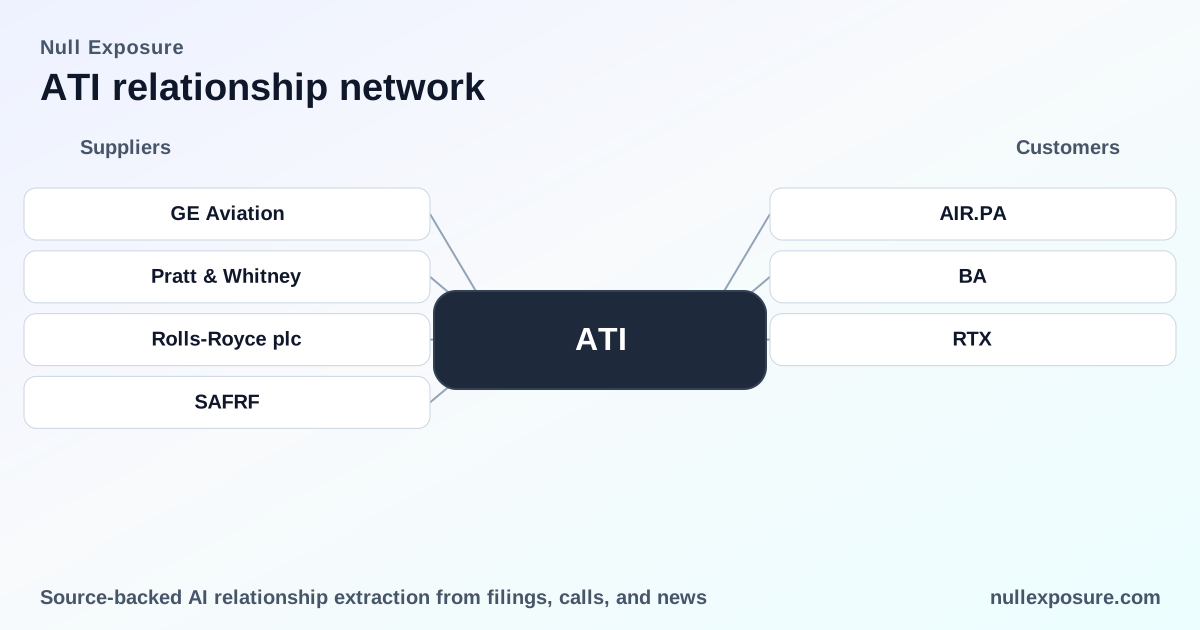
ATI maintains long‑term agreements with GE Aviation to supply premium titanium alloys, nickel‑based alloys, and vacuum‑melted specialty alloys used in commercial and military jet engines, reflecting multi‑material, multi‑product exposure to a top aerospace OEM. According to ATI’s FY2024 10‑K, those LTAs position ATI as a primary metals provider to GE’s engine programs (FY2024 10‑K).
Safran — parallel long‑term alloy supply across products
ATI has LTAs with Safran for supply of the same classes of products—premium titanium and nickel alloys and vacuum‑melted specialty alloys—for commercial and military engine applications, creating a mirrored OEM exposure that diversifies end customers while keeping product scope consistent. ATI documents this relationship in its FY2024 10‑K (FY2024 10‑K).
Pratt & Whitney — dedicated forgings for engines
ATI supplies isothermal and conventional forgings to Pratt & Whitney under contractual arrangements for jet‑engine components, indicating a focused forgings capability that feeds Pratt & Whitney’s engine manufacturing supply chain. The Pratt & Whitney relationship is described in ATI’s FY2024 10‑K as part of its long‑term commercial engagement (FY2024 10‑K).
Rolls‑Royce plc — disc‑quality mill products and precision forgings
ATI holds LTAs with Rolls‑Royce plc to supply disc‑quality mill products and precision forgings for commercial jet engines, signaling supplier status for critical rotating components where metallurgy and quality control are mission‑critical. This relationship is cited in ATI’s FY2024 10‑K (FY2024 10‑K).
Each relationship above is documented by ATI in its FY2024 10‑K and collectively demonstrates broad OEM coverage across the four largest engine manufacturers, with product depth spanning alloys, vacuum‑melted specialty metals, and forgings.
Constraints and what they tell investors about ATI’s operating model
The FY2024 disclosures contain explicit constraints that reveal how ATI runs the business:
- Long‑term contracting is strategic: “We enter into long‑term supply contracts where possible to ensure an adequate supply of these products,” which confirms a deliberate LTA posture that supports capital intensity and product specialization (company filing, FY2024).
- Buyer role and working‑capital dynamics: ATI details active management of Managed Working Capital—leveraging favorable payment terms, supplier financing programs, and accounts receivable arrangements—indicating the company both pays for large raw‑material inflows and uses financing tools to optimize cash flow (company filing, FY2024).
- Large procurement magnitude: Contractual cash obligations for raw materials appear in the filing with line items for Raw Materials — unconditional purchase obligations in the order of $1,052.2 million, $531.1 million, and $521.1 million across disclosed periods, establishing raw‑material spend well above $100 million and signaling meaningful procurement concentration (company filing, FY2024).
Taken together, these constraints present a corporate profile of mature supplier relationships, concentrated procurement, and deliberate working‑capital structuring. Investors should price both the revenue stability of LTAs and the procurement and counterparty risks that come with concentrated, high‑dollar commitments.
Portfolio implications and risk checklist for operators and investors
- Revenue stability vs. commodity exposure: LTAs underpin predictable demand but transfer raw‑material price and supply volatility into ATI’s margin stack.
- Counterparty concentration: Four major engine OEMs dominate relationships; a disruption at any large OEM program would be material to ATI revenue.
- Working‑capital sensitivity: ATI’s role as buyer and its use of supplier financing programs mean liquidity management is a lever for both growth and risk mitigation; investors should monitor days payable outstanding, facility terms, and any changes in supplier financing participation.
- Operational criticality: Deliverables (disc‑quality products, precision forgings, vacuum‑melted alloys) are critical inputs for engine safety and performance, creating stickiness but also high certification and quality costs.
For investors performing supplier due diligence or quantifying counterparty exposure, NullExposure’s supplier intelligence page provides structured risk scoring and relationship mapping — start your review at https://nullexposure.com/.
Bottom line: exposure, durability, and what to watch next
ATI’s FY2024 disclosures paint a supplier business that monetizes through deep, product‑level LTAs with the major engine OEMs, supported by significant raw‑material purchase obligations and active working‑capital programs. The company’s strength is in durable OEM contracts and proprietary metallurgy; its principal risks are procurement concentration, raw‑material inflation, and working‑capital execution. Monitor LTAs’ renewal terms, changes in purchase‑obligation cadence, and any shifts in working‑capital programs—those variables drive both cash flow volatility and valuation multiple sensitivity.
For a focused counterparty risk assessment or to integrate ATI supplier exposures into your investment model, visit https://nullexposure.com/ for premium analytics and relationship-level detail.