ATIF Holdings Limited (ATIF) — supplier relationships, capital posture, and what counterparties reveal
Thesis: ATIF Holdings Limited monetizes by operating as a publicly traded holding company that funds operating initiatives through capital markets transactions and small institutional placements while outsourcing market-facing functions (investor relations, placement agents, exchange services) and prime brokerage to major financial intermediaries. Revenue and operating continuity are driven by access to short-cycle capital and the integrity of its counterparty network — placement agents, exchange agents, a national exchange, and a prime broker. If you are evaluating ATIF as a capital provider, service vendor, or potential operator partner, focus on counterparty concentration, the company’s reliance on financing, and the market infrastructure relationships that preserve listing status. For more on supplier and counterparty mapping, visit https://nullexposure.com/.
Quick read: how ATIF runs and pays for it
ATIF relies on capital raises and corporate actions to sustain operations and maintain NASDAQ listing eligibility; it outsources investor communications and transaction plumbing while retaining a major bank as prime broker. The business model is cash-flow dependent, with liquidity episodically replenished via registered direct offerings, pre-funded warrants, and reverse splits to meet listing rules. That structure makes counterparty durability and placement execution central to business continuity. If you want a consolidated view of these counterparty relationships and what they imply for risk and execution, see https://nullexposure.com/.
What we found: counterparties and what they do for ATIF
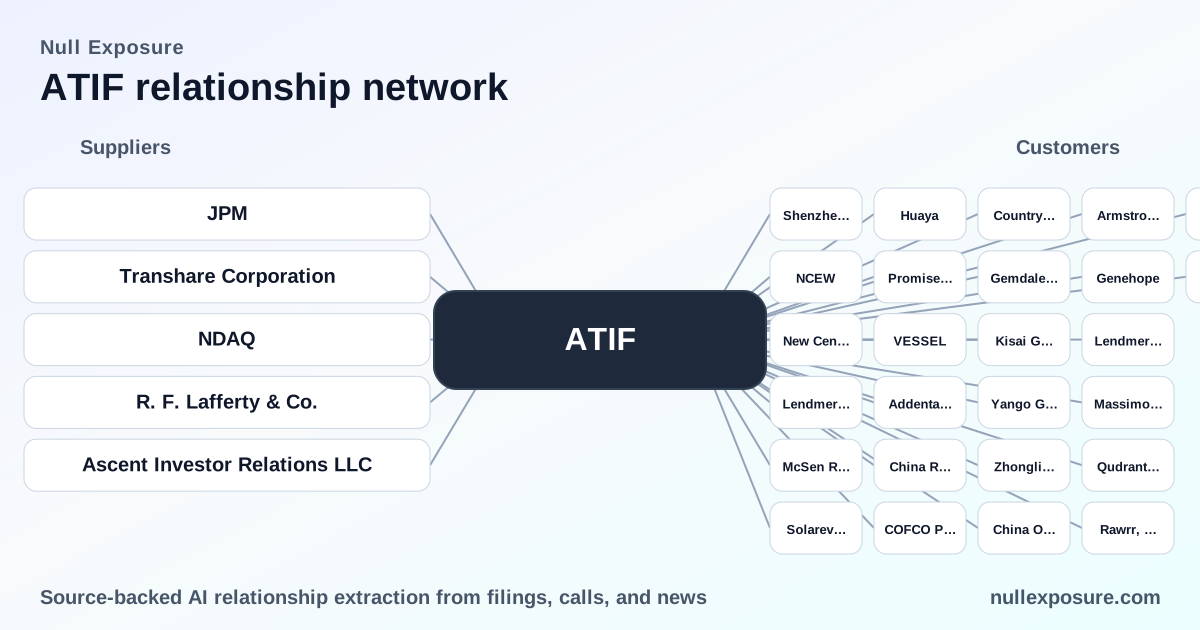
Below are every relationship surfaced in the available records, each with a concise plain-English description and the original source context.
-
J.P. Morgan (JPM) — J.P. Morgan is retained as ATIF’s prime broker and remains a central capital markets intermediary while ATIF reorganizes its asset management leadership, including Jun Liu and a newly appointed CEO of ATIF-1, Ian Zhou. This indicates ATIF maintains institutional brokerage services for trading and custody needs. Source: PR Newswire reference captured via Finviz reporting on Mar 9, 2026.
-
Transhare Corporation — Transhare is acting as the exchange agent and paying agent for ATIF’s 1-for-18 reverse share split implemented to regain Nasdaq compliance, and it handled logistics for the split that reduced outstanding shares from roughly 18.2 million to about 1.01 million. Transhare’s role covers share exchange mechanics and shareholder communications for the corporate action. Source: StockTitan coverage of ATIF’s reverse split announcement and exchange-agent designation (FY2024/FY2025 reports, first seen Mar 9, 2026).
-
Nasdaq (NDAQ) — Nasdaq is the listing venue; ATIF announced a ticker change to “ZBAI” and retained Nasdaq listing status conditional on corporate actions including the reverse split. The exchange relationship is material insofar as ATIF’s market access and liquidity depend on meeting Nasdaq’s minimum bid-price and listing standards. Source: Yahoo Finance press release reporting the ticker change (FY2024, Mar 9, 2026).
-
R. F. Lafferty & Co. — R. F. Lafferty acted as exclusive placement agent on a $2.5 million registered direct offering and a concurrent private placement completed Feb 5, 2025, selling ordinary shares and a mix of pre-funded warrants and exercise-priced warrants. The engagement shows ATIF’s use of boutique placement agents for small institutional capital raises. Source: StockTitan summary of the offering (FY2024, first seen Mar 9, 2026).
-
Ascent Investor Relations LLC — Ascent Investor Relations (contact: Tina Xiao) is ATIF’s investor relations provider referenced across multiple 2020 press releases about corporate relocations, product plans (5G-AI platform), and donation activity. This relationship demonstrates how ATIF outsources ongoing investor communications and media distribution. Source: GlobeNewswire press releases archived in 2020 (April–July 2020).
Why these relationships matter — three investor-focused takeaways
- Capital sourcing is the operational backbone. The placement with R. F. Lafferty and the pre-funded-warrant structure show ATIF’s recurring reliance on equity-linked financings rather than operating cash flow. That elevates execution risk tied to placement agents’ networks and market appetite.
- Market infrastructure preserves optionality. Nasdaq’s listing and Transhare’s role in the reverse split are critical operational relationships: if listing status or exchange-agent execution had failed, liquidity and investor access would be materially impaired.
- Institutional services reduce transactional friction. Retaining J.P. Morgan as prime broker indicates ATIF maintains a professional trading and custody arrangement that supports capital market activity and hedging, a signal of operational maturity relative to peers using retail-only channels.
Operating model signals and constraints
ATIF’s counterparty footprint signals a company that is capital-constrained but institutionally integrated. Contracting posture is transactional: ATIF uses third-party placement agents and exchange service providers for discrete financing events and corporate actions, rather than maintaining large in-house corporate finance teams. Concentration risk is moderate — the corporate model concentrates critical functions into a small number of counterparties (exchange agent, placement agent, prime broker, investor-relations firm) whose continuity directly affects listing, liquidity, and capital access. Maturity is early-stage: the company executes frequent capital transactions and corporate housekeeping (ticker change, reverse split) consistent with a developmental issuer managing compliance and runway rather than a cash-flow positive operating franchise.
Risk implications for investors and suppliers
- For investors: equity dilution is a recurring lever; warrants and pre-funded instruments used in capital raises compress future upside. Monitor placement terms and frequency of offerings.
- For vendors and service suppliers: reliance on a small set of counterparties concentrates operational dependency; contractual clarity around fees, termination, and contingency handling is essential.
- For counterparties (banks, exchanges): ATIF’s dependence on market actions to maintain listing status raises operational sensitivity; counterparties need robust KYC and remediation playbooks for thin-cap issuers.
If you want a structured supplier-risk matrix for ATIF or comparable issuers, start here: https://nullexposure.com/.
Closing view and recommended next steps
ATIF operates as a financing-first public company that outsources market-facing operations to established intermediaries while using boutique placement agents for capital needs. The company’s sustainability hinges on execution of capital raises, the durability of its prime brokerage relationship, and successful maintenance of Nasdaq listing criteria. For counterparties evaluating exposure or investors sizing due diligence, prioritize contract terms around equity issuance, exchange-agent responsibilities, and prime-broker service levels.
To map these relationships into procurement or counterparty limits for your fund or operating model, run a supplier risk review with primary-source verification at https://nullexposure.com/. For a comparative review across small-cap issuers and their placement agents, see our deeper analyses and vendor scorecards at https://nullexposure.com/.
(End of coverage — all relationships in the sourced results above have been included and cited to the referenced press reports and filings.)