Ames National (ATLO): Supplier Relationships and Operational Constraints that Matter to Investors
Ames National Corporation operates as a regional multi-bank holding company centered in central Iowa, generating revenue through net interest margin on a retail and commercial loan book, deposit gathering, and fee-based services including wealth management. The company monetizes through interest spread and non-interest income from wealth and service fees, and it runs a geographically concentrated franchise that leverages third-party services for risk, compliance, and operational scale. For investors and operators evaluating supplier exposure, the mix of short-term liquidity practices, targeted long-term vendor commitments, and an explicit third‑party oversight posture are the critical signals to watch.
Explore more supplier intelligence at https://nullexposure.com/ to support diligence and decision-making.
How Ames buys core capabilities and manages vendor risk
Ames National outsources specialized functions that it does not scale in-house—most visibly fraud and adverse‑media screening for commercial lending—while retaining supplier governance through formal risk assessment processes. Company disclosures highlight routine treatment of short‑maturity funding and borrowing, but also reference negotiated long‑term vendor contracts that drove one-time consulting spend in 2024; together these points indicate a hybrid contracting posture: operational items and liquidity management tilt short-term, while strategic vendor relationships can be multi‑year and negotiated. The bank’s supplier oversight is explicit: information security and third‑party risk assessment frameworks are in place to control how external service providers handle sensitive customer data.
What the Thomson Reuters relationship is and why it matters
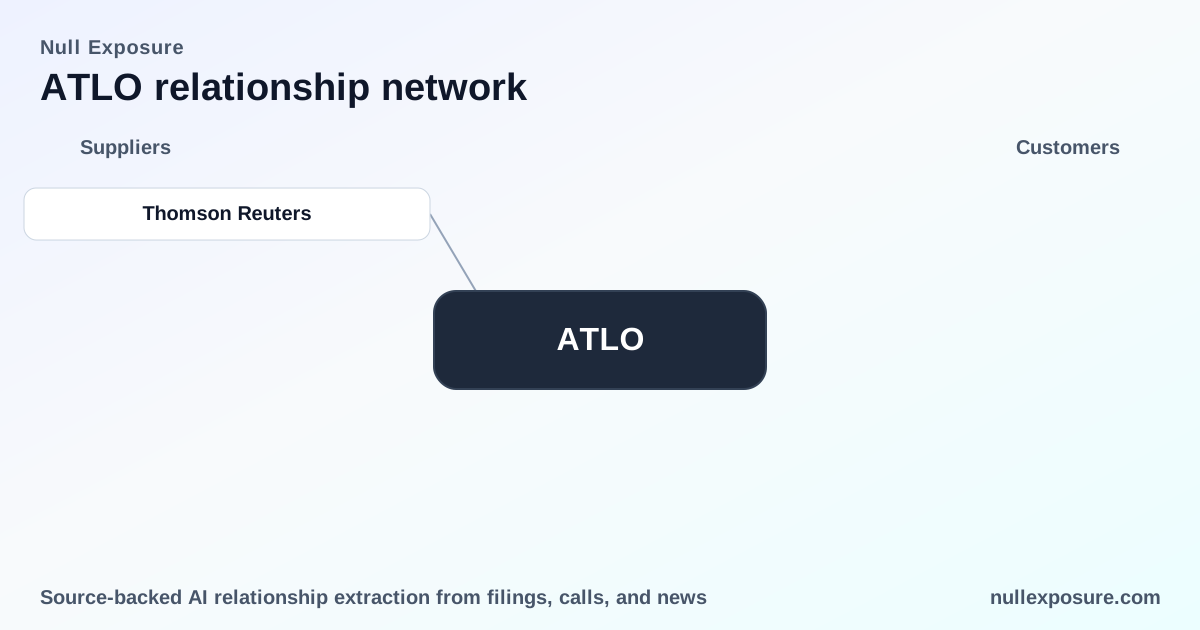
Ames National uses the Thomson Reuters Risk & Fraud Solutions suite—specifically CLEAR, CLEAR ID Confirm, CLEAR Risk Inform, and CLEAR Adverse Media—to perform due diligence on commercial loan applicants and to flag higher‑risk transactions. According to a Thomson Reuters case study (first seen March 9, 2026), these tools support underwriting and fraud prevention workflows across commercial lending. The relationship is functionally critical for credit quality monitoring in higher‑risk commercial origination, and it is a clear example of the bank outsourcing specialist intelligence rather than building it internally. (Source: Thomson Reuters case study, FY2025 / published March 2026.)
Every supplier relationship in the public results
- Thomson Reuters — Ames National deploys the CLEAR suite (CLEAR, CLEAR ID Confirm, CLEAR Risk Inform, CLEAR Adverse Media) to support commercial loan due diligence and to surface adverse‑media and fraud indicators for higher‑risk transactions; this is documented in a Thomson Reuters case study first seen March 9, 2026. (Source: Thomson Reuters case study, FY2025.)
Constraints that define Ames National’s supplier profile — and what they mean for investors
The public constraint excerpts reveal three company-level signals that shape how Ames engages suppliers and the risk profile of those engagements:
-
Short-term funding and operational cadence: Disclosures note net cash flows for customer loan transactions, deposits, and short‑term borrowings with maturities of 90 days or less. This signals a liquidity management posture that prioritizes short-dated funding and transactional flexibility, which translates into preference for suppliers and contracts that support rapid operational cycles and low long-term lock‑in.
-
Select long-term vendor commitments exist: Management commentary ties a 2024 earnings decline in part to consultant fees associated with negotiating long-term vendor contracts. This confirms the bank will enter multi‑year strategic relationships when vendors deliver capabilities (e.g., risk analytics, core services) that justify negotiation and one-time transition costs.
-
Service-provider governance is formalized: Ames maintains an information security program and supplier risk assessment processes requiring third parties to provide protections comparable to the bank’s own controls. This is a sign of mature contract and oversight expectations, including data protection, vendor monitoring, and compliance clauses that increase switching costs and raise the bar for new suppliers.
Taken together, these constraints describe a bank that balances liquidity-driven short-term operational behavior with selectively strategic long-term vendor commitments under a formal third‑party risk framework. That combination raises the importance of due diligence on essential vendors and on contractual terms tied to resilience and data security.
Explore how supplier posture affects valuation and operational risk at https://nullexposure.com/.
Investment implications and supplier risk calculus
-
Concentration and criticality. The Thomson Reuters relationship is an example of a critical, specialized provider: outsourced screening tools directly affect credit decisioning and fraud detection, so vendor outages, model inaccuracy, or contract disputes would have direct operational and credit-quality implications. Investors should treat such vendors as high‑criticality exposures even if they are not large line‑item costs.
-
Contracting posture and negotiation leverage. Ames’ mix of short‑term funding and occasional long‑term vendor negotiation implies the bank retains some negotiating leverage for commodity services but accepts lock‑in for strategic analytics and compliance tools. Contract length and termination rights become central to scenario analysis—especially for risk tools that ingest sensitive data.
-
Operational maturity reduces but does not eliminate vendor risk. The formal supplier risk assessment program is a positive governance signal that limits operational surprises, yet reliance on external risk products transfers model and data‑integrity risk to third parties. Investors should examine vendor continuity plans, SLAs, and cyber‑contracting terms when assessing execution risk.
Key monitoring items for operators and investors:
- Confirm the scope and SLAs of the Thomson Reuters engagement for uptime, data accuracy, and model refresh cadence.
- Validate the bank’s vendor continuity and portability provisions for strategic services should a supplier dispute or termination occur.
- Track ongoing spend and one‑time transition costs tied to new long‑term contracts that can depress near‑term earnings but potentially improve long‑term margins.
Actionable takeaways and recommended next steps
- Treat third‑party risk tools as core operational dependencies: when underwriting ATLO, score vendor criticality and contract terms alongside asset quality metrics.
- Focus diligence on contract maturity and exit provisions: short-term funding practices paired with multi-year vendor contracts create asymmetric risk if supplier performance deteriorates.
- Use governance signals as a risk mitigant, not a control guarantee: the presence of supplier risk assessments reduces probability of surprise but requires verification against real SLAs and incident history.
For deeper supplier intelligence and structured diligence frameworks, visit https://nullexposure.com/ — the site consolidates supplier relationships, constraint signals, and governance indicators that materially affect operational and valuation risk.
Ames National’s operating model is straightforward: regional lending and deposit intermediation augmented by outsourced risk and compliance tools. That outsourcing strategy concentrates vendor risk where precision matters—commercial underwriting and fraud detection—making supplier diligence an essential component of any investment thesis on ATLO.