Actinium Pharmaceuticals (ATNM): Supply relationships and what they mean for investors
Actinium Pharmaceuticals is a clinical-stage biotechnology company that develops radioimmunotherapies and adoptive cell therapy adjuncts, and it monetizes by advancing clinical candidates toward commercialization where revenue will depend on successful regulatory approvals and third‑party manufacturing partnerships. The company’s near-term value is driven less by product sales today and more by the integrity of its supply chain for radioisotopes and its ability to execute clinical programs efficiently and on budget. For investors and operators evaluating supplier risk, the critical question is whether Actinium’s partners can reliably provide clinical‑grade radioisotopes and finished product services as the company progresses Actimab‑A and other candidates through trials.
Explore the supplier intelligence hub for more supplier-focused analysis: https://nullexposure.com/
Why the supplier angle matters now
Actinium’s lead asset, Actimab‑A, depends on a scarce radioisotope (Actinium‑225) and on contract manufacturers for radiolabeling and final product assembly. When a biotech’s active ingredient is a tightly constrained radiotherapy isotope, supplier continuity is an explicit value driver—disruptions or price shocks can delay trials and increase cash burn. Actinium’s public financial profile underlines that runway and clinical progress, not current revenue, determine investor returns: the company reports negative EBITDA and nominal revenues as of the latest filings, emphasizing operational execution over near‑term commercialization.
A clear overview is available on the company homepage and supplier pages at https://nullexposure.com/.
Supplier relationships reported in the open record
Below I cover every supplier mention surfaced in the compiled results. Each relationship summary is concise and sourcing is stated naturally.
-
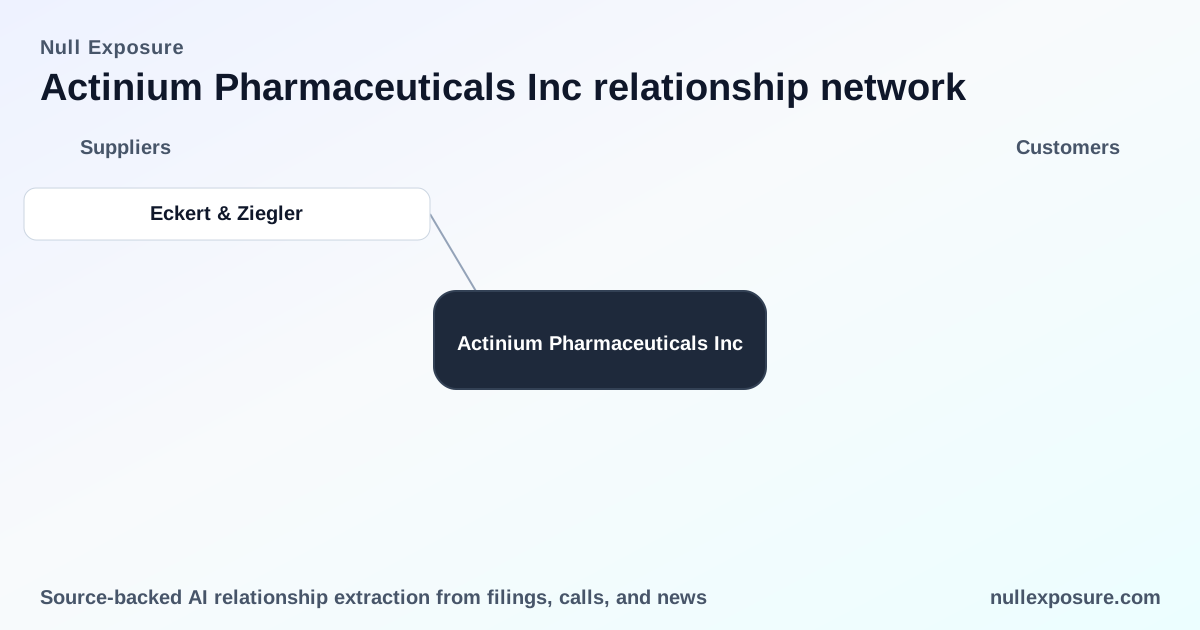
Eckert & Ziegler — A new supply agreement to secure Actinium‑225 for clinical development of Actimab‑A and other pipeline candidates was announced in media coverage. A StocksToTrade news item reported that a fresh partnership with Eckert & Ziegler will supply the crucial Actinium‑225 and elevate development prospects for Actimab‑A (news coverage dated March 25, 2025).
Source: StocksToTrade coverage on the March 25, 2025 item. -
Eckert & Ziegler — A second StocksToTrade piece the following day reiterated that the new supply agreement will secure Actinium‑225, explicitly linking the isotope supply to Actimab‑A’s clinical program (news coverage dated March 26, 2025).
Source: StocksToTrade coverage on the March 26, 2025 item.
Both items describe the same commercial relationship from independent press coverage and together establish Eckert & Ziegler as the announced supplier of the required radioisotope for Actinium’s lead program.
What company‑level constraints tell investors about operating risk
The public disclosures and constraint excerpts provide company‑level signals that frame supplier risk and contracting posture:
-
Single‑source manufacturing exposure and concentration. Actinium explicitly depends on single third‑party manufacturers for pre‑clinical and clinical supplies and uses CDMOs with specific radiotherapy experience. That indicates a concentrated manufacturing footprint where a vendor outage could materially delay timelines (company Form 10‑K commentary for year ended December 31, 2024).
-
Geography and logistics leaning U.S. Finished drug product CDMOs are located in the U.S. and have international radiotherapy shipping experience. This is a positive control for regulatory alignment but implies cross‑border logistics and isotope transport remain operational considerations.
-
Mix of manufacturing and services vendors. The company not only engages CDMOs (manufacturing) but also engages service providers—CROs, accounting firms, and specialized consultants—illustrating an ecosystem of active service relationships necessary to run trials and comply with reporting obligations.
-
Active but variable spend posture. Evidence shows some suppliers fall into smaller spend bands—e.g., compensation committee consultant fees of $35,000 and audit fees in the low‑hundreds of thousands—indicating that while strategic manufacturing relationships are critical, many service relationships are modestly scaled.
-
Operational maturity consistent with a clinical‑stage biotech. Reliance on third‑parties to conduct clinical trials and on single manufacturers reflects a company advanced enough to secure specialized partners but not yet vertically integrated across production and trial execution.
These constraints combine into a clear operating profile: high supplier criticality concentrated in a small number of specialized providers, located primarily in the U.S., with modest operational spend elsewhere supporting clinical and reporting needs.
How the Eckert & Ziegler relationship reshapes the risk profile
Eckert & Ziegler’s role as supplier of Actinium‑225 is the single most consequential supplier disclosure in the results. For investors and operators, the relationship alters three vectors:
-
Supply continuity: Securing a named isotope supplier reduces immediate operational risk relative to an uncontracted sourcing posture, but it does not eliminate concentration risk because the isotope market is structurally constrained.
-
Timing and visibility: A formal agreement provides clarity on availability windows and batch scheduling, which supports trial timelines and cash planning.
-
Execution risk transfer: By outsourcing isotope production and radiolabeling, Actinium transfers manufacturing execution risk to a specialized partner—useful operationally but increasing counterparty reliance.
Practical investor implications and risk checklist
Investors should treat supplier disclosures as first‑order drivers of clinical milestone timing and cash consumption. Key considerations:
-
Concentration risk: One or a very small number of isotope suppliers creates single points of failure; confirm whether backup supply channels or contingency inventory plans exist.
-
Contract terms and exclusivity: Investors should seek detail on duration, volume commitments, and termination clauses in supply agreements (press mentions do not provide those contractual specifics).
-
Logistics and regulatory complexity: Radiotherapy ingredients require specialized transport and handling; assess whether partners have international shipping experience and regulatory track records (company statements indicate U.S. CDMO locations with such experience).
-
Spend and scale: Small aggregated spend on non‑manufacturing services is normal for a clinical‑stage firm, but manufacturing spend commitments drive balance sheet exposure.
A concise set of actionable checks for due diligence:
- Request confirmation of multi‑quarter isotope delivery schedules and fallback suppliers.
- Validate manufacturing site regulatory certifications and batch release histories.
- Model cash impact if production timing shifts by one to two quarters.
Learn about supplier risk scoring and comparative intelligence at https://nullexposure.com/
Final recommendations and next steps
For buy‑side investors and strategic operators, the Eckert & Ziegler tie‑up is materially positive because it secures a scarce input essential to Actimab‑A development. However, Actinium remains exposed to single‑source concentration and typical clinical‑stage cash burn dynamics. Prioritize contractual transparency and operational contingency planning in any engagement or valuation update.
If you want ongoing monitoring of ATNM’s supplier profile and supplier‑specific alerts, start with the supplier hub at https://nullexposure.com/ — the homepage links to detailed supplier intelligence and monitoring workflows.
Bottom line: the announced Eckert & Ziegler supply relationship reduces short‑term sourcing ambiguity for Actinium’s clinical program, but investors must still underwrite concentration risk and demand contractual detail to translate that reduction into durable valuation uplift.