Atossa Therapeutics (ATOS): Supplier relationships that shape a clinical-stage play
Atossa Therapeutics is a clinical-stage biopharmaceutical company that discovers and advances small-molecule and repurposed-drug therapies primarily in oncology and women's health. The company generates value by advancing (Z)-endoxifen through clinical trials, licensing opportunities and partnership-enabled development rather than by product sales; operating cash needs are financed by equity markets and milestone-driven collaborations. For investors evaluating supplier exposure, the company’s supplier profile is dominated by clinical services, third-party manufacturing and small operational leases — a model that concentrates counterparty risk in CROs and a limited set of external service providers. Learn more at the NullExposure homepage: https://nullexposure.com/
Why supplier relationships matter for a clinical-stage biotech
Atossa has no product revenue and negative operating cash flow, so its path to value depends on executing trials efficiently and protecting time-to-data. Supplier choices directly affect trial timelines, marginal cost of development and potential partner interest. A delay or failure at a major CRO or manufacturing partner would have outsized operational impact given Atossa’s reported non-cancellable clinical commitments and lean internal capabilities.
Who Atossa is working with now — the relationship roll call
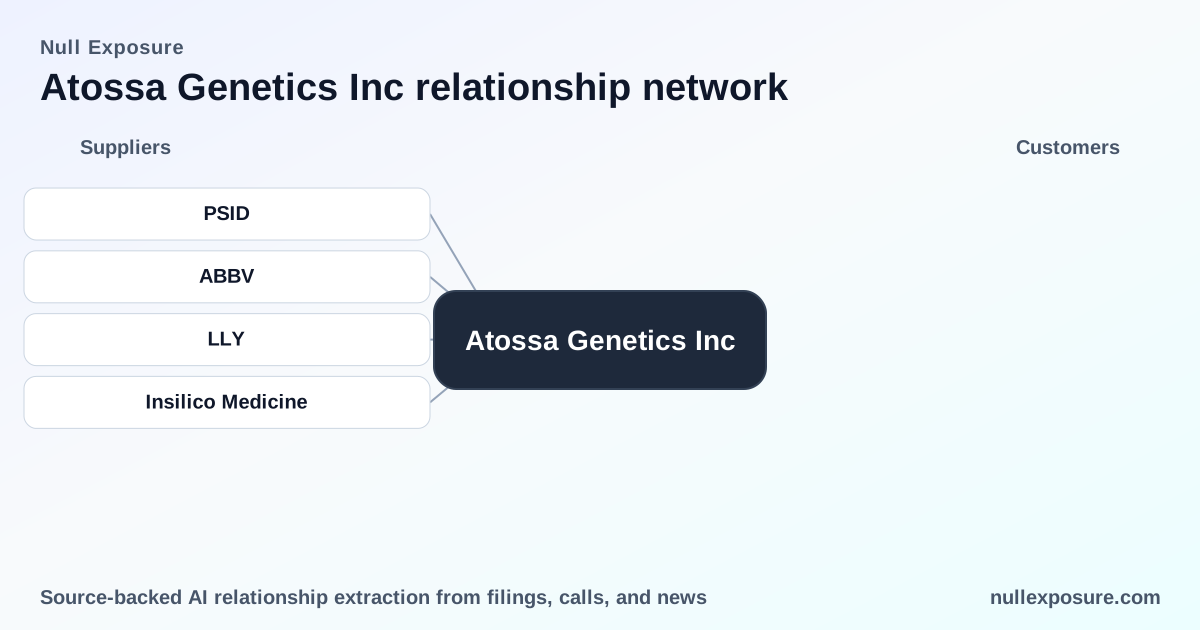
Below I cover every supplier and partner mentioned in the source results, with concise summaries and source references.
PSI (PSID) — CRO selected to run an upcoming dose-ranging study
Atossa selected PSI, a global contract research organization, in August 2025 to operationalize and manage a planned (Z)-endoxifen monotherapy dose-ranging study in women with metastatic breast cancer. This is an active CRO engagement that places clinical execution responsibility off-balance-sheet to a specialist vendor. According to Atossa’s third-quarter 2025 corporate update on BioSpace, PSI was chosen to manage that study (BioSpace, Q3 2025 corporate update).
AbbVie, Inc. (ABBV) — combination therapy partner in I-SPY 2 studies
Atossa is evaluating (Z)-endoxifen in combination with AbbVie’s elagolix (ORILISSA®) as part of multiple I‑SPY 2 platform studies, positioning AbbVie’s marketed compound as a combination arm rather than a classic supplier. The company letter to shareholders referenced these I‑SPY 2 collaborations and named AbbVie’s elagolix as a partner compound in FY2026 reporting (Finviz/Atossa shareholder letter, FY2026).
Eli Lilly and Company (LLY) — co-investigational partner via abemaciclib combination
Atossa’s I‑SPY 2 program also investigates (Z)-endoxifen combined with abemaciclib (VERZENIO®), a CDK4/6 inhibitor marketed by Eli Lilly, placing Lilly’s marketed agent in a strategic combination role that can amplify clinical read-through if the combination shows activity. The company communicated these ongoing studies in its FY2026 shareholder letter posted on Finviz (Finviz/Atossa shareholder letter, FY2026).
Insilico Medicine — AI-driven discovery collaborator and co-author
Insilico Medicine and Atossa published a joint study identifying (Z)-endoxifen as a potential therapeutic candidate for glioblastoma multiforme, reflecting a research collaboration that leverages AI drug-discovery capabilities to expand Atossa’s indication set beyond breast cancer. The joint publication and press release were distributed via PR Newswire in FY2025 (PR Newswire, FY2025).
What the company-level constraints signal about operations and supplier posture
Atossa’s disclosures and the extracted constraints reveal a clear operating model and supplier posture that investors should internalize:
- Contracting posture is short-term and project-oriented. The company disclosed a short-term operating lease with Regus for Seattle office space, indicating a lean fixed-cost footprint and flexible real-estate posture rather than long-duration facilities exposure.
- Geographic focus is North America for corporate operations. The operating lease in Seattle is an explicit geographic anchor.
- Third-party dependence is integral and explicit. Atossa uses CROs, CMOs and other third parties for procurement, manufacturing and distribution; this is a core element of the business model, not an occasional outsourcing choice.
- Supplier roles are diversified across service provider, manufacturer and distributor functions. The filings point to qualified third-party clinical manufacturing capabilities and external partners for storage and distribution, signaling multiple vendor categories under active management.
- Spend concentration is meaningful around clinical programs. Atossa reported an estimated non-cancellable commitment of $10.2 million as of December 31, 2024, which will be paid over clinical trial terms — this creates a mid-sized committed spend band that scales with trial progression.
- Maturity and stage are early but active. Contracts disclosed (lease commencement, CRO engagements) and ongoing I‑SPY 2 activity indicate active relationships rather than purely prospective or one-off agreements.
These are company-level signals drawn from the firm’s own disclosures and are not assigning any particular constraint to a specific named supplier unless the filing explicitly did so.
Explore how supplier relationships shape clinical risk profiles at https://nullexposure.com/ for deeper supplier analytics.
Investment implications — what investors should watch in the next 12–18 months
- Execution risk is concentrated in the CRO/CMO ecosystem. PSI’s role as operational lead on a dose-ranging study makes timely delivery and data quality dependent on that vendor; investors should track enrollment, monitoring reports and any announcements about vendor changes.
- Clinical partnerships broaden potential exit routes but do not replace execution. The use of marketed agents from AbbVie and Eli Lilly in I‑SPY 2 studies increases strategic optionality — positive combination signals would materially enhance licensing conversations — but those outcomes are binary and trial-dependent.
- Non-cancellable commitments create short-term liquidity pressure but also signal program commitment. The reported $10.2 million commitment should be assessed against Atossa’s cash runway and capital strategy given zero product revenue and negative EBITDA.
- Research collaborations expand indication breadth with low capital intensity. The Insilico co-publication is a strategic way to explore additional indications (glioblastoma) with limited upfront manufacturing spend compared with full preclinical programs.
Tactical items for operators and investors
- Monitor PSI’s trial milestones and site activation updates for leading indicators of timeline health.
- Track I‑SPY 2 readouts and partnership statements from AbbVie and Lilly for combination efficacy signals.
- Reconcile Atossa’s committed spend against reported cash and financing activity when assessing dilution risk.
For a structured view of supplier exposure and third-party concentration across clinical-stage biotechs, visit our homepage: https://nullexposure.com/
Final takeaway
Atossa operates as a classic clinical-stage sponsor that relies heavily on external CROs, CMOs and strategic compound partners to advance (Z)-endoxifen. The balance of risk lies in clinical execution and committed trial spend rather than commercial operations; supplier performance and milestone cadence will be the primary drivers of value realization for shareholders. If you need a focused supplier risk briefing tailored to ATOS, start at https://nullexposure.com/ and request the ATOS supplier pack.