Atara Biotherapeutics (ATRA) — Supplier relationships that shape commercial rollout
Atara Biotherapeutics operates as a clinically focused T‑cell immunotherapy company that monetizes through the commercialization of cell‑therapy products and strategic partner arrangements. Revenue drivers are product sales and partnership economics tied to the manufacturing and commercialization of tabelecleucel (tab‑cel / EBVALLO), while outsourced manufacturing and third‑party services determine delivery capability and near‑term revenue recognition. Investors should evaluate vendor concentration, contract tenor, and the operational handoffs described in corporate filings and press reports. For a concise marketplace lens on supplier exposures, visit Null Exposure: https://nullexposure.com/.
How Atara organizes manufacturing and services — practical implications for investors
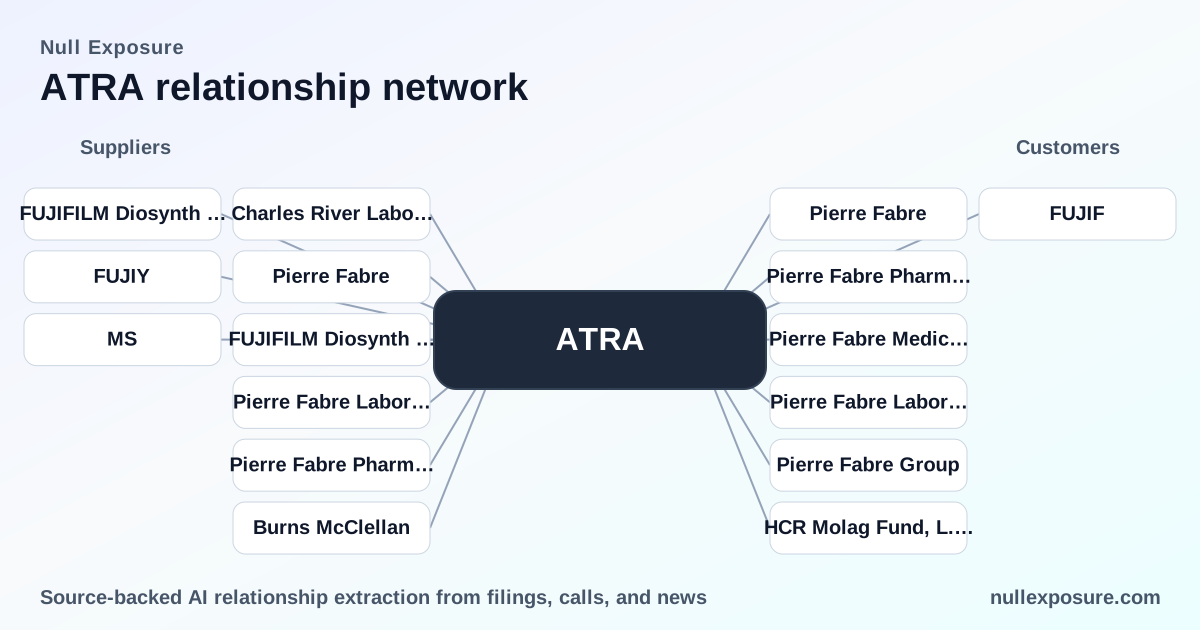
Atara outsources core manufacturing and several specialized services under multi‑year contracts with minimum purchase commitments, creating a predictable but committed cost base. According to the 2024 Form 10‑K, Atara entered a Master Services and Supply Agreement with FUJIFILM Diosynth Biotechnologies California, Inc. (FDB) effective April 2022 that could extend up to ten years and includes non‑cancellable minimum commitments. The same filing documents a wind‑down of a prior Commercial Manufacturing Services Agreement with Charles River Laboratories (CRL), highlighting a deliberate consolidation of manufacturing partners.
Operationally this means:
- Contracting posture: Atara favors long‑term MSAs and multi‑year commitments that lock in capacity and quality control but create fixed purchasing obligations. The 10‑K confirms non‑cancellable minimum commitments and the Fujifilm MSA’s potential ten‑year term.
- Concentration and criticality: A small number of CMOs and service providers handle manufacturing qualification, regulatory compliance, and critical supply — making those relationships high‑impact for product availability and revenue timing.
- Maturity and stage: Atara reports completed commercial production qualification activities for tab‑cel in the EEA and ongoing qualification for the U.S., signaling the supplier base is partially mature but still executing U.S. scale‑up.
These structural traits create both operational predictability and single‑point risks that investors must price into forecasts.
The supplier roll call — who matters now
Below are the company’s named supplier and service relationships from public filings and press coverage, with a concise plain‑English summary and source.
Charles River Laboratories, Inc.
Atara is completing the wind‑down of a Commercial Manufacturing Services Agreement with Charles River, indicating a de‑risking of legacy manufacturing arrangements and a shift toward other CMOs. This detail is disclosed in Atara’s 2024 Form 10‑K. (Atara 10‑K FY2024)
FUJIFILM Diosynth Biotechnologies California, Inc. (FDB)
Atara executed a Master Services and Supply Agreement with FDB effective April 2022 that can run up to ten years; under the MSA FDB will manufacture specified quantities of cell therapy products under cGMP and Atara carries non‑cancellable minimum purchase commitments. The 2024 10‑K documents the MSA, and later press coverage notes that a Thousand Oaks FDB facility received EMA approval to manufacture tab‑cel. (Atara 10‑K FY2024; CGTLive, Jan 2025 coverage)
Pierre Fabre (Pierre Fabre Laboratories / Pierre Fabre Pharmaceuticals)
Pierre Fabre will assume responsibility and costs for manufacturing and supplying tab‑cel in the defined Territory upon a Manufacturing Transition Date that could occur as early as completion of the transfer or by December 31, 2025, and the transition has already driven revenue recognition changes. Atara’s 2024 10‑K describes the manufacturing transition clause, and company press and media reports in 2025‑2026 note accelerated revenue recognition and an expanded commercialization partnership covering additional territories. (Atara 10‑K FY2024; Biospace press release Q2 2025; StockTitan report FY2025/FY2026)
Burns McClellan
Burns McClellan appears as an investor relations/media contact in Atara press materials and was listed in a 2019 press release circulating clinical progress; this reflects a historical communications relationship rather than a manufacturing or clinical services role. (GlobeNewswire / Atara press release, June 2019)
Morgan Stanley Smith Barney LLC Executive Services
Morgan Stanley Smith Barney LLC Executive Services is named in a filing as the broker for a transaction, indicating routine capital markets or insider transaction facilitation rather than an operational supply relationship. (SEC‑filing coverage reported by StockTitan, FY2026)
Each of these relationships is documented in Atara’s public materials or press coverage; the party list spans contract manufacturers, commercialization partners, and service providers involved in investor communications and securities transactions.
What the constraints tell us about operational risk and levers
Atara’s constraint signals from supplier disclosures translate into company‑level strategic characteristics investors must weigh:
- Long‑term contract orientation: Atara signs multi‑year MSAs and accepts non‑cancellable minimum purchase commitments. This gives revenue partners certainty on supply but obligates Atara to committed spend even if demand cycles fluctuate.
- Manufacturer role and buyer posture: The firm functions as a buyer with contractual minimums and relies on CMOs for cGMP manufacture; the Fujifilm MSA explicitly frames FDB as a manufacturer supplying Atara’s products under long‑dated terms (source: 10‑K).
- Service provider dependency: Atara contracts third parties for waste disposal, cybersecurity monitoring, and clinical services — services that are operationally necessary but can be sourced from multiple vendors.
- Active commercialization stage: The company reports that CMOs have completed EEA commercial production qualification and are completing U.S. qualification activities, signaling a transition from development to commercialization.
Collectively, these constraints paint a capital‑efficient outsourcing model that trades lower fixed capital for supplier concentration and contractual obligations. That trade‑off is central to forecasting margins and cash flows.
Investment implications and risk checklist
- Positive: Multi‑year MSAs and established CMOs (FDB) create supply visibility necessary for commercialization and support predictable recognition of partnership revenue when manufacturing transitions occur. EMA approvals for manufacturing sites improve EU supply resilience.
- Negative: Vendor concentration and non‑cancellable commitments increase downside if demand underperforms or regulatory setbacks occur; the wind‑down with CRL and transfer to Pierre Fabre represent execution risk during handoffs. Regulatory decisions (e.g., FDA CRLs reported in media) directly affect revenue and partner responsibilities.
- Near term: Watch quarterly revenue disclosures for the effects of manufacturing transitions and any further milestones or recognition tied to the Pierre Fabre handoff.
For a sharp, deal‑level read on how supplier exposures influence valuation and financing risk, explore more analysis at Null Exposure: https://nullexposure.com/.
Bottom line and next steps
Atara’s supplier network is a central determinant of commercialization success: long MSAs and partner transitions provide scale and predictability but concentrate risk around a handful of CMOs and commercialization partners. Investors should track the completion of U.S. commercial production qualifications, the operational handoff to Pierre Fabre, and any contract amendments that change purchase commitments.
If you want a tailored supplier‑risk briefing or to map these relationships against cash‑flow scenarios, visit Null Exposure for detailed supplier analytics and scenario workups: https://nullexposure.com/.
Key takeaway: supplier contracts drive Atara’s ability to convert regulatory approvals into revenue — and the firm’s contractual posture means those suppliers are strategic assets and potential single points of failure.