AtriCure (ATRC) — How its credit line, trial contracts and counterparties shape execution risk
AtriCure develops, manufactures and sells surgical ablation devices to hospitals and medical centers worldwide and monetizes primarily through product sales and accompanying service arrangements to the cardiovascular surgical market. The company's operating rhythm is capital-intensive and cadence-driven — device revenue flows from procedure volume while financing and trial agreements govern working capital and multi-year cash commitments. Investors assessing ATRC supplier relationships should focus on the company's lender posture, the structure of its clinical contracts, and how those relationships influence liquidity and operational flexibility. For detailed supplier intelligence, visit https://nullexposure.com/.
Why the JPMorgan credit facility matters to investors
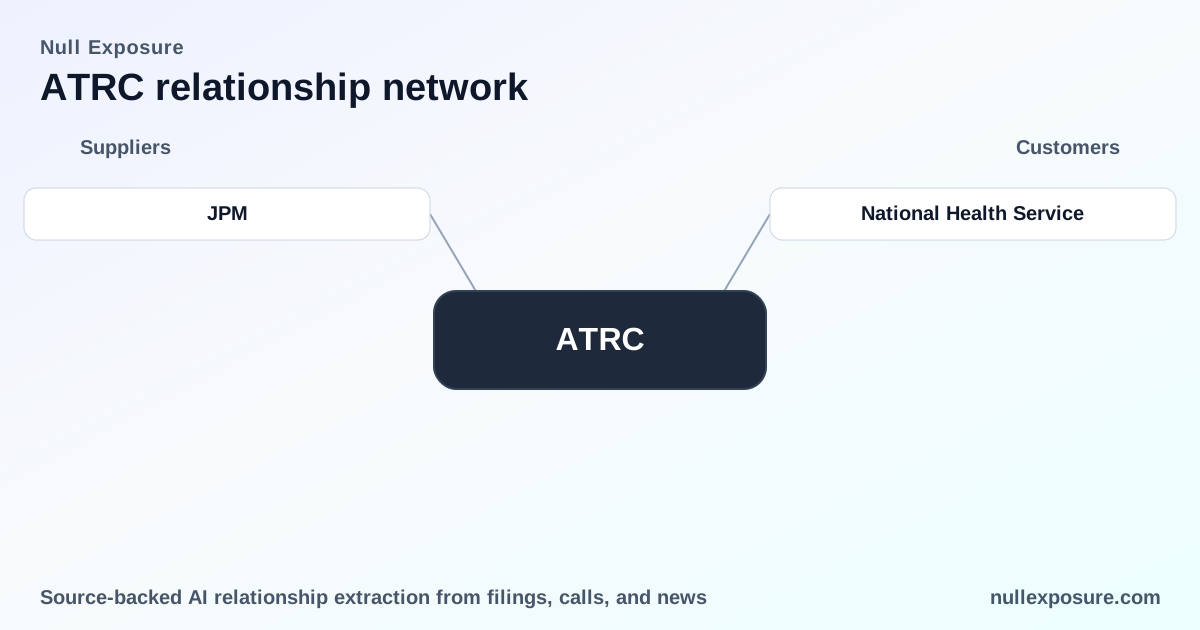
AtriCure manages short-term liquidity through an asset-based credit agreement with JPMorgan Chase Bank that provides a $125,000 revolving facility with an option to increase capacity by $40,000. According to ATRC’s FY2026 disclosures as reported on TradingView, JPMorgan serves as the administrative agent for that facility and coordinates the lender group. (TradingView, FY2026).
This relationship is functionally a working-capital backstop: the asset-backed structure ties borrowing capacity to receivables and inventory, giving JPMorgan direct influence over covenant testing and availability metrics, and creating a concentration of execution risk around a single administrative agent. The explicit facility size and the lender role make JPMorgan a critical counterparty for ATRC’s near-term funding posture (TradingView, FY2026).
Two related filings — same counterparty, complementary disclosures
- TradingView’s summary of ATRC’s SEC 10‑K describes the $125,000 revolving credit facility with an option to increase by $40,000, establishing the baseline size and collateral nature of the line (TradingView, SEC 10‑K excerpt, FY2026).
- A separate TradingView notice emphasizes that JPMorgan Chase Bank is the Administrative Agent and lender group participant, confirming JPMorgan’s formal role in arranging and administering the agreement (TradingView, press release announcing first amendment, FY2026).
Each citation points to the same commercial reality: JPMorgan is the principal liquidity provider and administrative hub for ATRC’s asset-based financing.
Clinical trial contracts increase variability in cash flows
Company disclosures note that in 2022 ATRC entered a clinical trial management agreement for the LeAAPS trial, with payments tied to enrollment and project milestones scheduled across an estimated ten-year term. The contract allows early termination for any reason and imposes variable pass-through costs from trial sites, which increases the company's near- and long-term cash-flow variability.
This contractual profile is a company-level signal rather than a counterparty-specific one: it indicates multi-year contingent cash obligations, milestone-driven payout timing, and limited downside protection for the company if enrollment stalls. For a device manufacturer whose working capital is materially supported by an asset-based credit line, this creates a predictable channel by which clinical spending can influence borrowing needs and covenant compliance.
How these relationships convert into operational constraints
- Contracting posture: ATRC uses an asset-based credit facility rather than an unsecured term loan, signaling a conservative lender view of collateral quality and the company's need to match borrowing capacity to cyclical receivables and inventory.
- Concentration risk: JPMorgan’s role as administrative agent concentrates counterparty risk on a single bank relationship for day-to-day liquidity and covenant management.
- Criticality: The credit facility is critical to smoothing working capital and absorbing timing mismatches from trial payments and production cycles; any restriction on availability would stress operations.
- Maturity and optionality: The reported facility level and the option to increase by $40,000 give ATRC limited but useful optionality; however, availability is tied to asset performance rather than an unconditional commitment.
These constraints explain why ATRC’s financing posture is an important lens for investors: operational execution (procedure volumes, device margins, trial enrollment) flows through to receivables and inventory, which in turn determines borrowing availability under JPMorgan’s facility.
Relationship-by-relationship readout
- JPMorgan Chase Bank — asset-based lender and administrative agent: The company disclosed a $125,000 revolving credit facility, with an option to expand by $40,000; JPMorgan is named as Administrative Agent and coordinates the other lenders, making it ATRC’s principal funding counterparty (TradingView, ATRC SEC 10‑K excerpt, FY2026).
- JPMorgan Chase Bank — counterparty to the first amendment: A subsequent announcement identifies JPMorgan Chase Bank explicitly as Administrative Agent alongside other lenders in the first amendment to the credit agreement, reinforcing the bank’s operational role in ATRC’s credit structure (TradingView, press release on first amendment, FY2026).
Both entries reference the same commercial relationship through different disclosures; together they confirm the operational centrality of JPMorgan to ATRC’s credit architecture.
Financial context that amplifies relationship importance
AtriCure reported $534.5 million in trailing twelve‑month revenue and a gross profit of $400.8 million, but delivered a negative diluted EPS of -$0.24 and modest operating margin dynamics. Market capitalization is roughly $1.52 billion, and EV/EBITDA sits elevated relative to peers. Those financials make access to committed and asset-based liquidity structurally important — ATRC needs clean working-capital access to fund growth, manage seasonal receipts, and support clinical program spend. Investors should weigh the lender relationship against these underlying metrics when modeling covenant sensitivity and downside scenarios.
For a deeper supplier-risk perspective and counterparty mapping, see https://nullexposure.com/.
Investor takeaways and monitoring checklist
- JPMorgan is a primary execution risk: any tightening or amendment that reduces availability would have an immediate operational impact.
- Clinical trial payment structure introduces cash-flow timing risk that interacts directly with asset-based borrowing availability.
- Concentrated counterparty exposure increases negotiation leverage for the bank and reduces ATRC’s optionality in stress scenarios.
- Model liquidity scenarios using receivables and inventory conversion assumptions — those inputs drive availability under the asset-based facility.
Monitor quarterly covenant disclosures, amendments to the credit agreement, and clinical trial enrollment milestones as near-term indicators of stress or flexibility. For ongoing updates on ATRC’s supplier and counterparty footprint, visit https://nullexposure.com/.
What to watch next and a final word
Near-term catalysts that change the risk profile include amendments to the JPMorgan facility, material changes in trial spending cadence or enrollment, and quarter-to-quarter shifts in receivables and inventory that affect borrowing base availability. Active investors should prioritize covenant transparency and the timeline for exercise of the $40,000 increase option as a barometer of both growth financing and downside protection.
To review supplier relationships across portfolios or to commission bespoke counterparty analysis, start at https://nullexposure.com/.