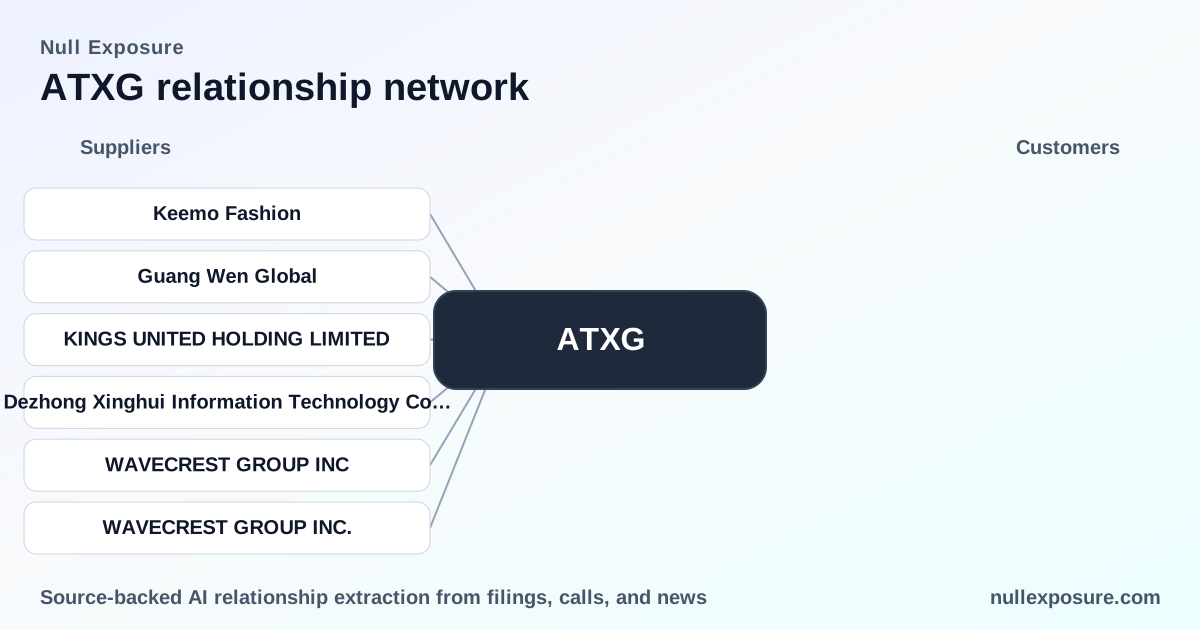
Addentax Group (ATXG) — Supplier relationships, strategic moves, and what investors should watch
Addentax Group monetizes through an integrated model that combines logistics and freight services with garment manufacturing and related supply‑chain operations in China, while increasingly pursuing strategic asset acquisitions and Web3 payment initiatives to unlock new settlement and monetization layers. Revenue derives from freight and logistics fees plus product sales in garment operations; the company is actively extending into payments and real‑world asset use cases through acquisitions and cooperation agreements. For a concise vendor‑risk and counterparty primer, visit https://nullexposure.com/.
Why these relationships matter now: control, payments, and supply‑chain leverage
Addentax is executing a two‑track strategy: preserve core logistics/manufacturing revenue while using acquisitions and Web3 partnerships to build settlement infrastructure and new financing channels. That strategy changes the counterparty profile for the business — from traditional fabric and delivery suppliers to financial counterparties, payment‑platform partners, and boutique retail targets. The transactions announced over FY2025–FY2026 increase both operational complexity and dependency on a few material counterparties.
Key company‑level signals from public disclosures:
- Short‑term contracting posture: several related‑party balances are unsecured, non‑interest bearing and repayable on demand, indicating a working capital model that relies on flexible, short‑dated commitments rather than long vendor finance.
- Geography concentrated in APAC: raw materials and manufacturing sourcing are heavily local, exposing the supply base to regional disruption risks.
- Supplier concentration is material: one supplier accounted for more than 10% of costs in the latest two fiscal years, creating single‑source risk for manufacturing inputs.
- Mixed relationship roles: Addentax acts as buyer for raw inputs, outsources logistics as a service provider in places, and sources finished materials from manufacturers — the firm relies on subcontractors and third‑party delivery when its fleet is constrained.
If you want to map counterparty exposures for underwriting or operations, start here: https://nullexposure.com/.
The public relationships you need to know (each result documented)
Keemo Fashion — acquisition to gain control (FY2026)
Addentax announced an agreement to acquire 62% of Keemo Fashion for approximately $5.5 million, funding the purchase through a partial transfer of an existing bond; the deal gives Addentax immediate control over a retail/manufacturing asset. According to TradingView (reported March 9, 2026), the transaction is structured as a stock purchase agreement to acquire 34.2 million Keemo shares.
Guang Wen Global — counterparty in the Keemo purchase (FY2026)
The Keemo stock purchase agreement lists Guang Wen Global as the transfer counterparty in the $5.5 million acquisition transaction, making Guang Wen Global a transactional counterparty in Addentax’s acquisition of Keemo Fashion. TradingView reported the transaction details on March 9, 2026.
KINGS UNITED HOLDING LIMITED — Web3.0 payments cooperation discussions (FY2025)
Addentax announced discussions with KINGS UNITED to integrate Web3 payment infrastructure and Real‑World Asset enablement into Addentax’s supply‑chain and settlement ecosystem, positioning KINGS as a strategic payments and RWA partner. StockTitan reported this development in FY2025, and MarketScreener carried the same release, highlighting the strategic cooperation narrative (March 2026 press releases).
KINGS UNITED HOLDING LIMITED — duplicated coverage from MarketScreener (FY2025)
MarketScreener republished the company announcement that Addentax is in talks with KINGS UNITED to advance Web3 payment rails and RWA functionality within its logistics and settlement flows, underlining corporate intent to build payment‑layer capabilities. MarketScreener distributed this release in March 2026.
Dezhong Xinghui Information Technology Co., Ltd. — software and digital retail partner (FY2025)
Dezhong Xinghui contributes SaaS systems, big data and AI expertise and digital retail solutions, while Addentax contributes logistics network capabilities — the relationship looks like a technology‑service complement to accelerate digital retail and data analytics across Addentax’s channels. StockTitan summarized this cooperative contribution in FY2025.
WAVECREST GROUP INC — investor relations contact tied to a term sheet narrative (FY2025)
A StockTitan notice around Addentax’s term sheet coverage included WAVECREST GROUP INC as an investor relations contact, associating Wavecrest with investor communication around a substantial term sheet disclosed for Addentax operations. StockTitan’s FY2025 release lists Wavecrest and an IR contact for follow‑up.
WAVECREST GROUP INC. — referenced again in sovereign‑stablecoin initiative messaging (FY2026)
Addentax’s communications on advancing a sovereign‑aligned stablecoin initiative referenced WAVECREST GROUP INC. as the investor relations contact, linking Wavecrest to the company’s public outreach on the stablecoin and payments agenda. StockTitan covered this FY2026 item.
What the relationship mix means for underwriting and operational risk
The portfolio of relationships shifts Addentax from a pure logistics/manufacturing operator into a hybrid logistics + payments company. That exposes investors and counterparties to three structural risks:
- Concentration and supplier dependency: one supplier supplying >10% of costs is a clear single‑source vulnerability for manufacturing inputs. Given Addentax’s modest scale (reported revenue TTM ~$4.25M and market capitalization approximately $3.0M), loss of a key supplier would be immediately material to margins and operations.
- Short‑term finance posture and related‑party exposure: the company uses unsecured, demand‑payable related‑party borrowings, increasing liquidity fragility in stress scenarios. This contracting posture reduces negotiating leverage with suppliers and raises counterparty credit sensitivity.
- Operational complexity from fintech partnerships and acquisitions: acquisitions (Keemo) and Web3/RWA cooperation (KINGS) enlarge counterparty classes to include financial infrastructure and digital‑asset counterparties; these are higher‑complexity, higher‑operational‑risk relationships that demand rigorous vendor governance and regulatory oversight.
Financial snapshot that reinforces the risk profile: Addentax reported negative EBITDA and net losses (negative diluted EPS and negative margins), while price‑to‑book and EV multiples signal small capitalization and thin institutional ownership — together these figures mean counterparties should underwrite counterpart risk tightly.
Practical investor takeaways and next steps
- Prioritize supplier concentration and continuity plans: require disclosure of the supplier that represented >10% of costs and documented contingency sourcing plans.
- Assess contract tenor and related‑party exposure: demand clarity on the volume and terms of unsecured related‑party borrowings and how working capital will be supported through volatility.
- Insist on governance and compliance evidence for fintech initiatives: Web3 payment and stablecoin initiatives increase regulatory risk; verify third‑party controls, custody arrangements, and legal opinions before underwriting payment or settlement exposure.
For a structured counterparty due diligence checklist and supplier mapping tools, go to https://nullexposure.com/. For a deeper briefing tailored to underwriting teams or portfolio managers, contact us through https://nullexposure.com/ and we will prepare a supplier risk memo customized to your exposure thresholds.
Closing assessment: Addentax is scaling horizontally into payments and retail while its core manufacturing and logistics remain materially dependent on a concentrated APAC supplier base and short‑term financing arrangements. That duality creates an asymmetric risk profile — potential upside from new monetization channels, offset by clear concentration and liquidity vulnerabilities — and requires active counterparty governance for operators and investors.