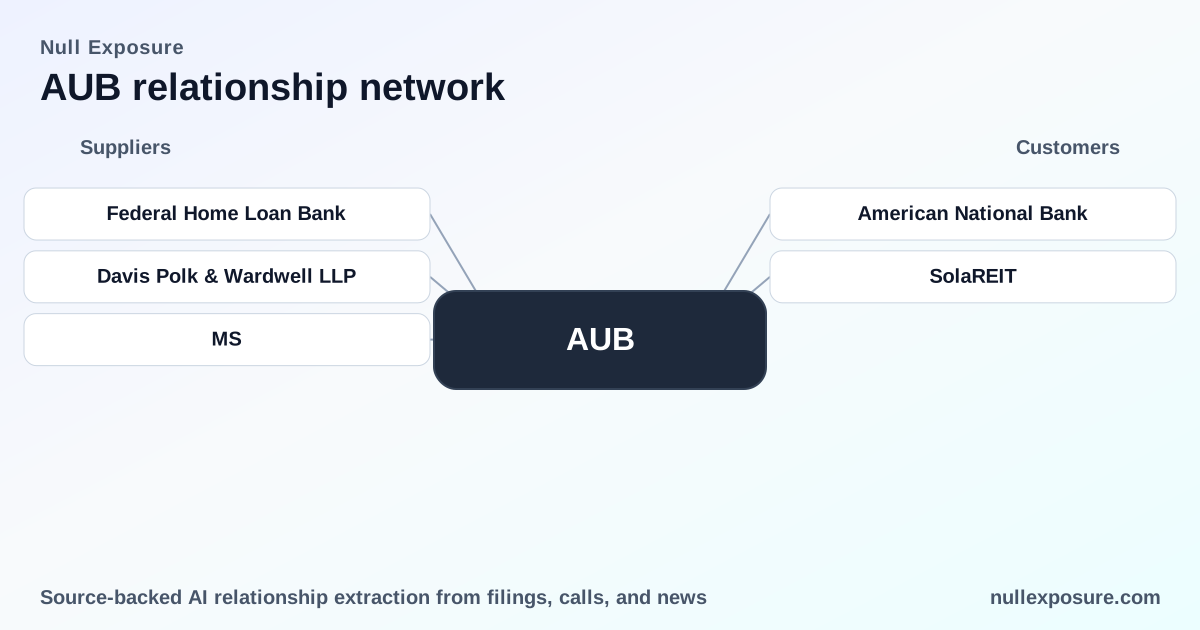
Atlantic Union Bankshares (AUB): supplier relationships and what they signal for investors
Atlantic Union Bankshares operates as the holding company for Atlantic Union Bank, generating net interest income and fee income by taking customer deposits and deploying those funds into commercial and consumer loans, mortgage securities, and fee-based banking services. The franchise monetizes scale in regional lending and treasury services while selectively using wholesale funding and outside advisors for strategic transactions. For a broader map of AUB’s counterparties and supplier posture, visit https://nullexposure.com/.
A compact financial snapshot that frames supplier risk
Atlantic Union is a regional bank headquartered in Richmond, VA, with ~$1.23 billion in trailing revenue and a market capitalization near $4.87 billion (latest public figures). The franchise shows healthy profitability metrics—profit margin ~22% and return on equity ~6.7%—and a modest valuation profile with price-to-book around 0.98. These metrics place supplier and funding relationships into a context where funding flexibility, advisor capability, and third‑party infrastructure directly influence execution on growth and M&A.
Who Atlantic Union contracts with and why it matters
Federal Home Loan Bank
Atlantic Union’s short‑term advances from the Federal Home Loan Bank (FHLB) are a component of its wholesale funding mix. According to Atlantic Union’s 2024 Form 10‑K, total FHLB borrowings were $534.6 million at December 31, 2024, down from $1.3 billion a year earlier after repayment using deposit growth, indicating a material reduction in reliance on that funding source between 2023 and 2024 (FY2024 company filing).
Davis Polk & Wardwell LLP
Davis Polk served as Atlantic Union’s legal advisor on the Sandy Spring Bank acquisition. A WTOP news report from October 2024 noted that Davis Polk & Wardwell LLP acted as legal counsel in the transaction, reflecting engagement of top‑tier external legal capacity for large regional M&A (WTOP, Oct 2024).
Morgan Stanley & Co. LLC
Morgan Stanley was Atlantic Union’s financial advisor on the same deal. The WTOP article from October 2024 reported that Morgan Stanley & Co. LLC acted as financial advisor to Atlantic Union, signaling the use of an investment‑banking relationship for transaction structuring and capital markets advice (WTOP, Oct 2024).
What the company‑level constraints reveal about operating posture
Three constraint signals in the company materials color Atlantic Union’s supplier and counterparty profile:
-
Government‑backed mortgage exposure lowers credit concentration risk at the security level. The 10‑K states that the majority of the bank’s mortgage‑backed securities are issued by Fannie Mae, Freddie Mac and Ginnie Mae and carry implicit or explicit government guarantees, which eliminates direct credit risk on those holdings (FY2024 Form 10‑K). This is a company‑level signal about asset quality rather than a single external supplier relationship.
-
Third parties supply core processing and valuation services, indicating an outsourced infrastructure posture. The company discloses that third parties provide data processing, online banking interfaces, core processing, network access and a third‑party portfolio accounting vendor for securities valuation, showing operational dependency on outsourced service providers for critical infrastructure (FY2024 Form 10‑K). This design reduces in‑house capital expenditure but raises vendor management and continuity importance.
-
Low materiality of sublease arrangements is an occupancy signal, not a dependency. The 10‑K explicitly notes there are no material sublease contracts, indicating that real estate sublease exposure is immaterial to operations (FY2024 Form 10‑K). Treat this as a minor operational constraint rather than a supply‑chain vulnerability.
Collectively these constraints show a bank that reduces credit risk via government‑guaranteed securities, leverages external vendors for core banking technology, and carries limited sublease exposure—a profile consistent with a modern regional bank balancing capital efficiency and operational outsourcing.
For a structured view of AUB’s external counterparties and supplier posture, see https://nullexposure.com/.
Investment implications: funding, execution capacity, and operational risks
The relationships and constraints create three actionable investment observations:
-
Funding flexibility is improving. The sharp decline in FHLB borrowings from $1.3 billion to $534.6 million over the 2024 year signals stronger deposit growth and a reduced reliance on short‑term advances, which improves liquidity and lowers funding‑cost volatility (FY2024 Form 10‑K).
-
M&A execution leverages elite advisors. Engaging Davis Polk for legal and Morgan Stanley for financial advisory on the Sandy Spring acquisition demonstrates Atlantic Union’s access to top‑tier external capacity for complex regional deals, improving execution quality and deal credibility (WTOP, Oct 2024).
-
Operational continuity depends on third‑party vendors. Core processing and portfolio valuation are outsourced, which reduces fixed costs but increases vendor concentration and third‑party operational risk; active vendor governance and contingency planning are critical to preserve service levels (FY2024 Form 10‑K).
These points suggest a bank that is transitioning toward more stable funding, executing on regional consolidation with high‑quality advisors, and accepting managed vendor risk as part of its operating model.
What investors and operators should do next
- Validate funding trends and stress scenarios against deposit behavior and wholesale liquidity metrics. The FHLB withdrawals are positive for funding cost and stability, but runway under stressed deposit outflows should be modeled.
- Assess vendor concentration and contractual protections for core processing and valuation services, including service levels, termination rights, and contingency plans.
- Monitor integration milestones and cost synergies from the Sandy Spring Bank transaction and track the ongoing role of external advisors in capital markets or restructuring activities.
For a deeper counterparty map and supplier‑risk heat map for Atlantic Union, visit https://nullexposure.com/ to explore provider relationships and constraint intelligence.
Bottom line
Atlantic Union’s supplier set shows a bank oriented toward deposit‑led liquidity, selective wholesale funding, and external advisory and operational partnerships. The decline in FHLB advances, the use of elite advisors for M&A, and the reliance on outsourced processing are the defining supplier signals investors should weave into valuation and risk scenarios. For ongoing monitoring and an expanded supplier intelligence view, go to https://nullexposure.com/.