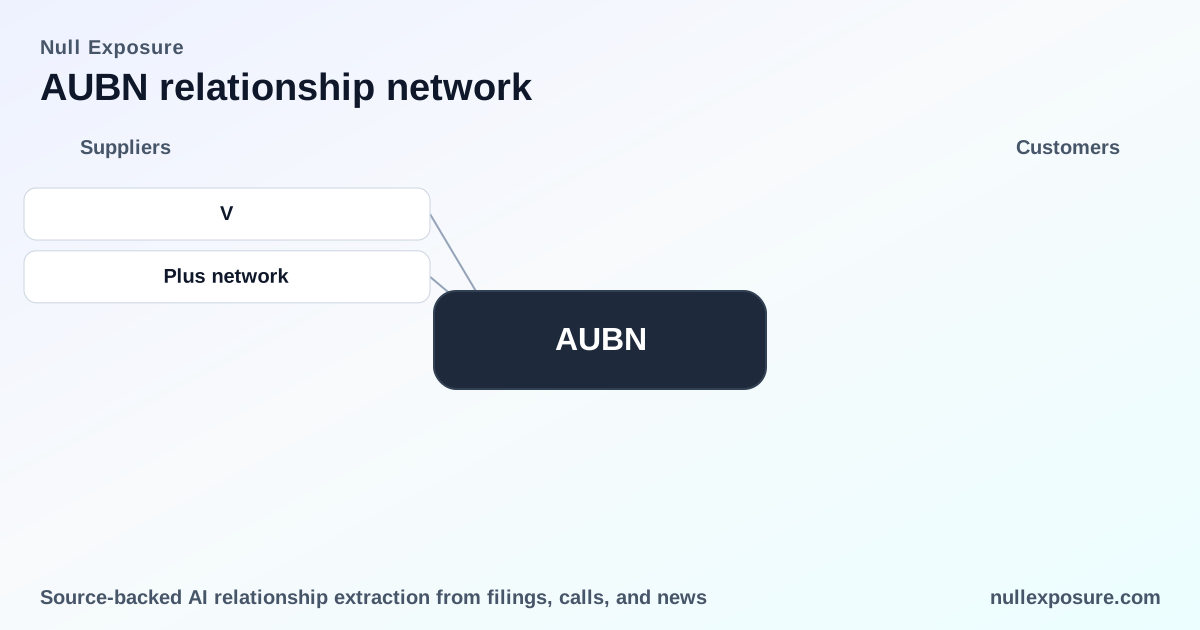
Auburn National Bancorporation (AUBN): What Visa and the Plus Network Mean for Investors
Auburn National Bancorporation operates as the holding company for AuburnBank, a regional bank that monetizes through net interest margin on loans and deposits, plus fee income from retail banking services including card programs. The bank supplements interest revenue with recurring retail fees and card interchange economics tied to its partnership with payment networks; those relationships are operational levers for customer acquisition and deposit retention. Understanding how AUBN depends on third‑party card networks is essential for evaluating service continuity and fee capture.
Explore deeper supplier risk intelligence at https://nullexposure.com/.
Two names, repeated mentions: Visa and the Plus network
AUBN’s public reporting and market coverage highlight two payment‑network relationships in its recent news mentions. The press references are succinct: AUBN issues Visa Check cards and those cards are routable internationally via the Plus ATM network. Below I list each recorded mention from the results so investors can see the primary sources and the fiscal context.
Visa — FY2025
MarketScreener’s Q3 coverage of Auburn National Bancorp noted that the bank’s Visa Check cards are usable internationally through the Plus network, pointing to Visa as the card brand under which AUBN issues debit products. Source: MarketScreener Q3 earnings note (published March 2026) — https://www.marketscreener.com/news/auburn-national-bancorp-q3-eps-rises-on-higher-interest-income-ce7d5dd8d18cf620
Visa — FY2026
A separate MarketScreener report covering the bank’s dividend announcement reiterated that AUBN issues Visa Check cards usable on the international Plus network, underscoring that the Visa relationship is operationally referenced in routine corporate communications. Source: MarketScreener dividend note (published March 2026) — https://www.marketscreener.com/news/auburn-national-bancorporation-keeps-quarterly-dividend-at-0-27-a-share-payable-march-25-to-holder-ce7e5adcdc80f621
Plus network — FY2026
The dividend announcement specifically calls out international ATM access via the Plus network for the bank’s Visa Check cards, demonstrating that the Plus relationship is the routing partner that enables cross‑border cash access for customers. Source: MarketScreener dividend note (published March 2026) — https://www.marketscreener.com/news/auburn-national-bancorporation-keeps-quarterly-dividend-at-0-27-a-share-payable-march-25-to-holder-ce7e5adcdc80f621
Plus network — FY2025
The Q3 earnings coverage likewise references the Plus network as the international routing solution for the bank’s Visa Check cards, repeating the same operational fact across reporting periods. Source: MarketScreener Q3 earnings note (published March 2026) — https://www.marketscreener.com/news/auburn-national-bancorp-q3-eps-rises-on-higher-interest-income-ce7d5dd8d18cf620
What the supplier list actually signals about AUBN’s operating model
The relationship entries are short and narrowly focused, but they deliver concrete operating signals investors can act on:
- Operational criticality: Card network access is a core retail banking capability—international ATM acceptance and domestic POS routing are customer‑facing functions that directly affect depositor satisfaction and competitive positioning. The MarketScreener notes explicitly link Visa branding and Plus routing to card functionality, making these suppliers operationally critical to the consumer banking product suite.
- Supplier maturity and stability: Visa and the Plus network are global, mature payment infrastructures. For a regional bank, partnering with these networks provides proven, standardized rails rather than bespoke technology, which reduces implementation risk and supports scale.
- Buyer posture and third‑party dependency: AUBN’s regulatory disclosures state, “We rely heavily on communications and information systems, including those of third‑party service providers, to conduct our business.” That language establishes a company‑level posture: Auburn is a buyer of third‑party services with meaningful operational reliance on vendors for critical systems and connectivity (evidence from company disclosures). This creates concentrated third‑party risk even when the suppliers themselves are high quality.
- Concentration and negotiation leverage: With card processing and network access sourced from dominant global networks, Auburn lacks substitutes that match ubiquity, which limits supplier replacement options and places Auburn in a buyer role but with limited leverage on core network terms.
Key takeaway: AUBN leverages mature payment networks to deliver standard card capabilities to customers, but its operational dependence on third‑party communications and network services creates a measurable outsourcing risk vector that investors should price into operating continuity and contingency costs.
Explore supplier risk scoring and vendor intelligence on the platform: https://nullexposure.com/.
Investment implications: risk, cost, and upside
AUBN is a small regional bank with a market capitalization under $100 million and traditional community banking economics. Several firm-level facts should shape investment decisions:
- Revenue and margin profile: The bank generates revenue through core banking activities—interest spread and retail fees—with reported RevenueTTM and positive profit margins consistent with a profitable regional franchise (RevenueTTM: $32.34M; ProfitMargin: 22.1%).
- Card partnerships are retention tools: The Visa/Plus linkage is not a major standalone revenue driver for AUBN, but card availability and international ATM access are important customer retention and deposit acquisition features for retail clients who travel or transact beyond local networks.
- Operational risk premium: The firm’s stated reliance on external communications and information systems is a structural constraint; investors should assign a modest operational risk premium and monitor vendor contracts, SLAs, and business continuity provisions.
- Capital return characteristics: AUBN distributes a meaningful dividend (DividendPerShare: $1.08; DividendYield: 4.22%), which complements its small‑cap profile and makes supplier disruption risk relevant to cash‑return stability.
- Valuation context: The bank trades below book on PriceToBookRatio (0.892) and exhibits a conservative beta (0.445), suggesting a defensive asset with concentrated vendor dependencies that are typical for regional banks deploying third‑party payment rails.
Bottom line: the Visa and Plus network relationships are standard and operationally necessary; they are not exotic suppliers but they are critical. Investors should emphasize operational resilience, contingency planning for vendor outages, and the cost of maintaining card services when modeling forward cash flow and dividend stability.
Final guidance: what to watch and next steps
Monitor three practical items that materially affect the supplier risk profile and shareholder outcomes:
- Contract and SLA disclosures for payment processing and communications vendors.
- Any announcements around card program changes, interchange routing, or partnership renegotiations.
- Operational incident reports or regulatory filings that reference third‑party outages.
For a focused view of supplier relationships and vendor risk across small and mid‑cap banks, visit our research hub at https://nullexposure.com/.
Investor action: position risk models to reflect critical third‑party dependence while valuing AUBN’s conservative capital returns; use vendor disclosures and routine press mentions (such as the MarketScreener items cited above) to validate continuity assumptions.