Aurinia Pharmaceuticals (AUPH): supplier concentration, long-term capacity commitments, and what it means for investors
Aurinia Pharmaceuticals operates and monetizes through the commercialization of voclosporin (marketed as LUPKYNIS) and related therapies, outsourcing nearly all drug substance and finished-dose manufacturing to third parties while capturing revenue from product sales. The company's commercial model is asset-light on manufacturing but highly concentrated on a small number of critical contract manufacturers, with fixed-capacity commitments that extend into 2030. For investors evaluating supplier risk and counterparty exposure, the combination of sole-sourced drug substance and long-term facility fees defines the principal operational lever and the principal operational vulnerability. Learn more about supplier exposure and research tools at https://nullexposure.com/.
The two supplier relationships that dominate Aurinia’s manufacturing footprint
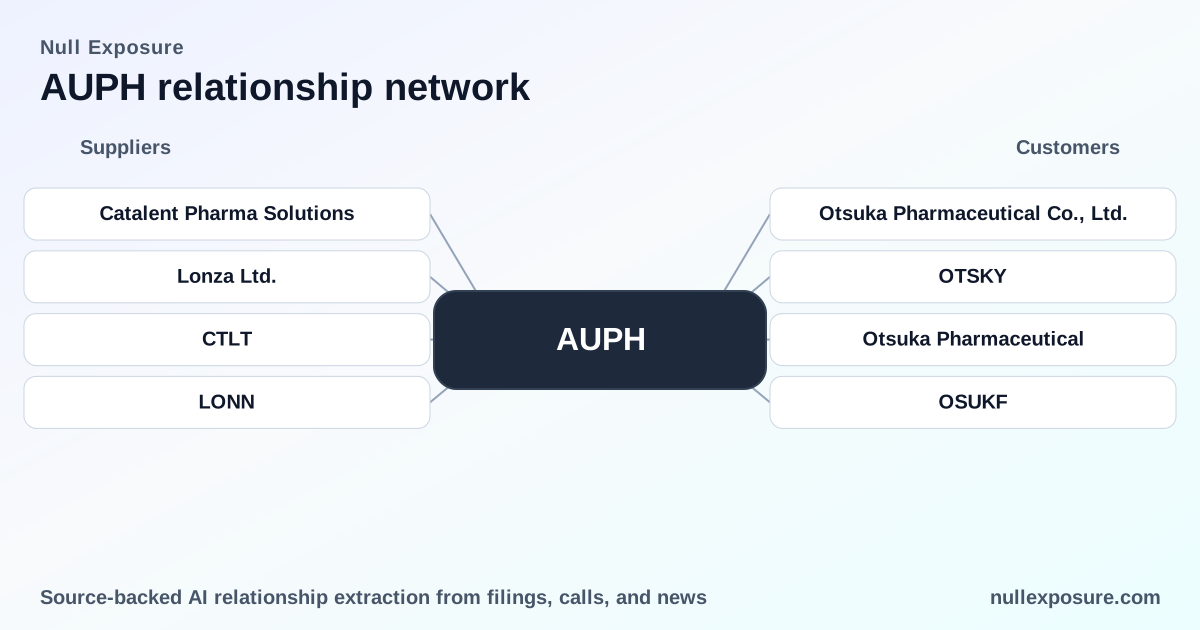
Catalent Pharma Solutions — sole encapsulation and finished-dose preparation
Catalent is identified in Aurinia’s 2024 Form 10‑K as the sole supplier for preparation (encapsulation) of voclosporin capsules, placing Catalent in a critical downstream finishing role for the product that reaches market. A March 2026 market report reiterated that Catalent handles the encapsulation while Lonza supplies drug substance. (Source: Aurinia 2024 Form 10‑K; TradingView news report, Mar 2026.)
Lonza Ltd. — sole supplier of voclosporin drug substance
Lonza is named in Aurinia’s filings and market coverage as the sole supplier of the voclosporin drug substance and as a contract manufacturing partner that provides dedicated facility capacity. The company’s reliance on Lonza for the specialized drug substance manufacturing process creates a single‑point dependency upstream in the supply chain. (Source: Aurinia 2024 Form 10‑K; TradingView news report, Mar 2026.)
What the filings and constraints tell you about Aurinia’s operating model
- Contracting posture and maturity: Aurinia pays a quarterly fixed facility fee for exclusive use of a manufacturing Monoplant through March 31, 2030, reflecting a long‑term capacity reservation posture and sunk fixed costs. The filing describes this as a multi‑year contractual commitment rather than spot procurement. (Company-level signal from Aurinia 2024 Form 10‑K.)
- Concentration and criticality: The 10‑K explicitly identifies sole‑supplier arrangements: Lonza for drug substance and Catalent for capsule preparation. That concentration creates high operational criticality — a disruption at either provider would directly affect product supply. (Relationship-level signal from Aurinia 2024 Form 10‑K.)
- Spend profile and scale: Aurinia disclosed non‑cancellable purchase commitments of $11.7 million through 2025, and a quarterly fixed facility fee of CHF 3.6 million (approximately $4.0 million). These commitments are material to cash flow planning and indicate mid‑single‑digit percentage exposure relative to trailing revenues. (Company-level signal from Aurinia 2024 Form 10‑K.)
- Role mix: Contracts reflect both manufacturer roles (drug substance and finished dose) and service provider roles (blistering and packaging for U.S. commercial cartons cited), indicating Aurinia delegates both technical production and secondary packaging. (Company-level signal; relationship mentions in the 10‑K.)
If you are modeling supply risk into valuation, these constraints are not theoretical — they are contractual realities that shape Aurinia’s operating leverage and downside risk.
Explore supplier exposure mapping and comparative intelligence at https://nullexposure.com/ to incorporate these contract signals into your investment models.
Financial context that matters to supplier risk
Aurinia reported trailing revenue of $283.1 million and EBITDA of $135.7 million, with market capitalization around $1.9 billion. Fixed facility fees and multi‑year purchase commitments are therefore meaningful but not balance‑sheet‑breaking in absolute terms; the $11.7 million of non‑cancellable commitments through 2025 represents a modest share of trailing revenue. However, the strategic value of uninterrupted supply for a single marketed product elevates the operational importance of those expenditures beyond their raw dollar amount. (Source: Aurinia financials — TTM Revenue and EBITDA from company disclosures.)
Investor implications: where risk converts to value or downside
- Single‑source exposure elevates operational risk. Sole sourcing of drug substance (Lonza) and capsule preparation (Catalent) means supply disruptions translate directly to lost sales and potential regulatory or recall costs. Operational continuity is the primary supply-side risk for revenue realization.
- Long-term fixed fees reduce procurement flexibility but secure capacity. The Monoplant-exclusive fee through 2030 protects capacity but creates a sunk‑cost exposure if demand falls or if a replacement supplier is required. That dynamic compresses Aurinia’s ability to re‑negotiate terms quickly.
- Leverage in negotiations is asymmetrical. With only a few qualified suppliers for specialized manufacturing, Aurinia has limited near‑term leverage on price and change‑order elasticity; conversely, suppliers have limited pricing risk given Aurinia’s revenue significance.
- Mitigants to watch: multi‑source qualification programs, validated contingency inventories, reciprocal supply agreements, and the financial strength of counterparties (Lonza and Catalent are well‑capitalized providers). Confirming these mitigants is central to due diligence.
Practical due diligence checklist for operator and research teams
- Confirm contract end‑dates, renewal options, and termination triggers for both Lonza and Catalent as presented in the 10‑K.
- Verify inventory buffers and dual‑sourcing plans for active pharmaceutical ingredient (API) and finished dose.
- Assess the Monoplant fee structure (fixed vs. variable components) and how much of the fee is recoverable or transferable.
- Request recent audit reports or regulatory inspection history for the named manufacturers.
- Model demand sensitivity scenarios that stress single‑source supply and estimate break‑fix timelines and costs.
Bottom line and recommended next steps
Aurinia’s manufacturing model is deliberately outsourced and concentrated: Lonza supplies the drug substance and Catalent handles encapsulation, supported by a long‑term Monoplant capacity commitment through 2030. That structure reduces Aurinia’s capital requirements but concentrates operational risk in two third‑party providers and creates meaningful fixed contractual spend. Investors should prioritize supplier continuity, contractual terms, and contingency plans in any valuation or risk assessment.
For a deeper mapping of supplier exposures and to integrate these relationship signals into investment workflows, visit https://nullexposure.com/. For bespoke supplier risk analysis and portfolio-level exposure reports, see https://nullexposure.com/ for service options and datasets.