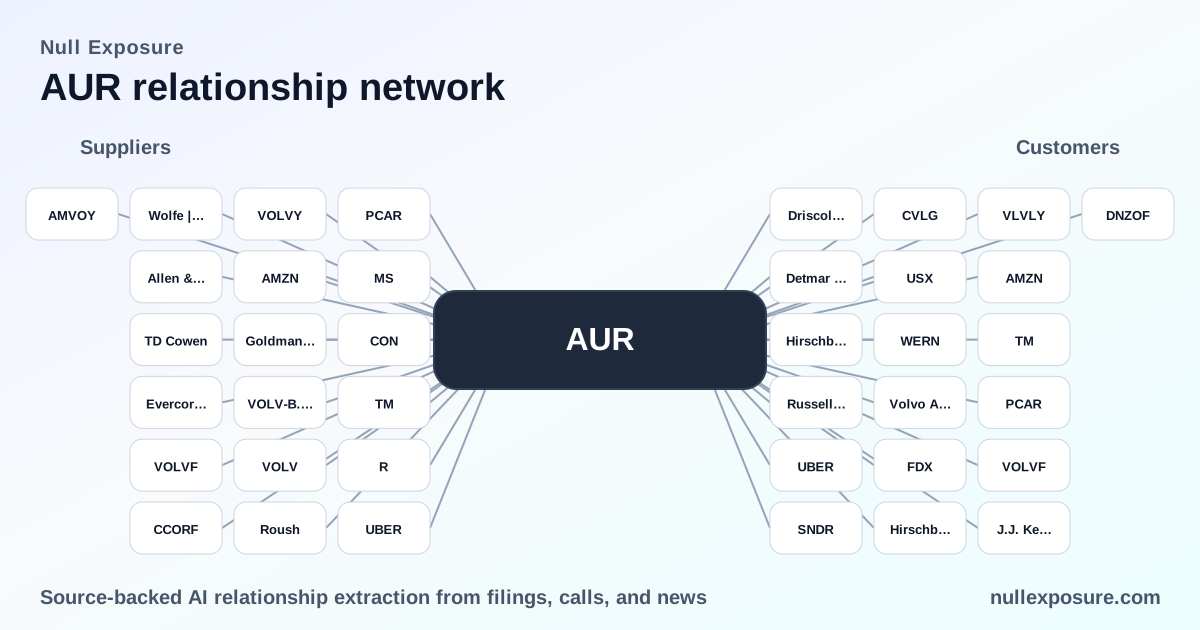
Aurora Innovation (AUR): Supplier and partner map for investors and operators
Aurora builds, licenses, and operates autonomous driving systems (the Aurora Driver) and monetizes through a multi‑pronged model: hardware kit sales and integrations with OEMs, fleet ownership and carrier services for freight, and recurring software/hardware-as-a-service contracts with logistics partners. The company's go‑to‑market is deliberately multi‑OEM and partner‑centric, using manufacturing, logistics, and cloud suppliers to industrialize the Aurora Driver and scale commercial deployments.
For a compact read on partner exposure and sourcing risk, see the NullExposure home page: https://nullexposure.com/
What investors need to know up front
- Core commercial engine: Aurora’s revenue mix will shift from engineering services and pilot fees to recurring DaaS/kit revenue and carrier services once industrialization completes. This transition relies on several strategic supplier relationships to provide trucks, upfit capacity, components and cloud infrastructure.
- Capital and execution cadence: Recent equity raises involved major banks and underwriters, improving liquidity to fund industrialization but increasing execution pressure to convert pilots into repeatable production runs.
- Operational posture: Aurora pursues a controlled production strategy—owning fleets while partnering with OEMs and upfitters to accelerate volume; that creates concentration exposure around a handful of manufacturing and upfitting partners and critical dependence on cloud and service providers for operations.
Explore supplier risk profiles and signals on NullExposure: https://nullexposure.com/
How Aurora integrates suppliers into its business model
Aurora’s operating model is neither end‑to‑end manufacturing nor pure software licensing: it is a hybrid supplier orchestration model. The company secures vehicle supply through multi‑OEM agreements (PACCAR, Volvo, others), contracts out upfitting and lineside integration to partners like Roush, and centralizes compute and data infrastructure with cloud providers such as AWS. This posture reduces capital intensity of vehicle manufacturing but increases contractual and operational complexity, making supplier performance and single‑source clauses material to commercialization timing.
Supplier and partner relationships (each item from the coverage set)
Below are one‑to‑two sentence plain‑English summaries for every relationship noted in the source results, with source references.
-
PACCAR (earnings call, 2025Q3): PACCAR is actively advancing prototype testing of a scalable autonomy‑enabled truck platform in collaboration with Aurora, reflecting deep engineering integration ahead of production launch. Source: Aurora 2025 Q3 earnings call (first seen Mar 2026).
-
Morgan Stanley (news, FY2024): Morgan Stanley acted as a joint book‑running manager on Aurora’s upsized public offering that raised gross proceeds of $483m, providing capital markets execution support. Source: TheRobotReport summary of FY2024 offering coverage.
-
Paccar (TechCrunch, FY2024): Aurora will own and operate up to 20 Paccar‑ and Volvo‑produced trucks and act as a carrier on the Uber Freight network, indicating Aurora’s mixed model of fleet ownership plus marketplace presence. Source: TechCrunch, June 2024.
-
PACCAR (news, FY2026): Reports describe a shift in prototype observer positioning during Phoenix testing driven by PACCAR’s manufacturing partner role, signaling close operational oversight from PACCAR on early prototypes. Source: KTAR, FY2026 reporting.
-
Continental (TechCrunch, FY2024): Continental is Aurora’s hardware supplier slated to mass‑produce the autonomous vehicle hardware kit by 2027, tying Aurora’s commercial hardware timetable to a tier‑one supplier. Source: TechCrunch, June 2024.
-
Toyota (TradingView SEC summary, FY2026): Toyota is listed among strategic partners for integrating the Aurora Driver into vehicles and scaling operations, underscoring Aurora’s OEM diversification strategy. Source: TradingView recap of Aurora SEC filing, FY2026.
-
Ryder System (TruckingInfo, FY2022): Ryder embedded technicians to support Aurora’s South Dallas terminal maintenance program, showing outsourced fleet maintenance and local operator partnerships for field support. Source: TruckingInfo, FY2022.
-
Uber Freight (FutureTransport, FY2021): Aurora launched a multiphase commercial pilot with Uber Freight to move freight in Texas and to integrate access to Uber Freight’s network within Aurora Horizon, signaling routing and commercial distribution experiments. Source: FutureTransport News, FY2021.
-
Paccar (FreightWaves, FY2022): FreightWaves reported Aurora partnerships to install its autonomy hardware in Paccar trucks, reinforcing manufacturing OEM ties. Source: FreightWaves, FY2022.
-
Volvo (FreightWaves, FY2022): FreightWaves noted Aurora’s installation plans for Volvo trucks, matching the multi‑OEM approach and creating a parallel supply stream to PACCAR. Source: FreightWaves, FY2022.
-
Amazon Web Services (stocktitan.net SEC summary, FY2026): AWS is identified as a long‑standing infrastructure partner, indicating Aurora relies on cloud compute and data services for development and operations. Source: SEC 8‑K coverage via StockTitan, FY2026.
-
PACCAR (stocktitan.net SEC summary, FY2026): Aurora and PACCAR are jointly defining a path to scalable launch for the third‑generation Aurora Driver hardware kit integrated on PACCAR assembly lines, showing deep production planning alignment. Source: SEC 8‑K coverage via StockTitan, FY2026.
-
Goldman Sachs & Co. (TheRobotReport, FY2024): Goldman served as a joint book‑running manager on Aurora’s public offering, providing capital markets and underwriting capacity. Source: TheRobotReport, FY2024 offering recap.
-
Volvo (earnings call, 2025Q3): Aurora achieved lineside integration of its second‑generation commercial hardware kit into the Volvo VNL Autonomous at Volvo’s New River Valley pilot line, marking an industrialization milestone. Source: Aurora 2025 Q3 earnings call.
-
Volvo (TechCrunch, FY2024): TechCrunch reported Aurora will operate Volvo‑produced trucks as part of the initial fleet, confirming OEM supply for pilot fleet operations. Source: TechCrunch, June 2024.
-
PACCAR (earnings call, 2025Q4): Aurora highlighted a multi‑OEM strategy anchored by foundational partnerships with Volvo and PACCAR to secure truck supply for customers, reinforcing dual OEM dependency. Source: Aurora 2025 Q4 earnings call.
-
PACCAR (TradingView SEC summary, FY2026): PACCAR is again cited in Aurora’s SEC filing summary as a strategic partner crucial for integrating the Aurora Driver and scaling operations. Source: TradingView recap of SEC filing, FY2026.
-
Roush (stocktitan.net SEC summary, FY2026): Aurora selected Roush as the upfitter to leverage its manufacturing footprint, initially equipping Roush to produce 20 trucks per week later in 2026 — a key capacity decision for scale. Source: SEC 8‑K coverage via StockTitan, FY2026.
-
Wolfe | Nomura Alliance (TheRobotReport, FY2024): Wolfe | Nomura Alliance acted as a book runner on the public offering, contributing to underwriting syndicate depth. Source: TheRobotReport, FY2024.
-
Allen & Co. (TheRobotReport, FY2024): Allen & Co. was a joint book‑running manager on the offering, providing placement support. Source: TheRobotReport, FY2024.
-
TD Cowen (TheRobotReport, FY2024): TD Cowen acted as a book runner, supplementing the underwriting group for Aurora’s equity raise. Source: TheRobotReport, FY2024.
-
Evercore ISI (TheRobotReport, FY2024): Evercore ISI functioned as a book runner for the offering, expanding distribution reach to institutional investors. Source: TheRobotReport, FY2024.
-
Toyota (MoneyShow, FY2025): MoneyShow coverage lists Toyota among operators partnering with Aurora to develop fully autonomous Class 8 trucks, reflecting OEM validation from a global automaker. Source: MoneyShow, FY2025.
-
Volvo (MoneyShow, FY2025): MoneyShow similarly notes Volvo as an operator partner to produce advanced autonomous 18‑wheel trucks, underscoring Volvo’s production role. Source: MoneyShow, FY2025.
-
Paccar (MoneyShow, FY2025): MoneyShow reiterates Paccar’s partnership role with Aurora in commercial truck production for autonomous operation. Source: MoneyShow, FY2025.
-
AUMOVIO (stocktitan.net SEC summary, FY2026): Aurora is progressing on a third‑generation hardware kit with AUMOVIO intended to supply tens of thousands of trucks, positioning AUMOVIO as a volume supplier for later scale. Source: SEC 8‑K coverage via StockTitan, FY2026.
-
AUMOVIO (earnings call, 2025Q3): Aurora noted Continental completed a spin‑off of its automotive business into AUMOVIO, indicating continuity in supplier relationships post‑spin. Source: Aurora 2025 Q3 earnings call.
Constraints and company‑level sourcing signals
Aurora’s public disclosures and risk statements generate two clear company‑level signals:
- Manufacturing dependence: Aurora states it is reliant on suppliers for vehicle supply and lifecycle support, including single or limited‑source suppliers for current and future Aurora Driver systems. This creates a single‑sourcing concentration risk if one OEM or supplier underperforms. Evidence: Aurora supplier reliance excerpt in company filings.
- Third‑party service exposure: Aurora explicitly treats third‑party providers as critical to cybersecurity and operations, conducting security assessments and contractual incident reporting; this signals high operational criticality for service providers (cloud, telemetry, maintenance) and a mature vendor risk management posture. Evidence: Aurora’s vendor cybersecurity and security assessment excerpt.
These constraints translate into investor considerations: time‑to‑scale is conditional on supplier execution and upfitter capacity, while operational continuity depends on robust provider SLAs and cloud partnerships.
For a deeper supplier risk scorecard and comparative exposure analysis, visit NullExposure: https://nullexposure.com/
Bottom line and investor action
- Key strengths: Aurora has built a diversified OEM and service partner ecosystem (PACCAR, Volvo, Toyota, AUMOVIO, AWS, Roush), which supports its multi‑OEM commercialization strategy and reduces single‑OEM manufacturing risk relative to a single‑manufacturer approach.
- Primary risks: Execution on lineside integration, upfitter throughput, and cloud/service continuity are mission‑critical; any disruption at PACCAR/Volvo/Roush/AUMOVIO or AWS would materially affect Aurora’s industrialization timetable.
- What to watch next: Readouts from production ramp metrics (units per week from Roush), lineside yields at Volvo and PACCAR, and progress on the AUMOVIO high‑volume kit program.
If you manage supplier exposure or underwriting around AUR, validate contracts and SLAs with the OEM and cloud partners highlighted above — and track regulatory test results from the pilot fleets. For ongoing supplier intelligence and monitoring, start with our supplier profiles at NullExposure: https://nullexposure.com/