Aura Biosciences: supplier relationships, commercial posture, and what investors need to know
Aura Biosciences is a clinical‑stage biotechnology company that develops targeted oncology therapeutics using proprietary virus‑like particle (VLP) technology. The company currently monetizes through licensing arrangements, milestone and royalty obligations embedded in partner agreements, and — ultimately — commercial product sales if regulatory approvals are secured; today Aura has no product revenue and relies on third‑party manufacturing and licensing economics to advance its pipeline. Investors should view Aura as a research‑intensive, partner‑driven biotech with concentrated manufacturing dependencies and structured licensing costs that drive near‑term capital needs and medium‑term upside from successful Phase 3 readouts. Learn more about supplier intelligence and counterparty risk at https://nullexposure.com/.
How Aura operates and where the cash flows will come from
Aura advances therapeutic candidates (notably AU‑011 in VLP format and a Phase 3 program for bel‑sar) through clinical development while outsourcing manufacturing and many development functions. The company’s operating model is partner‑centric: it holds exclusive licenses for critical components, uses third‑party CDMOs for clinical and potential commercial supply, engages CROs and clinical sites for trials, and maintains contractual lease commitments for labs and offices. Monetization pathways are twofold — licensing and milestone receipts today, and product sales and royalties if candidates are approved — but current financials show zero revenue and negative earnings, consistent with a clinical‑stage profile.
If you want ongoing monitoring of Aura’s supplier exposures and counterparties, visit https://nullexposure.com/ for tailored supplier risk intelligence.
Contracting posture, concentration and criticality — what the constraints tell investors
Aura’s disclosures and contract excerpts reveal a clear set of structural characteristics that shape counterparty risk and capital planning:
-
Contracting posture: licensee and outsourcing focused. Aura is explicitly a licensee of core technologies (for example, Clearside’s suprachoroidal microneedle technology and LI‑COR’s IRDye 700DX), and it relies on third parties for manufacturing and services. The company’s SEC disclosures document exclusive license agreements dating back to 2014 and 2019 for foundational IP.
-
Concentration risk is material. The company states it is currently reliant on a single source for regulatory starting materials and drug substance/drug product manufacturing for bel‑sar, which creates a single‑point supply vulnerability that is critical to timelines and commercialization.
-
Manufacturing and regulatory approval are critical dependencies. Aura has no internal large‑scale manufacturing and transfers processes to external CDMOs; an FDA or comparable regulator denial of a manufacturing facility would significantly affect development and commercialization timelines.
-
Maturity: active clinical stage with long‑term fixed commitments. Aura’s office and lab lease commenced in 2022 with an initial 10‑year term and significant remaining commitments (estimated payments in the tens of millions), showing operational permanence despite pre‑revenue status.
-
Spend profile mixes small upfront license fees with material milestone and lease liabilities. Contract terms include modest initial license fees in the $0.4–0.5M range, milestone ceilings into the tens of millions (Clearside up to ~$21M aggregate), and lease obligations in the $10–100M band.
These constraints form a concise risk framework: high operational leverage to a small set of suppliers, meaningful fixed obligations, and milestone‑driven cash needs that depend on successful clinical progression.
Documented counterparties in recent filings — what the public record shows
This section lists every relationship recovered in the public results for Aura's supplier scope.
-
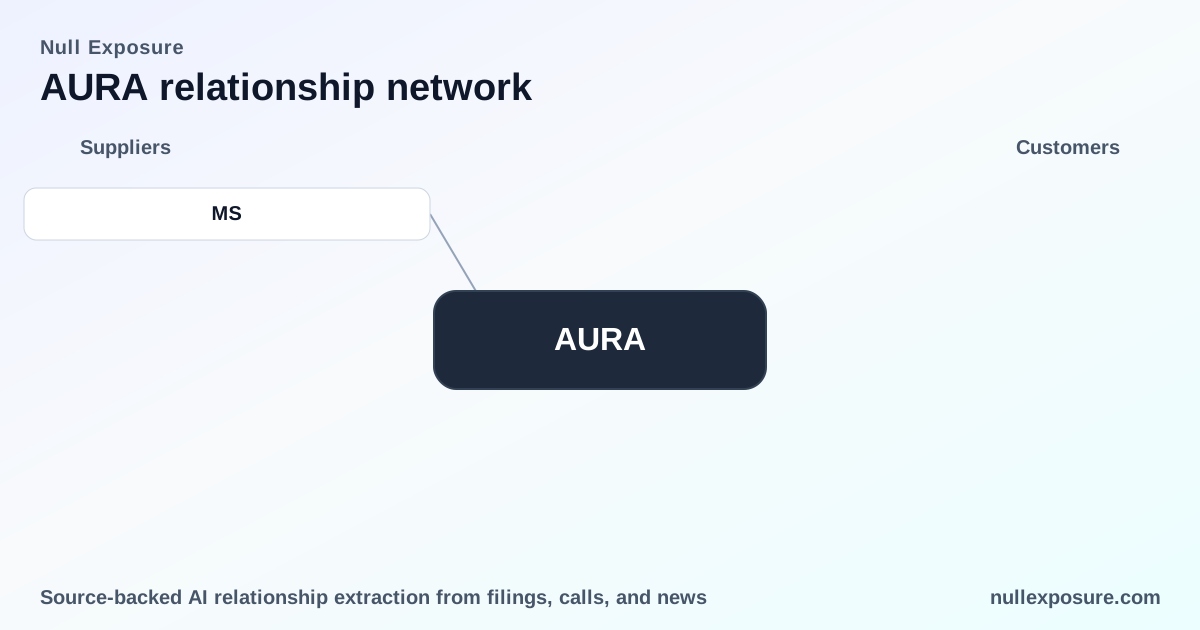
Morgan Stanley Smith Barney LLC — An SEC filing reported on StockTitan (FY2026) lists 15,890 shares associated with Morgan Stanley Smith Barney LLC as broker in a filing dated February 17, 2026, indicating broker custody or brokerage activity tied to an insider or large holder (StockTitan SEC filing, FY2026). https://www.stocktitan.net/sec-filings/AURA/144-aura-biosciences-inc-sec-filing-3ac263ea636a.html
-
Morgan Stanley Smith Barney LLC — A separate SEC filing (recorded FY2026) documents a sale of 17,109 shares for $92,734.66 on November 17, 2025, with Morgan Stanley Smith Barney LLC named again as the broker, reflecting executed disposition activity in the registrant’s shareholder registry (StockTitan SEC filing, FY2026). https://www.stocktitan.net/sec-filings/AURA/144-aura-biosciences-inc-sec-filing-f5555ef3cda3.html
Both filings point to routine brokerage reporting and insider/registrant share movement; they do not indicate supplier contracts but are material for ownership and trading surveillance.
Other named partners and commercial relationships called out in company disclosures
Certain constraints explicitly name counterparties and the nature of those relationships; these are critical to supplier and IP strategy.
-
Clearside Biomedical, Inc. — Aura executed an exclusive license in July 2019 for Clearside’s Suprachoroidal Microneedle Technology to deliver therapeutics for choroidal tumors and indeterminate lesions, with milestone payments and commercialization terms embedded in the agreement (company SEC disclosures). This license is a strategic delivery partner that shapes clinical route‑to‑market economics.
-
LI‑COR — Aura’s January 2014 Exclusive License and Supply Agreement (amended multiple times through 2019) covered IRDye 700DX and related patents for ocular cancer treatment and diagnosis; the document framed early intellectual property access and initial supply economics.
-
CDMOs and CROs (unnamed) — The company states it relies on third‑party CDMOs to produce clinical supplies and for any potential commercial manufacturing, and it engages CROs and clinical sites for trial execution — a classic outsourced biotech model that concentrates execution risk off‑balance‑sheet but on‑timeline.
Company SEC filings and internal disclosures provide these details; they inform counterparty due diligence and should be cross‑checked against contract schedules when underwriting supplier risk.
If you are evaluating Aura’s partner list for procurement or investor due diligence, start a tailored review at https://nullexposure.com/.
Investment implications — what matters for investors and operators
- Upside is binary and trial‑driven. Success in the Phase 3 CoMpass trial and manufacturing scale‑up would convert licensing economics into commercial revenue streams; failure would impair valuation materially.
- Supply and manufacturing are single‑point failure risks. Reliance on single suppliers for starting materials and drug product manufacture elevates execution risk and could force costly tech transfers or regulatory delays.
- Financial posture reflects clinical intensity. Aura reports zero revenue, negative EBITDA, and negative EPS, while institutional ownership is high (≈85%), indicating concentrated professional investor exposure and limited insider holdings.
- Contractual cash obligations are non‑trivial. License fees, milestone ceilings (up to ~$21M for Clearside), and long‑term lease liabilities (tens of millions) require careful treasury planning.
Bottom line and next steps
Aura is a classic partner‑dependent biotech: innovation and clinical progress drive value, while concentrated supplier relationships and significant contractual commitments shape downside risk. For investors and operators, the immediate priorities are monitoring CDMO commitments, tracking Clearside and LI‑COR license milestones, and watching for any disclosure of alternate suppliers or remediation plans for single‑source components.
For ongoing supplier risk monitoring and counterparty intelligence on Aura and comparable biotechs, visit https://nullexposure.com/ for professional coverage and alerts.