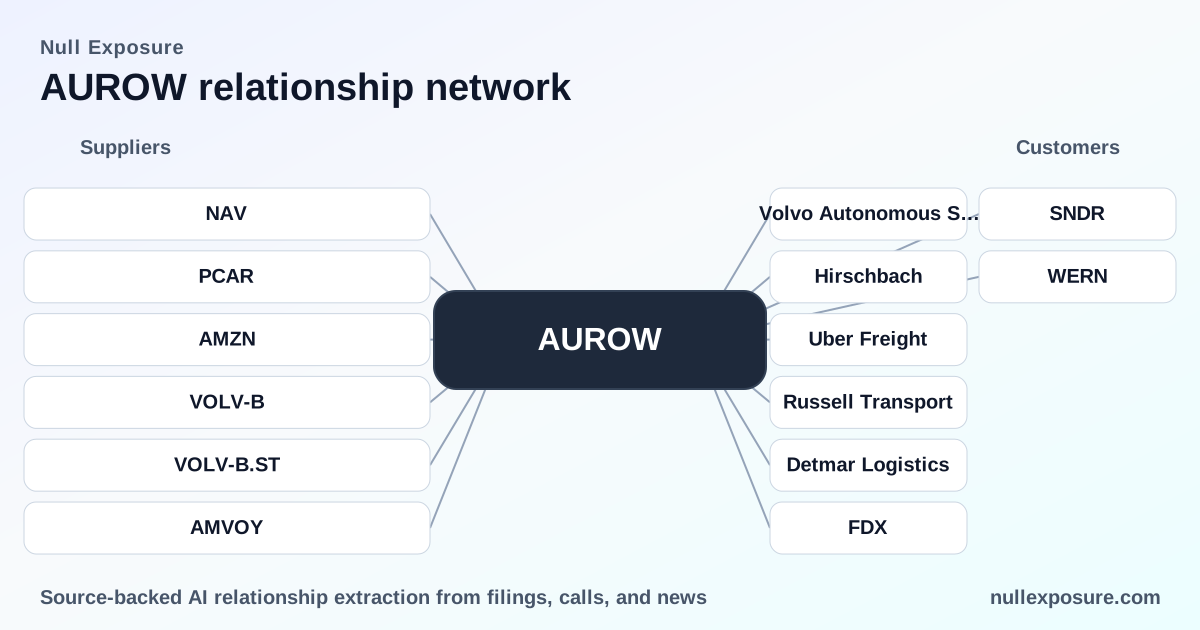
Aurora Innovation (AUROW) — supplier relationships that determine commercial scale
Aurora monetizes its autonomous-driving software and hardware stack by partnering with vehicle manufacturers and logistics operators under a mix of integration and recurring service contracts, including a Hardware-as-a-Service (HaaS) per‑mile model. The company provides the Aurora Driver and upfit services while depending on OEMs and contract manufacturers for vehicle supply and on cloud and systems providers for operations and security. For investors and operators, the critical questions are supply concentration, contractual posture (usage‑based vs. fixed), and the maturity of manufacturing integration—factors that directly affect unit economics, deployment cadence, and operational risk.
Explore supplier intelligence and relationship mapping at https://nullexposure.com/ to assess counterparty risk on these commercial partnerships.
What Aurora’s partner list tells you about commercialization
Aurora’s public commentary during 2025 earnings calls reveals a deliberate supplier strategy: OEM co‑development and lineside integration for scale, a reliance on strategic truck OEMs for vehicle platforms, and the use of cloud providers for data and fleet services. That strategy supports a per‑mile revenue model but also concentrates operational risk where single‑source suppliers or nascent manufacturing partners exist. Aurora’s latest financials show minimal revenue (Revenue TTM: $3.0M) against heavy operating losses (EBITDA: -$871M; Diluted EPS: -2.271), reinforcing the need for predictable supplier execution to move from pilot to scale.
For immediate due diligence and ongoing monitoring of these supplier signals, see https://nullexposure.com/.
How each named partner features in Aurora’s public disclosures
-
International (Navistar/NAV): Aurora said a fleet will be based on the International LT Series truck with Aurora performing all necessary upfit for driverless operations. This confirms International is a platform supplier for Aurora’s commercial fleets and that Aurora retains responsibility for the autonomy-specific hardware integration. According to Aurora’s 2025 Q3 earnings call, Aurora will perform all necessary upfit on the International LT Series truck (2025Q3 earnings call).
-
PACCAR (PCAR): PACCAR is advancing prototype testing of a scalable autonomy‑enabled truck platform at PACCAR facilities, indicating joint development/testing activity that supports a volume pathway for Aurora’s Driver. Aurora referenced PACCAR’s ongoing prototype testing during its 2025 Q3 earnings commentary, and again anchored PACCAR as a foundational partner in the 2025 Q4 earnings call (2025Q3/2025Q4 earnings calls).
-
Volvo (VOLV / VOLV‑B): Volvo has begun lineside integration of Aurora’s second‑generation Driver commercial hardware kit into the Volvo VNL at the New River Valley, Virginia plant—an industry‑first manufacturing milestone that moves Aurora from lab installs to factory‑aligned production flows. Aurora disclosed the lineside integration milestone in its 2025 Q3 earnings call and reiterated Volvo as a foundational OEM partner in 2025 Q4 remarks (2025Q3/2025Q4 earnings calls).
-
Amazon Web Services (AMZN): Aurora noted that Aeva MoVeo selected Amazon Web Services as its preferred cloud provider, underscoring the use of mainstream cloud infrastructure for sensor data, mapping, and fleet services that support Aurora’s operational stack. Aurora referenced AWS selection in its 2025 Q4 earnings call commentary (2025Q4 earnings call).
-
AUMOVIO (AMVOY): Aurora highlighted a $110 million investment by AUMOVIO to expand a New Braunfels, Texas manufacturing facility where the Aurora Driver hardware kit will be produced, signaling the emergence of a dedicated manufacturing partner for autonomy hardware production. The investment and factory expansion were mentioned in Aurora’s 2025 Q3 earnings call (2025Q3 earnings call).
Operating model constraints and what they imply for investors and operators
Aurora’s disclosures and constraint signals produce several company‑level operating characteristics you must treat as real inputs to valuation and contract negotiation:
-
Usage‑based contracting is embedded in commercial terms. Aurora explicitly described a Hardware‑as‑a‑Service model where Aurora pays for hardware and related services on a per‑mile basis. This structure aligns network economics with utilization but transfers volume and uptime risk to hardware/service providers if uptime and reliability targets are not met.
-
Manufacturer dependence is material. Aurora acknowledges reliance on others for vehicle supply and lifecycle support of the Aurora Driver system, including single or limited‑source suppliers. That dependence raises supply‑chain concentration risk and negotiation leverage for OEMs.
-
Third‑party service providers function as critical service suppliers. Aurora conducts security assessments and contractually requires incident notifications from third‑party providers that handle confidential Aurora information or access computing environments. This signals that cloud, mapping, and telemetry partners are operationally critical and contractually embedded.
These constraints are company‑level signals derived from Aurora’s public statements about its commercial model and risk management, not attributes of any single partner unless explicitly stated.
Concentration, criticality, and maturity — a concise risk profile
-
Concentration risk: OEM partnerships with Volvo, PACCAR, and International provide route‑to‑market, but also create vendor concentration where delays at one OEM can bottleneck deployments. The AUMOVIO factory investment reduces some concentration by adding manufacturing capacity, yet operational maturity remains an execution risk.
-
Operational criticality: Cloud providers and third‑party service vendors are integral to safety, security, and fleet operations; any service disruption has immediate revenue and safety implications under a per‑mile model.
-
Maturity of manufacturing integration: Lineside integration at Volvo and the New Braunfels expansion are positive signals that Aurora is moving toward production‑scale installs, but current revenues remain minimal and losses substantial—meaning commercial scale is not yet achieved.
Key takeaway: Supplier execution and contractual alignment (especially usage‑based vs. fixed pricing and single‑source provisions) determine whether Aurora’s per‑mile economics can convert R&D investment into durable revenue.
Practical implications for investors and operations teams
For investors:
- Model sensitivity to supplier delays and per‑mile utilization is essential; small shifts in fleet uptime or OEM production cadence will have outsized effects on near‑term cash flow.
- Weight governance and supply diversification evidence heavily when assessing enterprise value given the company's negative margins and low revenue base.
For operators and procurement:
- Negotiate strong uptime SLAs, spare‑parts commitments, and escalation paths with OEMs and manufacturing partners.
- Embed cybersecurity and incident notification clauses with cloud and systems vendors; these are already a part of Aurora’s third‑party security posture and should be mirrored in counterparty contracts.
If you need a deeper supplier‑level risk map or contract clause templates aligned to Aurora‑style HaaS models, visit https://nullexposure.com/ for tooling and reports.
Final assessment and next steps
Aurora’s supplier roster reflects a transition from pilot projects to production‑aligned partnerships: lineside integration with Volvo, prototype testing with PACCAR, platform selection with International, cloud services via AWS, and manufacturing capacity from AUMOVIO. These relationships are constructive for scale, but the business model’s success depends on precise execution of usage‑based contracts, multi‑source supply resilience, and third‑party operational security.
For investors and operators focused on counterparty risk and contract structure, prioritize verification of manufacturing timelines, per‑mile pricing floors/ceilings, and contractual remedies for supply interruptions. For more supplier intelligence and firm‑level constraint analysis, consult the resources at https://nullexposure.com/.